Find answers to common questions about research peptides, including quality standards, storage, handling, Certificates of Analysis, ordering, and research-grade products to support informed laboratory purchasing decisions.
For research use only. Not for human consumption.
This page answers the questions we're asked most often by researchers and institutions sourcing peptides for laboratory use. It's intended as a general educational reference and covers legal status, product documentation, storage, and how to evaluate research literature — not as guidance for human or animal use.
What is a research peptide?
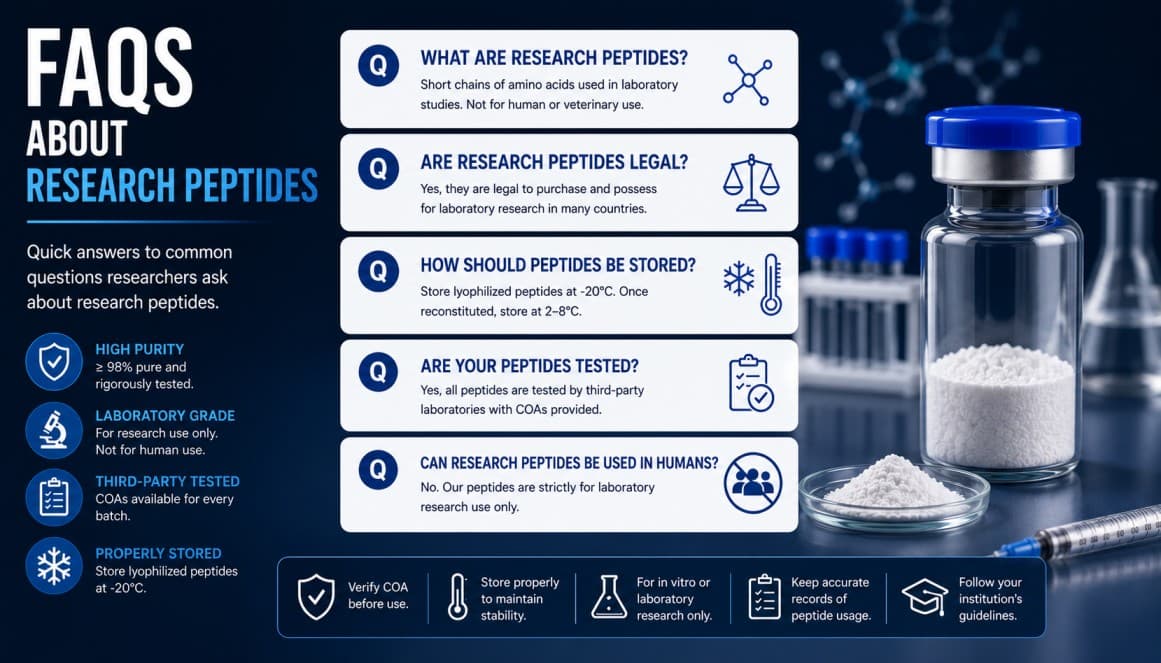
A research peptide is a synthetic compound — typically a short chain of amino acids — manufactured and sold specifically for laboratory and in-vitro research purposes, such as cell culture experiments, animal studies, and mechanistic biochemistry research. Research peptides are not dietary supplements, cosmetics, or medicines, and are not intended for human or animal consumption outside of a controlled research setting.
Are research peptides legal to buy and sell in the UK?
In the UK, research peptides are legal to buy, sell, and possess as materials for laboratory research. Most are not controlled substances under the Misuse of Drugs Act 1971 and are generally not psychoactive, so they typically fall outside the Psychoactive Substances Act 2016.Possession for research purposes is not a criminal offence.
However, legality depends entirely on how a product is marketed and used, not on the compound itself. Research peptides are not authorised medicines: under the Human Medicines Regulations 2012, supplying a product for treating, preventing, or diagnosing a condition in people requires a marketing authorisation from the MHRA, so selling or using peptides for human consumption, or marketing them with medical claims, is unlawful. The product itself never changes; its legal status is decided entirely by how it is presented and marketed.
Is it legal for a supplier to give dosing or injection instructions?
No. If a website provides human dosing protocols, cycle guides, or injection instructions, this is treated as marketing for human consumption, which crosses the legal line under the Human Medicines Regulations 2012. Supplying instructions on how to inject, dose, or administer peptides to humans is interpreted as marketing for human consumption and can trigger MHRA enforcement. This is exactly why legitimate research suppliers, including FlexPeptides, discuss peptides in terms of their published mechanisms and research findings rather than providing any form of human-use instructions.
Are any peptides classified as controlled substances in the UK?
Most are not. The only peptide-related substance that is controlled is full-chain human growth hormone (somatropin), which is Class C under the Misuse of Drugs Act. Growth-hormone-releasing peptides such as CJC-1295 and ipamorelin are not HGH and are not controlled substances. As of the most recent regulatory review, widely researched compounds such as BPC-157, GHK-Cu, and TB-500 remain unscheduled under the Misuse of Drugs Act 1971.
What does "not for human consumption" actually mean, and why does every product say it?
This labeling reflects the legal boundary described above. Under the Human Medicines Regulations 2012, peptides cannot legally be sold for human consumption unless they have MHRA approval as licensed medicines.Research peptide suppliers in the UK must avoid therapeutic claims, dosing advice, or marketing language that implies human use in order to remain compliant, and clear "research use only / not for human consumption" labeling is the mechanism that keeps a supplier operating lawfully as a laboratory-materials business rather than an unlicensed medicines seller.
What should I look for on a Certificate of Analysis (COA)?
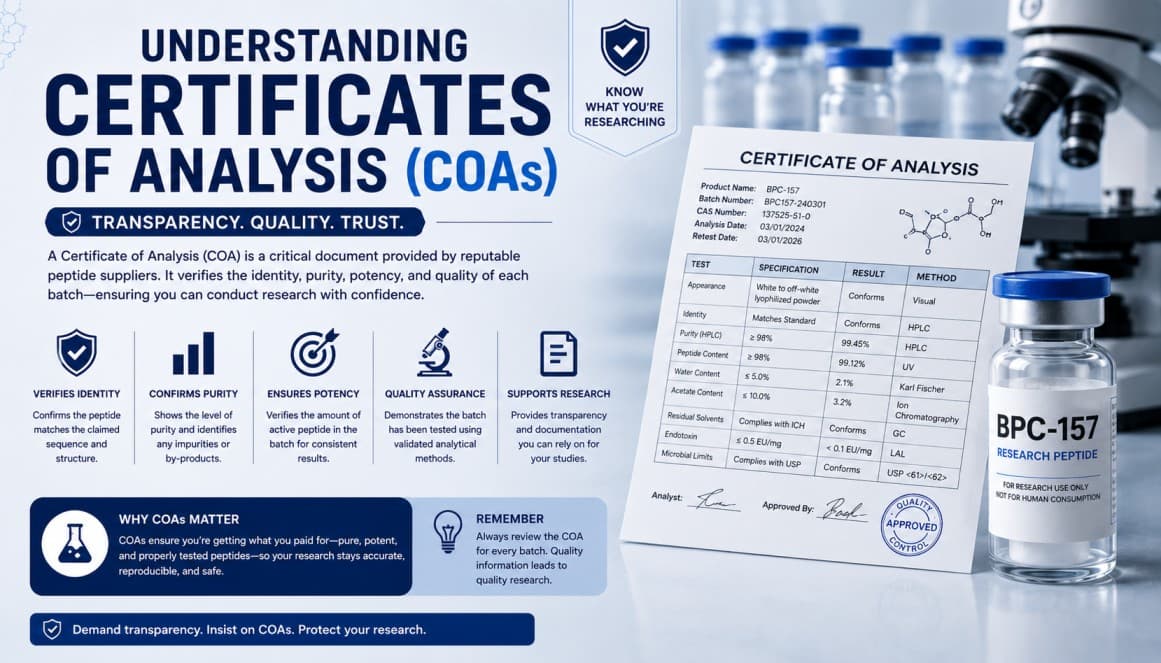
A complete COA should include, at minimum: HPLC purity with a visible chromatogram, mass spectrometry identity confirmation showing both theoretical and observed molecular weight, water content, and a batch/lot number with an analysis date from an identifiable laboratory. For a full breakdown of how to read each of these fields, see our companion article, "How to Read Product Specifications."
What purity level should I expect from a research-grade peptide?
A purity result in the 99.5%–99.8% range represents a realistic ceiling for well-synthesized research peptides; be cautious of any supplier advertising "100% purity," since this is rarely achievable and often signals rounded or misleading reporting. A purity of 99% or higher is generally the standard for the most rigorous research applications, while 95–98% may be acceptable for exploratory screening work but is generally considered inadequate for quantitative dose-response studies, and results below 95% are not considered suitable for reproducible research.
How should lyophilized (freeze-dried) peptides be stored?
While exact storage parameters vary by compound and should always be checked against the specific product's documentation, lyophilized peptide powder is generally most stable when kept cold, dry, dark, and sealed, and reconstituted solutions used for laboratory assays are generally more stable refrigerated than at room temperature and are typically used within a period of days to a few weeks rather than stored indefinitely. Always refer to the specific storage guidance provided with your batch, since stability profiles differ meaningfully between compounds.
Why do some products come as blends rather than single compounds?
Pre-formulated blends combine two or more peptides at a fixed ratio, typically to support research designs examining how complementary signaling pathways interact — for example, pairing compounds that act on separate but related biological pathways. Blends introduce additional interpretive complexity compared with single-compound research, since attributing an observed effect to a specific component becomes harder as more compounds are combined. Our companion article, "Understanding Peptide Blends," covers this in more depth, including what to check before incorporating a blend into a study design.
Is "research peptide" evidence the same as clinical evidence?
Not necessarily, and this distinction matters when interpreting published literature. Some compounds discussed in the research-peptide space — tesamorelin, for example — have gone through formal human clinical trials and carry FDA-approved indications for a specific population. Others, such as many newer or more experimental peptides, currently have evidence limited to cell-culture and animal-model studies, with human data either absent, preliminary, or drawn from small, non-controlled reports. When reading any research summary — including the ones on this site — it's worth checking whether a given claim is backed by controlled human trials, animal studies, or purely in-vitro work, since these carry very different levels of evidentiary weight.
Can research peptides be shipped internationally, and are there customs considerations?
Import and export rules vary by destination country and by compound, and researchers and institutions are responsible for understanding the regulations that apply in their own jurisdiction. Because regulatory frameworks and enforcement priorities can change, researchers should check current guidance from their national regulator (in the UK, the MHRA) and their institution's procurement or compliance office before ordering, rather than relying solely on a supplier's general statements.
Where can I find more detail on a specific peptide?
See our individual research overviews and guides for compound-specific mechanisms, study findings, and handling considerations, including our articles on MOTS-c, AOD9604, GHK-Cu, Tesamorelin, and Ipamorelin.
A Note on Responsible Research Use
All products referenced on this site are supplied strictly for laboratory and in-vitro research use by qualified professionals and institutions. They are not intended for human or animal administration outside of a controlled research setting, and nothing on this page should be read as medical, legal, or dosing advice. For legal questions specific to your situation, consult a solicitor or your institution's compliance office; for regulatory questions, consult the MHRA directly.
Disclaimer: This article summarizes publicly available information for general educational purposes. It is not legal or medical advice, and FlexPeptides does not sell products intended for human consumption.