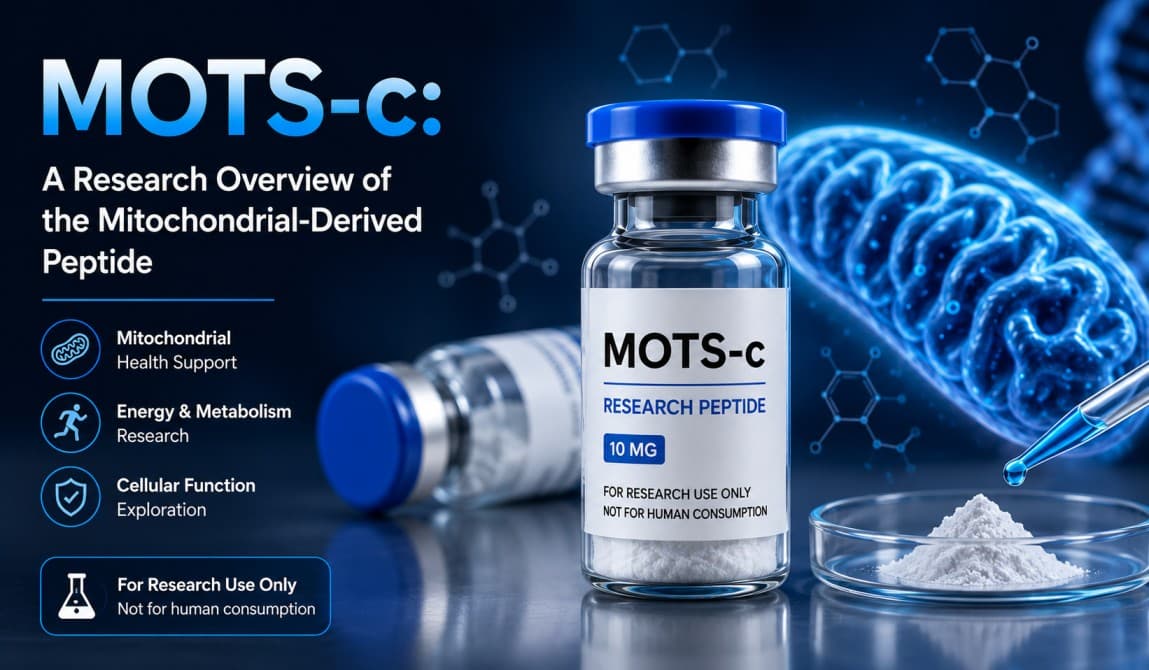
Discover the latest research on MOTS-C, a mitochondrial-derived peptide studied for its potential role in cellular metabolism, energy regulation, and metabolic pathways. Explore current laboratory findings, research applications, and key considerations for scientific investigations.
Introduction
Among the growing family of mitochondrial-derived peptides (MDPs) that have reshaped our understanding of mitochondrial biology, MOTS-c stands out as one of the most studied. First identified in 2015, MOTS-c has moved from a biochemical curiosity to a peptide of significant interest across metabolic, cardiovascular, musculoskeletal, and aging research. This overview summarizes what the current scientific literature says about MOTS-c: what it is, how it behaves in cellular and animal models, and where the research currently stands. It is intended as an educational resource for laboratory professionals and researchers working with this compound, not as guidance for human use.
What Is MOTS-c?
MOTS-c takes its name from its origin: the Mitochondrial Open Reading Frame of the Twelve S-ribosomal RNA type c. It is a short open reading frame within the mitochondrial 12S rRNA gene, encoding a peptide with a molecular weight of roughly 2174.7 daltons and a sequence of sixteen amino acids: Met-Arg-Trp-Gln-Glu-Met-Gly-Tyr-Ile-Phe-Tyr-Pro-Arg-Lys-Leu-Arg. Despite its mitochondrial origin, MOTS-c is found predominantly in skeletal muscle, white fat, and brown fat, and is also detectable circulating in peripheral blood.
This places MOTS-c alongside other mitochondrial-derived peptides such as humanin and the SHLP family, all of which are encoded by small reading frames tucked within mitochondrial DNA rather than the nuclear genome — a discovery that has opened an entirely new area of peptide research, since mitochondria were traditionally viewed only as the cell's energy-producing organelles rather than as a source of signaling molecules in their own right.
Discovery and Early Characterization
MOTS-c was first reported in the scientific literature in 2015, when researchers demonstrated that the peptide plays a role in regulating glucose uptake, lipid metabolism, and insulin sensitivity, along with broader involvement in the physiological changes associated with aging. Since that initial characterization, the pace of MOTS-c research has accelerated considerably, with investigators expanding the peptide's known roles to include effects on obesity, inflammation, neuroprotection, and aging-related declines in physical activity, prompting several research groups to call for systematic reviews given how quickly the literature has grown.
Proposed Mechanisms of Action
A central theme across the MOTS-c literature is its relationship with AMPK (AMP-activated protein kinase), a key cellular energy sensor. Research suggests that MOTS-c regulates cellular metabolism through AMPK-dependent pathways, enhancing glucose utilization and cellular stress responses. Some investigators propose that this occurs, at least in part, through activation of the AICAR-AMPK signaling pathway via disruption of the folate-methionine cycle within cells, with downstream effects on the expression of metabolically important genes such as GLUT4, STAT3, and IL-10.
Perhaps the most striking finding in the mechanistic literature is that MOTS-c does not appear to act only as a local mitochondrial signal. Investigators have shown that MOTS-c can translocate into the cell nucleus in response to metabolic stress, where it regulates nuclear gene expression, including gene networks involved in the heat shock response and broader metabolic regulation. This retrograde signaling — a mitochondrial peptide traveling to the nucleus to influence gene transcription — has led some researchers to describe MOTS-c as evidence of a "bi-genomic" basis for processes like aging, in which both the mitochondrial and nuclear genomes contribute instructions that shape an organism's physical capacity over time.
Findings From Cell and Animal Models
A substantial portion of the MOTS-c evidence base comes from in vitro and animal studies:
Metabolic regulation. In foundational work using HEK293 cells, treatment with MOTS-c produced a marked, time-dependent shift in the global gene expression profile, with effects on metabolically relevant pathways becoming increasingly distinct between four and seventy-two hours of exposure. Researchers observed that MOTS-c levels decline with age in both plasma and muscle tissue, coinciding with age-related insulin resistance, and that administering MOTS-c to older animal models was sufficient to restore insulin sensitivity.
Exercise physiology. Work published in Nature Communications identified MOTS-c as an exercise-induced, mitochondrially-encoded regulator that appears to influence age-related physical decline and skeletal muscle homeostasis in animal models. The same research demonstrated that exogenously administered MOTS-c entered the nucleus of treated cells and altered the expression of genes tied to both the heat shock response and metabolic regulation, reinforcing the nuclear-signaling mechanism described above.
Cardiovascular research. Preclinical models point to a cardioprotective role for MOTS-c as well. MOTS-c administration has been shown, in animal studies, to help prevent age-related metabolic dysfunction, to counter metabolic disturbances following ovariectomy, to reduce insulin resistance associated with high-fat-diet-induced obesity, and to limit pressure-overload-induced cardiac hypertrophy. More recent work has extended this to models of diabetic cardiomyopathy, where MOTS-c treatment was associated with improved heart function in diabetic rats through enhanced glucose metabolism and upregulated antioxidant defenses, although the exact mechanism by which MOTS-c restores mitochondrial bioenergetics in the diabetic heart remains an open research question.
Inflammation and immune signaling. Beyond metabolism, studies have found that MOTS-c can significantly reduce pro-inflammatory markers while increasing anti-inflammatory factors and insulin-stimulated glucose uptake in animal models, suggesting a role for the peptide in immune regulation alongside its metabolic effects.
Bone metabolism. MOTS-chas also drawn attention in skeletal research, with investigators examining its role in bone remodeling processes as part of the broader push to understand how mitochondrial-derived peptides participate in tissue-level homeostasis beyond muscle and fat.
Circulating Levels and Disease Associations
An important line of observational research has looked at circulating MOTS-c levels in different populations. Blood MOTS-c concentrations have been reported to be lower in individuals with type 2 diabetes, in gestational diabetes, in coronary endothelial dysfunction, and in obese children and adolescents, as well as in diabetic mouse models. These associations have led researchers to explore MOTS-c as a potential biomarker of metabolic health, in addition to its role as a candidate therapeutic target — though correlation in observational studies does not establish that lower MOTS-c levels are a cause, rather than a consequence, of these conditions.
Genetic Variants and Longevity Research
A separate strand of MOTS-c research has focused on naturally occurring genetic variation in the peptide itself. A specific MOTS-c polymorphism (m.1382A>C, resulting in a Lys14Gln substitution) has been linked to longevity in population studies, adding to the broader hypothesis that MOTS-c activity may be one of several mitochondrial factors contributing to healthy aging trajectories across individuals and, in comparative work, across species.
Where the Research Stands Today
Despite a decade of accumulating preclinical data, the translational picture for MOTS-c remains incomplete. Reviewers have noted that although MOTS-c shows clear benefits for glucose metabolism in skeletal muscle in laboratory and animal studies, it has seen comparatively little use in actual disease treatment, and no effective clinical application method has yet been developed. Much of the current research effort is therefore directed at two goals: further clarifying the molecular mechanisms — particularly the AMPK and nuclear-translocation pathways — and exploring synthetic biology approaches that might make MOTS-c more tractable as a research and development target going forward.
Comparative and evolutionary research is also expanding the picture. Studies examining MOTS-c sequences across species, including recent work characterizing an avian version of the peptide, have found that the coding sequence is highly conserved but shows species-specific variations, with downstream effects on pathways such as AKT signaling — helping researchers build a broader phylogenetic understanding of how this peptide family has evolved.
Summary
MOTS-c is a compact, sixteen-amino-acid peptide encoded within mitochondrial DNA that has emerged as a significant focus of metabolic and aging research over the past decade. Preclinical and cell-based studies link it to AMPK signaling, nuclear gene regulation, glucose and lipid metabolism, cardiovascular protection, inflammatory regulation, and associations with longevity-related genetic variants. At the same time, the literature is clear that MOTS-c remains firmly in the research and preclinical stage, with no established clinical protocol and open questions about mechanism still under active investigation.
As with all compounds discussed on this site, MOTS-c is intended strictly for in vitro and laboratory research use by qualified professionals. It is not a drug, dietary supplement, or cosmetic, and none of the information above should be interpreted as a recommendation for human or animal use outside of a controlled research setting. Researchers should always consult the primary literature and follow their institution's protocols when designing studies involving MOTS-c.
Disclaimer: This article is provided for general scientific and educational purposes and reflects a summary of publicly available peer-reviewed research. It does not constitute medical advice, and FlexPeptides does not sell products for human consumption.