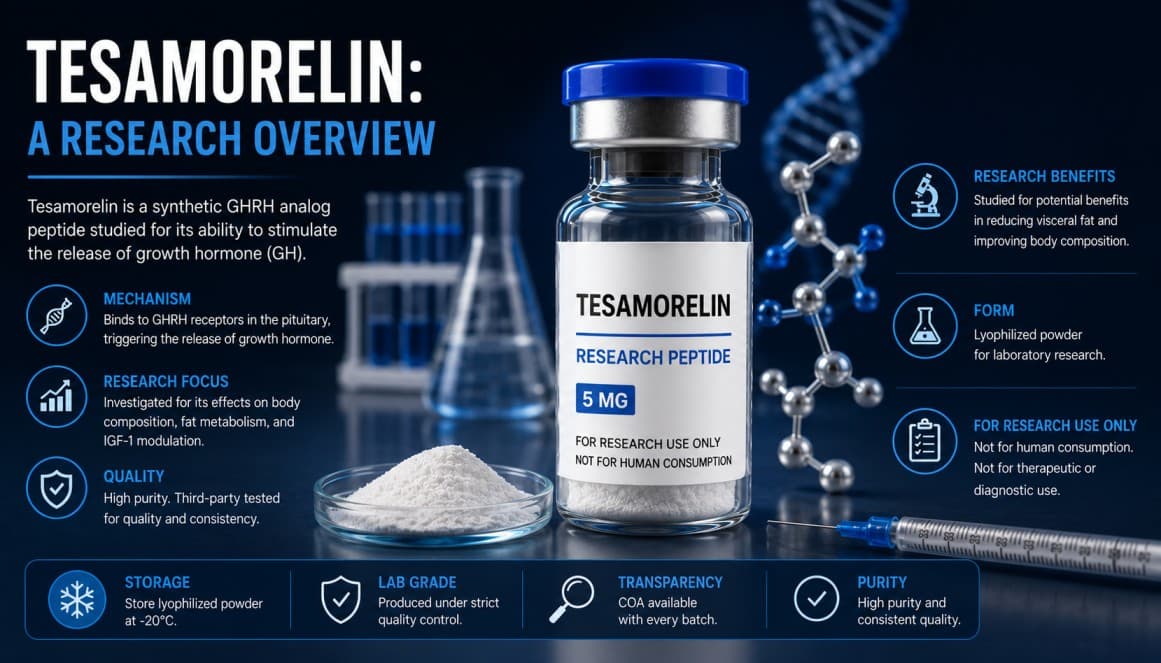
Learn about ongoing Tesamorelin research, including its investigation in endocrine and metabolic studies. Discover current laboratory applications, handling recommendations, and quality factors that support accurate scientific research.
For research use only. Not for human consumption.
Introduction
Tesamorelin occupies a somewhat unusual place among the peptides discussed on this site: unlike most research compounds, it has an FDA-approved history as a prescription drug, giving researchers an unusually deep and rigorous clinical trial record to draw on. This overview covers what tesamorelin is, how it is thought to work, and what the clinical and mechanistic literature has established — with an emphasis on its best-documented research area, visceral fat.
What Is Tesamorelin?
Tesamorelin is a synthetic analog of growth hormone-releasing hormone (GHRH), modified with a trans-3-hexenoic acid group that increases its metabolic stability relative to native GHRH. It works by binding GHRH receptors on pituitary somatotroph cells, stimulating the pulsatile release of endogenous growth hormone while preserving the body's natural feedback mechanisms through somatostatin regulation.
This mechanism is central to why tesamorelin has drawn sustained research interest. Unlike exogenous growth hormone (somatropin), which is administered directly and can override the body's own regulatory feedback loops, tesamorelin maintains the physiological, pulsatile release pattern of growth hormone secretion. Researchers have suggested that this distinction is significant: exogenous growth hormone can overwhelm normal feedback loops, whereas tesamorelin more closely restores a youthful hormonal secretion rhythm, which may help explain why its effects are relatively selective for visceral fat rather than producing large shifts in total body weight. Downstream, this GH stimulation raises circulating insulin-like growth factor-1 (IGF-1), a hormone tied to cellular repair, metabolic regulation, and body composition.
The Core Evidence Base: Visceral Fat Reduction
Tesamorelin's best-established research finding, by a considerable margin, is its effect on visceral adipose tissue (VAT) — the metabolically active fat surrounding internal organs, as distinct from subcutaneous fat.
The pivotal trial, published in the New England Journal of Medicine, randomly assigned 412 patients with HIV, 86% of whom were men and all of whom had abdominal fat accumulation, to receive a daily subcutaneous injection of either 2 mg of tesamorelin or placebo for 26 weeks, with the primary endpoint being percent change in visceral adipose tissue as measured by CT scan. The study found that tesamorelin's effects were highly specific to the visceral fat compartment, with relatively little effect on subcutaneous fat or limb fat, producing an estimated 1.0-kg selective loss in visceral fat over six months. A companion phase III trial reported a -10.9% reduction in visceral adipose tissue (a 21 cm² decrease) in the tesamorelin group compared with -0.6% in the placebo group over the six-month efficacy phase, alongside significant improvements in trunk fat, waist circumference, and waist-hip ratio, with the authors concluding that tesamorelin reduces visceral fat by approximately 18% and improves body-image distress in HIV-infected patients with central fat accumulation, without significant side effects or disruption of glucose control.
Because of this trial record, tesamorelin is an FDA-approved, prescription medication specifically studied and approved for reducing visceral fat in people with HIV-associated lipodystrophy, administered by daily subcutaneous injection under clinician oversight. It's worth being precise about the scope of that approval: clinical research has primarily evaluated tesamorelin for visceral fat reduction specifically in the HIV-lipodystrophy population, and evidence in other populations remains more limited.
Liver Fat and Metabolic Research
A more recent line of research has extended beyond visceral fat to examine tesamorelin's effects on the liver. A randomized, double-blind, placebo-controlled trial in HIV-infected patients with abdominal fat accumulation specifically investigated tesamorelin's effect on both visceral and liver fat, building on the observation that visceral adiposity in this population is associated with broader metabolic dysregulation and ectopic fat accumulation. More recent data, drawn from individuals on modern antiretroviral therapy including integrase inhibitors, found that tesamorelin not only prevented visceral fat gain but also reduced hepatic fat by nearly 5% compared with placebo.
A separate, longer trial examined whether these liver benefits extended to disease progression markers. A randomized, double-blind, multicenter trial in HIV patients with non-alcoholic fatty liver disease (NAFLD) found that tesamorelin, dosed at 2 mg daily for twelve months, reduced liver fat and prevented fibrosis progression, while also decreasing hepatic inflammatory gene expression and increasing markers of oxidative phosphorylation — findings some researchers have suggested point toward a direct hepatoprotective mechanism that goes beyond simple fat reduction, though this remains an active area of investigation rather than a settled conclusion.
Body Composition and Cardiometabolic Markers
Beyond fat reduction, the literature also points to effects on lean tissue and metabolic biomarkers. Clinical trials have shown significant increases in lean body mass alongside visceral fat reduction, and researchers have noted that while caloric restriction often leads to a loss of lean muscle mass, tesamorelin tends to preserve or slightly increase muscle tissue — a distinction of interest in body-composition research. Separately, clinical studies have reported improvements in triglyceride levels and inflammatory markers such as CRP, and post hoc analyses of phase III trial data have examined tesamorelin's effects in patient subgroups with and without dorsocervical fat accumulation, a body-composition feature seen in some forms of HIV-associated lipodystrophy.
Safety Signals From the Trial Record
Because tesamorelin has gone through formal drug-approval trials, its safety data are more extensive than for most research peptides. The pivotal NEJM trial reported that the percentage of patients experiencing symptoms of growth hormone excess — including joint pain, peripheral edema, and muscle aches — was lower than seen in earlier large trials of growth hormone itself in HIV-infected patients. One notable immunogenicity finding from that same trial is worth highlighting for researchers: antibodies developed in almost 50% of patients receiving tesamorelin, although the study authors noted this was a relatively short-duration trial and did not report this antibody development as being associated with a loss of efficacy or a distinct safety signal within the study period.
Emerging and Preliminary Research
A smaller and more preliminary body of research has begun exploring tesamorelin's effects outside of metabolic and body-composition endpoints. Some early research suggests tesamorelin may influence executive function and verbal memory through GH/IGF-1 signaling pathways in the brain. This line of investigation is considerably less developed than the visceral-fat and liver-fat literature, and should be treated as a preliminary research signal rather than an established finding.
Where Tesamorelin Fits Among Research Peptides
Tesamorelin's mechanism — stimulating the body's own pulsatile GH release via the GHRH receptor, rather than supplying growth hormone directly — distinguishes it from GH secretagogues that act through other receptor pathways, such as ghrelin-receptor agonists. Within body-composition and metabolic research specifically, tesamorelin currently has the most robust visceral-fat evidence base of any peptide in this category, owing largely to its formal path through FDA drug trials rather than purely preclinical or investigational research.
Summary
Tesamorelin is a GHRH analog with an unusually strong clinical evidence base for a research peptide, driven by its FDA-approved history in HIV-associated lipodystrophy. Randomized controlled trials consistently show selective reductions in visceral adipose tissue, with a growing secondary literature on liver fat, lean mass preservation, and cardiometabolic markers. Its safety profile is well characterized relative to most peptides discussed on this site, though notable findings — such as high rates of antibody development — are part of the record researchers should be aware of.
A Note on Responsible Research Use
Tesamorelin, as offered on this site, is supplied strictly for laboratory and in-vitro research use by qualified professionals and institutions. It is not intended for human or animal administration outside of a controlled research setting, and this article should not be read as guidance for personal or therapeutic use. Tesamorelin is an FDA-approved prescription medication for a specific indication; any human use outside of that approved context requires a licensed prescriber's oversight, not a research-supply purchase.
Disclaimer: This article summarizes publicly available research for general scientific and educational purposes. It is not medical advice, and FlexPeptides does not sell products intended for human consumption.