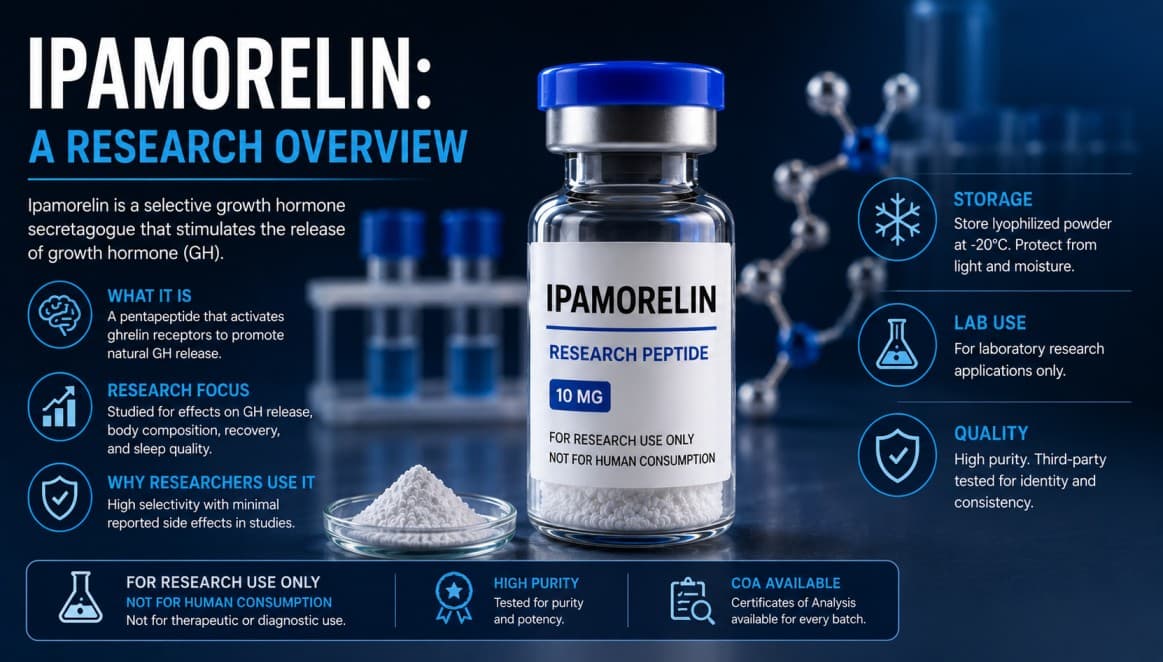
Explore the latest findings on Ipamorelin research, including its role in growth hormone-related laboratory studies. This guide highlights research applications, peptide quality, storage, and best practices for scientific use.
For research use only. Not for human consumption.
Introduction
Among growth hormone secretagogues (GHS) studied in preclinical research, ipamorelin is frequently described as the most selective. This overview covers ipamorelin's structure, its mechanism at the ghrelin receptor, what preclinical studies have found, and how it compares with earlier-generation GH secretagogues in the research literature.
What Is Ipamorelin?
Ipamorelin (Aib-His-D-2-Nal-D-Phe-Lys-NH₂) is a synthetic pentapeptide developed through systematic modification of earlier growth hormone-releasing peptide (GHRP) scaffolds. It was derived from GHRP-1 and incorporates non-natural amino acid substitutions — specifically D-2-naphthylalanine (D-2-Nal) and alpha-aminoisobutyric acid (Aib) — that confer resistance to enzymatic degradation while optimizing binding affinity at its target receptor. Its development code during preclinical characterization was NNC 26-0161.
Mechanism of Action
Ipamorelin exerts its primary pharmacological activity through selective agonism of the growth hormone secretagogue receptor type 1a (GHS-R1a), commonly known as the ghrelin receptor. This G-protein coupled receptor is expressed predominantly in the anterior pituitary gland, where its activation triggers intracellular calcium mobilization and subsequent growth hormone release from somatotroph cells. At the signaling level, the cascade initiated by ipamorelin binding to GHS-R1a involves phospholipase C activation and inositol trisphosphate (IP3) generation, leading to calcium release from intracellular stores — a pathway distinct from the GHRH receptor, which primarily signals through cyclic AMP.
This dual-pathway architecture — ghrelin-receptor agonists like ipamorelin acting through calcium/IP3 signaling, versus GHRH analogs acting through cAMP — has made ipamorelin a frequently used research tool for studying how these two pituitary signaling pathways interact and, in some study designs, potentiate one another.
Selectivity: The Defining Research Finding
The single most consistently reported characteristic of ipamorelin across the preclinical literature is its selectivity for GH release relative to other pituitary hormones. Published comparative studies demonstrate that ipamorelin produces GH release without significant elevation of ACTH, cortisol, or prolactin, even at doses exceeding 200-fold the GH-releasing ED50 in animal studies. Consistent with this, ipamorelin has been reported not to affect prolactin, follicle-stimulating hormone, or several other pituitary hormones that some earlier-generation secretagogues do influence.
This selectivity is frequently framed in the literature as a comparative advantage over earlier GHRP-family compounds. Unlike GHRP-6 and hexarelin, which increase cortisol, prolactin, and appetite alongside GH release, ipamorelin is reported to produce GH release with minimal off-target hormonal effects, which is why it has become a preferred pharmacological tool for isolating GH-axis effects from cortisol and prolactin-related confounders in experimental design. Some sources go further, noting that ipamorelin does not significantly increase appetite — a common side effect of ghrelin receptor activation — at the concentrations typically used in research protocols, distinguishing it from ghrelin's own broader physiological effects on feeding behavior.
Pharmacokinetics in Preclinical Models
Research in animal models has reported ipamorelin's plasma half-life to be relatively short, generally in the range of approximately two hours, a property that has practical implications for study design: this short half-life has made ipamorelin a useful tool for studying discrete GH pulse dynamics within controlled laboratory timelines, without prolonged receptor saturation confounding the measurement window.
Key Preclinical Research Areas
Bone metabolism. Preclinical research has examined ipamorelin's effects on longitudinal bone growth in rat models, building on earlier observations that ipamorelin has been reported to induce longitudinal bone growth in rats, which has made bone density and bone metabolism a recurring theme in ipamorelin-related research, often studied using ovariectomized rat models as a model of postmenopausal bone changes.
GH pulse dynamics and neuroendocrine signaling. Ipamorelin binding at GHS-R1a in the hypothalamus and pituitary triggers downstream signaling cascades that promote GH secretion, an area of active investigation in neuroendocrine research, and studies have used the compound to help elucidate how ghrelin-receptor pathways regulate GH pulsatility, making it a frequently cited tool compound in the somatotropic-axis literature.
Body composition and IGF-1. Studies in rodent models have examined ipamorelin's effects on GH pulse amplitude, IGF-1 elevation, bone mineral density, and body composition parameters.
Gastrointestinal motility. Ipamorelin has also been studied in the context of gastrointestinal motility, particularly post-operative ileus, and several peer-reviewed studies have explored its effects on GI motility in preclinical settings. Related research on the broader GHS-R1a agonist class has found that GHS-R1a agonists, including anamorelin and ipamorelin, inhibited cisplatin-induced weight loss in ferret models, a finding relevant to research on chemotherapy-associated appetite and weight loss.
Combination research with GHRH analogs. Because ipamorelin and GHRH analogs act through separate receptor pathways (GHS-R1a versus the GHRH receptor), preclinical research has investigated the two compound classes together, hypothesizing that dual-pathway stimulation may produce additive or synergistic effects on GH release compared with either pathway alone — a design that leverages the cAMP/calcium signaling distinction described above.
Comparative Position Among GH Secretagogues
Within the broader class of ghrelin-receptor-targeting compounds, ghrelin itself is understood as a multifunctional peptide, primarily synthesized in the stomach, that regulates GH secretion and energy homeostasis while playing a broader role in diverse physiological and pathological processes. Ipamorelin's research value largely derives from acting more narrowly within this system — activating the GH-release arm of ghrelin signaling with substantially less spillover into the appetite, cortisol, and prolactin pathways that broader ghrelin-receptor activation, or older secretagogues like GHRP-6, tend to produce. This makes it a commonly chosen reference compound in studies specifically designed to isolate GH-axis effects.
Summary
Ipamorelin is a synthetic pentapeptide and selective ghrelin-receptor (GHS-R1a) agonist, developed through targeted modification of earlier GHRP compounds to improve enzymatic stability and receptor selectivity. Its defining characteristic in the research literature is a "clean" hormonal profile: robust, dose-dependent GH release without the meaningful elevations in cortisol, prolactin, ACTH, or appetite seen with earlier-generation secretagogues. This selectivity, combined with a short plasma half-life in animal models, has made ipamorelin a widely used pharmacological tool for isolating GH-axis effects in neuroendocrine, bone-metabolism, body-composition, and gastrointestinal-motility research.
A Note on Responsible Research Use
Ipamorelin, as offered on this site, is supplied strictly for laboratory and in-vitro research use by qualified professionals and institutions. It is not intended for human or animal administration outside of a controlled research setting, and this article should not be read as guidance for personal or therapeutic use. Researchers should consult the primary literature and follow their institution's research protocols.
Disclaimer: This article summarizes publicly available research for general scientific and educational purposes. It is not medical advice, and FlexPeptides does not sell products intended for human consumption.