A practical guide to Certificates of Analysis (COAs), explaining what they contain, why they matter, and how researchers can use them to verify product quality.
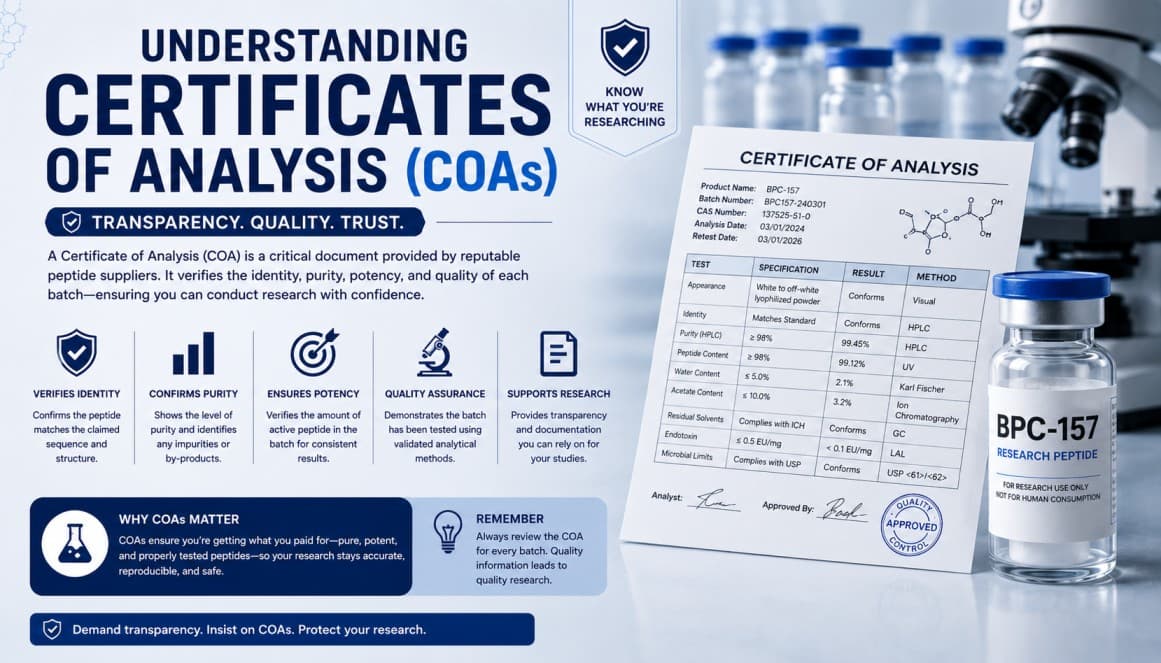
A Certificate of Analysis (COA) is a document — typically from a manufacturer or an independent testing lab — that reports the results of quality testing performed on a specific batch of a product. For research peptides, it's the single most important piece of documentation you should require before you buy, and before you rely on any result generated using the material it covers.
What should a proper COA include?
- Batch/lot number matching the specific vial you received, not a generic reference document
- HPLC purity percentage, ideally 98% or above for research-grade material
- Mass spectrometry confirmation of molecular identity, alongside the HPLC data
- Appearance data and other basic physical characteristics
- Testing facility credentials — named and identifiable, not anonymous
How to spot a weak or misleading COA
Watch for generic templates reused across multiple batches, missing batch identifiers, absent molecular-identity data (HPLC alone without mass spectrometry confirmation), and testing dates that are old relative to your shipment. Any one of these on its own might have an innocent explanation; more than one together is a real signal to ask questions before you order again.
Why this matters for reproducibility
Research built on unverified or poorly documented material is inherently harder to replicate — if you can't confirm exactly what you used, neither can anyone trying to reproduce your results. A batch-specific COA isn't paperwork for its own sake; it's the evidence trail that makes your research defensible.
A worked example: reading a tesamorelin COA
Using tesamorelin as a concrete case: a proper COA for a tesamorelin batch should show the batch/lot number matching your vial, HPLC purity data at 98%+, mass spectrometry confirming the molecular weight (~5,135 g/mol — see our tesamorelin structure overview for the full spec), and a testing date recent enough to reflect the batch you actually received. Apply the same read to any other compound's COA — identity, purity method, contaminant screening, and batch traceability are the four things that must be present, whatever you're checking.
Questions to ask a supplier about their COAs
- Does the COA match the specific lot number on the product I'm receiving?
- Does it include both HPLC and mass spectrometry data, or just one?
- Is the testing independent, or performed in-house by the supplier?
- How recent is the testing relative to when the batch shipped?
- Can you provide a fresh COA on request if mine seems outdated?
Final thoughts
A COA is only useful if you actually check it against what arrives — match the lot number, check the testing date, and don't accept a generic document in place of one specific to your order.
Disclaimer
Products discussed here are not approved by the MHRA or FDA for human or veterinary use, and are sold strictly for laboratory research purposes.
Related reading
What "98% Purity" Actually Means How to Choose a Trusted Peptide Supplier in the UK