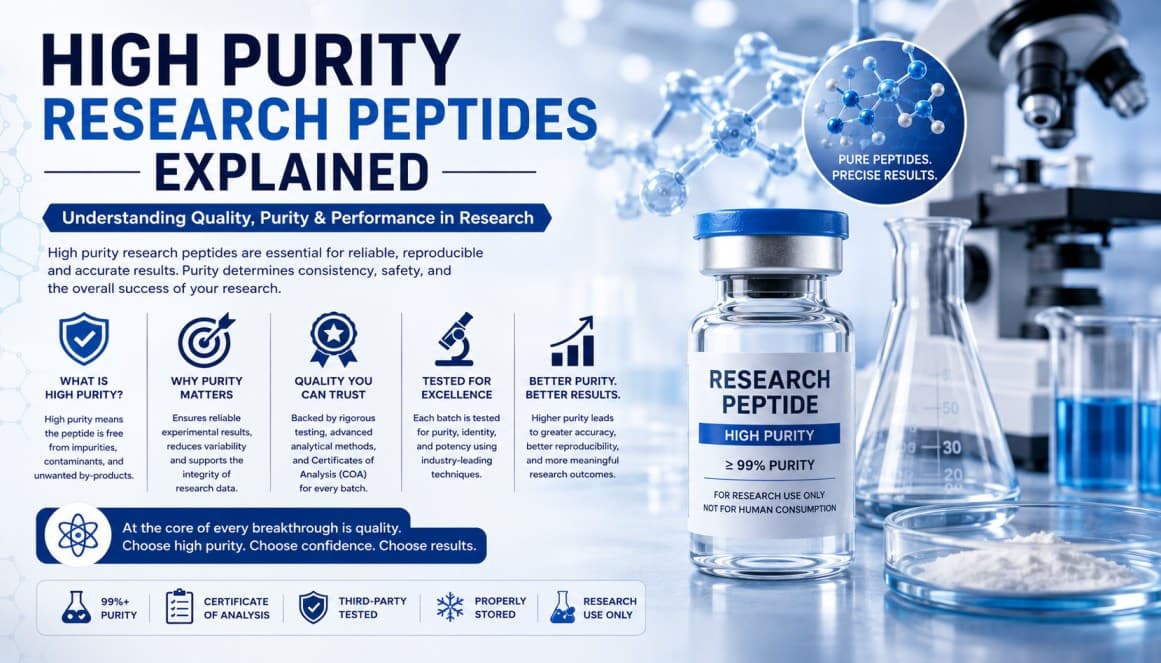
Discover why peptide purity matters in laboratory research and how high-purity research peptides contribute to more accurate, consistent, and reproducible results.
Purity is the single most important quality metric in peptide research. Impurities — leftover synthesis byproducts, truncated sequences, or contaminants — can undermine experimental outcomes in ways that are hard to detect after the fact, which is why understanding what a purity claim actually means matters more than it might seem.
What does "purity" actually mean?
When a supplier claims 98% purity, that figure represents the proportion of your intended peptide sequence relative to synthesis byproducts and other impurities in the same sample. No synthesis process achieves 100% purity — which is exactly why understanding the actual percentage, and how it was measured, matters as much as the headline number itself.
How purity is measured
HPLC (High-Performance Liquid Chromatography) separates the components of a sample, allowing the proportion of your target peptide to be quantified against everything else present.
Mass spectrometry confirms molecular identity — that what's present is actually the compound the label claims, not just "something" at a given purity percentage.
The two methods answer different questions: HPLC tells you how much of the target compound is present; mass spectrometry confirms it's actually the right compound. A COA with only one of the two is telling you half the story.
Why purity thresholds matter
Reproducibility. Batch-to-batch variation in purity introduces a variable into your research that has nothing to do with what you're actually studying.
Accurate dosing in models. If a compound is only 85% pure instead of the claimed 98%, your effective concentration in any dosing calculation is off by a meaningful margin.
Publication confidence. Reviewers and readers increasingly expect documented purity data behind reported results — undocumented material weakens the credibility of the work built on it.
What to look for in a supplier's purity claims
Batch-specific Certificates of Analysis, dual HPLC and mass spectrometry documentation, transparent labelling that states the method used, and willingness to explain their testing methodology when asked directly.
Research-grade vs. other grades
"Research-grade" is a specific designation — material sold with full technical documentation (COA, sequence, purity data) explicitly for laboratory use. This is distinct from cosmetic-grade or consumer-marketed versions of related compounds, which are formulated and regulated differently and typically carry no research-use documentation at all. A supplier who doesn't clearly distinguish research-grade from other grades in their listings is worth a second look.
Common misconceptions about purity
"Higher purity always means better research results." Purity alone doesn't guarantee valid results — study design and handling matter too. It's a necessary condition, not a sufficient one.
"98% purity means the same thing everywhere." Purity percentages can vary by testing methodology — a figure from HPLC alone isn't directly comparable to one confirmed by both HPLC and mass spectrometry.
"Purity doesn't affect storage." Impurities can affect stability during storage, not just the accuracy of results at the point of use.
Questions worth asking
- What testing method(s) were used, and are results from both HPLC and mass spectrometry available?
- Is the purity figure batch-specific or a general reference figure?
- Who performed the testing — an independent lab, or in-house?
- How does the supplier handle a batch that tests below their stated threshold?
Final thoughts
A purity percentage on its own tells you less than it appears to. Ask how it was measured, whether it's batch-specific, and whether it's backed by both HPLC and mass spectrometry data before treating any number as reliable.
Disclaimer
Products discussed here are not approved by the MHRA or FDA for human or veterinary use.
Related reading
Understanding Certificates of Analysis (COAs)
How to Choose a Trusted Peptide Supplier in the UK