Discover how Flex Peptides maintains premium quality through rigorous testing, strict quality control, trusted sourcing, and transparent standards. Learn the processes that help ensure every research peptide meets high levels of purity, consistency, and reliability.
When it comes to research peptides, quality is not optional — it is the foundation of valid science. A peptide that is even slightly impure, mislabelled, or poorly handled can produce misleading results, waste months of research time, and undermine the integrity of an entire study. At Flex Peptides, we believe that the UK research community deserves a peptide supplier that takes quality as seriously as the researchers it serves.
This article explains, in plain and specific terms, exactly how Flex Peptides maintains the premium quality standards that researchers, clinicians, and institutions across the UK rely on — from synthesis and testing through to the moment your order arrives at your door.
Every peptide we supply at FlexPeptides.co.uk is independently tested by a third-party accredited laboratory and supplied with a full Certificate of Analysis. This is not a marketing claim — it is a verifiable commitment attached to every order.
Step 1: We Only Source from Verified, Accredited Manufacturers
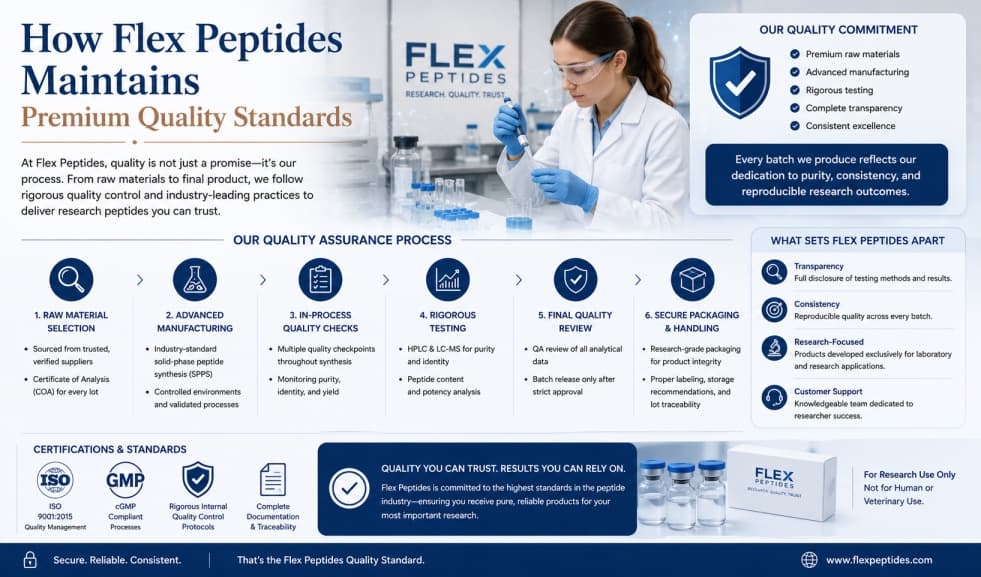
The quality of a peptide is determined long before it reaches our warehouse. That is why our first and most important quality checkpoint is at the point of sourcing. Flex Peptides works exclusively with peptide manufacturers who hold internationally recognised quality accreditations, operate under Good Manufacturing Practice (GMP) guidelines or equivalent standards, can demonstrate a consistent track record of producing high-purity compounds, and maintain full traceability from raw amino acid inputs through to finished lyophilised product.
We do not purchase peptides from unverified brokers, low-cost mass-market intermediaries, or suppliers who cannot provide complete synthesis and testing documentation. This rigorous sourcing approach means that every batch entering our supply chain starts from a position of verified quality — before any additional testing takes place.
Step 2: Independent Third-Party Laboratory Testing — Every Batch
We do not rely solely on manufacturers' own quality reports. Every batch of peptide received by Flex Peptides is submitted to an independent, accredited third-party laboratory for comprehensive analysis. This independent testing is the cornerstone of our quality assurance programme and includes the following:
1. HPLC purity analysis — High Performance Liquid Chromatography to confirm that the peptide constitutes 98% or more of the total substance, with full chromatographic data provided
2. Mass spectrometry (MS) confirmation — to verify the molecular weight of the compound and confirm that it matches the intended peptide sequence precisely
3. Amino acid sequence verification — confirming that the peptide contains the correct amino acids in the correct order
4. Residual solvent testing — identifying any manufacturing solvents remaining in the lyophilised product above accepted thresholds
5. Microbiological screening — checking for the presence of bacteria, yeast, and mould that could compromise research integrity
6. Water content analysis — relevant to accurate dosing and concentration calculations in research protocols
Our minimum acceptable purity threshold is 98% by HPLC. Batches that do not meet this standard are rejected. We do not sell sub-standard material at a discount — it is simply not supplied.
Step 3: Full Certificate of Analysis — Supplied with Every Order
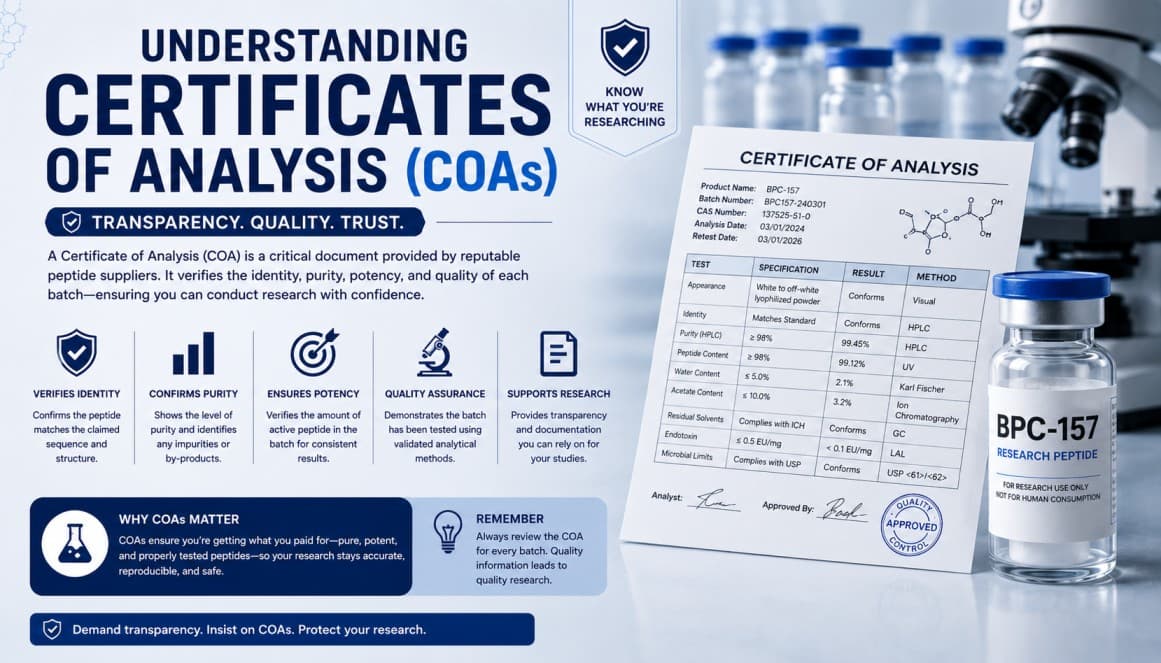
The Certificate of Analysis (COA) is the definitive quality document for any research peptide. At Flex Peptides, a COA is not a generic document generated once per product — it is a batch-specific report tied to the precise lot number of the peptide in your order. Your COA includes the compound name and CAS number, batch or lot number, date of testing, the name and accreditation details of the testing laboratory, purity result (% by HPLC), mass spectrometry data confirming molecular weight, and any additional test results relevant to that specific compound.
Every COA we supply is fully verifiable. If you have questions about the testing methodology or the laboratory that produced it, our team can provide supporting documentation on request.
Step 4: Rigorous In-House Quality Checks on Arrival
Even after independent testing, every shipment arriving at our UK facility undergoes in-house quality verification before it is added to available stock. This includes checking that packaging is intact and uncompromised, verifying lot numbers and labelling against the accompanying COA, visual inspection of vials for colour, clarity, and fill level, confirming storage conditions during transit using temperature monitoring where applicable, and cross-referencing all documentation against our product specifications database.
Any discrepancy — however minor — triggers a hold on that batch until the issue is investigated and resolved. We would rather delay an order than dispatch a product we are not fully confident in.
Step 5: Appropriate Storage from Day One
Quality preservation does not end at testing. Once approved, peptides are stored at precisely controlled temperatures — typically -20°C for lyophilised research peptides — in our UK-based cold storage facility. Products are kept in their original sealed vials, protected from light and humidity, and handled only by trained staff using appropriate equipment. Our storage protocols are reviewed regularly to ensure they reflect current best practice for peptide stability.
Step 6: Clear, Accurate, Research-Compliant Labelling
Every product we supply is clearly labelled with the compound name, CAS number, lot number, recommended storage conditions, and a clear research-use-only designation. We do not make unlicensed medicinal claims on any of our products, and our labelling is reviewed to ensure compliance with UK trading standards and consumer protection regulations.
Step 7: Continuous Improvement and Supplier Auditing
Our quality standards are not static. We conduct regular reviews of our supplier relationships, testing outcomes, and customer feedback to identify any areas for improvement. Where data suggests a batch variability issue or a supplier performance concern, we act swiftly — switching suppliers, increasing testing frequency, or adjusting our sourcing criteria as required.
Research conducted with impure or mislabelled peptides produces invalid data. This is not a minor inconvenience — it can mean wasted funding, incorrect conclusions, failed reproductions, and in clinical research contexts, potential safety implications. The UK's research community, including universities, NHS institutions, and independent laboratories, deserves a peptide supplier whose quality standards can be trusted implicitly. At Flex Peptides, that is precisely what we aim to provide.
✅ 98%+ Purity Guarantee
Every batch independently verified by HPLC before it reaches you.
✅ Batch-Specific COA
Not a generic document — tied to your exact lot number.
✅ UK-Based Cold Storage
Maintained at -20°C from arrival to dispatch, with no compromise.
✅ Zero Unlicensed Claims
Research-use-only designatio[n on every product, every time.
Explore Our Quality Range
Why Quality Control Matters When Purchasing Research Peptides | FlexPeptides
How Flex Peptides Stores Research Peptides to Preserve Product Integrity | FlexPeptides
Inside Flex Peptides: Our Commitment to Quality and Consistency | FlexPeptides
Why Researchers Choose Flex Peptides | FlexPeptides
How Every Order Is Carefully Prepared and Packaged | FlexPeptides
Disclaimer: All products sold by FlexPeptides.co.uk are for research and laboratory use only. They are not licensed medicines and must not be used for human administration. Research-use designation applies to all products. Always consult a qualified medical professional for clinical enquiries.