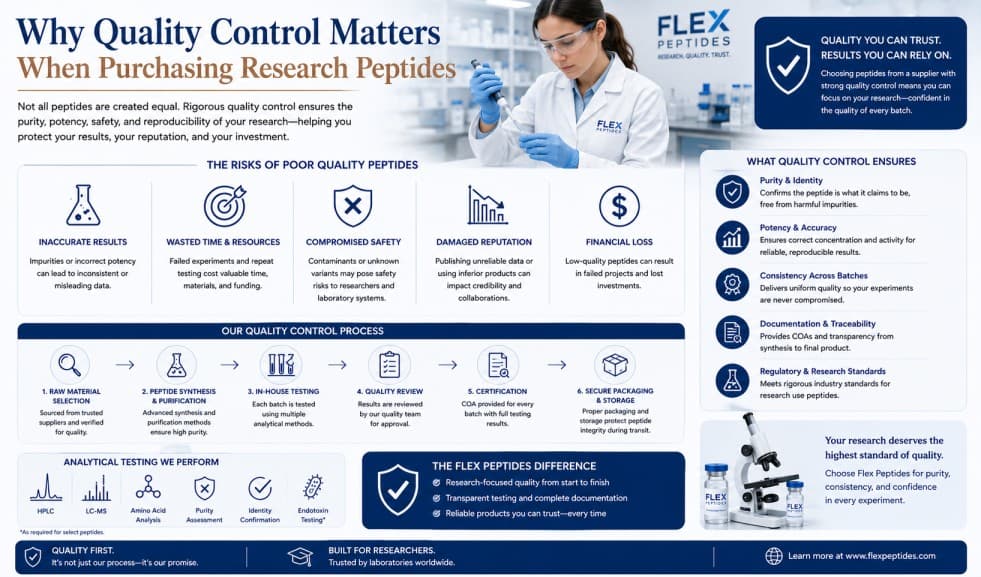
Quality control is essential when purchasing research peptides because it helps ensure product purity, identity, and consistency. Choosing a supplier that follows strict testing and transparent quality standards supports reliable research outcomes and confidence in every order.
For anyone purchasing research peptides in the UK — whether for academic study, preclinical investigation, or licensed clinical research — the question of quality control is not a secondary consideration. It is the primary one. The research peptide market in the United Kingdom spans a wide spectrum of suppliers, from highly rigorous domestic operations with full documentation and independent testing, to overseas vendors with minimal transparency and no verifiable quality standards.
Understanding why quality control matters — and what genuine quality control looks like — is essential for any UK researcher or institution making purchasing decisions in this market.
Purchasing peptides without verifiable quality documentation is not a cost-saving measure — it is a risk to your research, your institution, and in some contexts, the safety of your work.
What Can Go Wrong Without Quality Control?
The consequences of purchasing unverified or sub-standard research peptides are more serious than many buyers realise. Here is what peer-reviewed literature and industry experience tell us about the risks:
1. Incorrect Compound Identity
Without mass spectrometric confirmation of molecular weight and sequence identity, there is no guarantee that the compound in the vial matches the label. Studies have shown that a proportion of peptides sold through unverified channels contain incorrect compounds — sometimes entirely different peptides, sometimes synthetic analogues with different biological activity profiles.
2. Subthreshold Purity
A peptide listed as "research grade" by a supplier with no independent testing may be 85%, 80%, or even lower in purity. The remaining percentage may consist of truncated sequences, deleted peptides, improperly cleaved fragments, or residual synthesis chemicals. These impurities can interact with biological systems in unpredictable ways, producing confounded experimental data. A study designed around a 98% pure compound run with 85% pure material is, effectively, a different study.
3. Residual Solvent Contamination
Peptide synthesis involves multiple organic solvents. Without residual solvent testing, the presence of acetic acid, trifluoroacetic acid (TFA), dimethylformamide (DMF), and other solvents above safe thresholds cannot be excluded. These solvents can have their own biological effects — cytotoxicity, pH alteration, enzyme inhibition — that confound research results in ways that are extremely difficult to identify without knowing they are present.
4. Microbial Contamination
Lyophilised peptides stored or handled incorrectly can harbour bacterial, fungal, or yeast contamination. In cell culture studies, microbial contamination can devastate experimental results — sometimes destroying entire culture systems before the contamination is even identified. Without microbiological screening, there is no way to exclude this risk.
5. Degraded Product
Peptides stored at incorrect temperatures or exposed to light and moisture during transit can degrade significantly before they are used in research. Degraded material may appear visually identical to intact peptide while having substantially reduced or absent biological activity. Studies using degraded peptides generate null results that are falsely interpreted as negative biological findings.
The Financial Cost of Poor Quality Control
Many researchers initially gravitate toward cheaper peptide suppliers as a cost-saving measure. The economics of this decision rarely hold up under scrutiny. Consider the true costs of a failed experiment due to impure peptides: the cost of the peptides themselves, the cost of cells, culture media, reagents, and consumables used in the failed study, the cost of researcher time — often weeks or months, the cost of delayed publication or grant reporting, and in grant-funded research, the reputational cost of unproductive resource use.
In most scenarios, the savings from purchasing cheaper, unverified peptides are dramatically outweighed by the cost of a single failed study. High-quality, independently verified peptides from a trusted UK supplier are not a premium expense — they are the most cost-effective choice for serious research.
The average cost of a failed in vitro experiment in a UK academic research context, accounting for materials, time, and overhead, typically runs to hundreds of pounds. A single batch of high-quality peptides from a verified UK supplier costs a fraction of this. Quality control is the cheaper option.
What Does Genuine Quality Control Look Like?
When evaluating a UK peptide supplier, here is the quality control checklist that matters:
Quality Control Element
What to Look For
Red Flag
Certificate of Analysis
Batch-specific, from named independent lab
Generic, undated, or supplier-issued only
Purity Testing
HPLC with chromatographic data, 98%+
Purity stated without method or data
Identity Confirmation
Mass spectrometry with MW match
No MS data; sequence only stated on label
Solvent Testing
Residual solvent analysis included or available
Not mentioned or not available on request
Storage Standards
Cold storage (-20°C); cold chain dispatch
Standard courier, no temperature control stated
UK Base
Verified UK address, Companies House registration
Overseas dispatch; no verifiable UK presence
Research-Use Labelling
Clear "For Research Use Only" on all products
Therapeutic or supplement claims made
Customer Reviews
Consistent verified reviews on Trustpilot
No reviews, or sudden surge of identical reviews
The UK Regulatory Context
UK researchers should be aware that purchasing peptides for research is legal but subject to important constraints. Suppliers must not make unlicensed medicinal claims. Products sold for research must be clearly designated as such. The Human Medicines Regulations 2012 governs what can and cannot be marketed as a medicine. Responsible suppliers operate transparently within this framework — and quality control documentation is part of that transparency.
How Flex Peptides Meets This Standard
FlexPeptides.co.uk provides independent third-party COA documentation with every order, a minimum 98% purity guarantee confirmed by HPLC, mass spectrometry identity confirmation for all compounds, UK-based cold storage and cold-chain dispatch, clear research-use labelling on all products, no unlicensed medicinal claims, and full company transparency with UK registration. We believe that every researcher deserves this level of assurance — and we have[ built our supply chain to deliver it consistently.
Continue Reading
How Flex Peptides Maintains Premium Quality Standards | FlexPeptides
Inside Flex Peptides: Our Commitment to Quality and Consistency | FlexPeptides
Why Researchers Choose Flex Peptides | FlexPeptides
Best Place to Buy Peptides Online in the UK | FlexPeptides
How to Choose a Trusted Peptide Supplier in the UK | FlexPeptides
Disclaimer: All products sold by FlexPeptides.co.uk are for research and laboratory use only. Not licensed medicines. Must not be used for human administration. Always seek qualified professional advice for clinical or therapeutic applications.