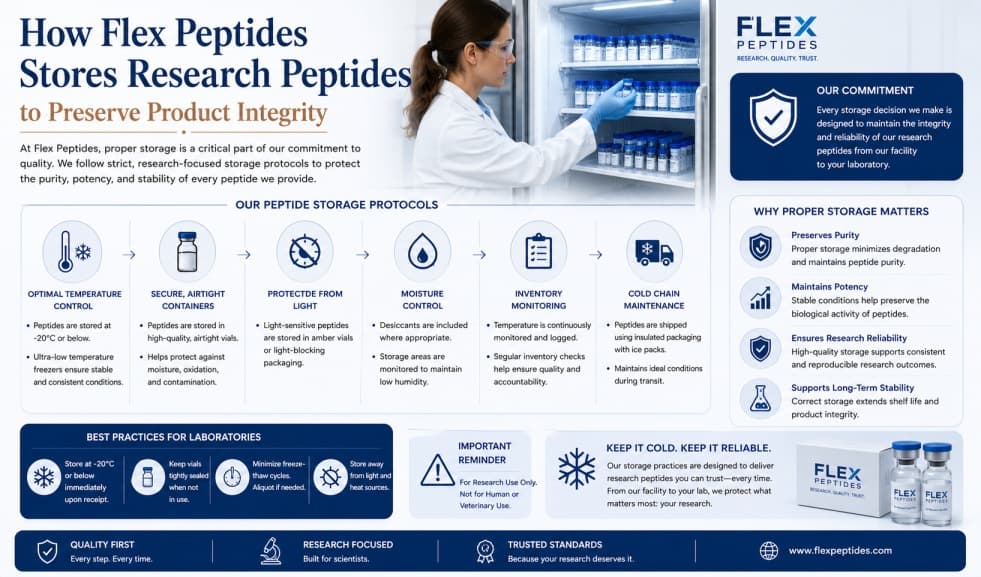
Learn how Flex Peptides stores research peptides under carefully controlled conditions to help preserve purity, stability, and product integrity. Discover the storage practices designed to maintain consistent quality from production through delivery to research laboratories.
Peptide storage is one of the most consequential — and most frequently overlooked — factors in research peptide quality. A compound that leaves its manufacturer at 99% purity can arrive at a research facility in significantly degraded condition if it has been stored or transported incorrectly. At Flex Peptides, our storage protocols are as rigorous as our testing standards, because we understand that quality must be preserved all the way from synthesis to your laboratory.
This article explains precisely how Flex Peptides stores research peptides at our UK facility, what conditions we maintain, and why these standards matter for the validity of your research.
Peptide degradation is cumulative and often invisible. A peptide can lose biological activity through temperature fluctuations, moisture exposure, or oxidation without any visible change in appearance. Rigorous storage protocols are the only reliable protection.
Why Peptide Storage Is a Scientific Issue, Not Just a Logistics One
Research peptides are chemically sensitive compounds. Unlike many laboratory chemicals, peptides are susceptible to degradation through multiple pathways simultaneously: hydrolysis (peptide bond cleavage by water), oxidation (particularly of methionine, cysteine, and tryptophan residues), aggregation (peptide chains clumping together, reducing bioavailability), and racemisation (amino acid stereocentres converting from L- to D-configuration, altering biological activity). Temperature is the single most important variable controlling the rate of all these processes. Even small deviations above optimal storage temperature can meaningfully accelerate degradation — which is why our storage protocols do not tolerate approximations.
Our UK Cold Storage Facility
All research peptides held by Flex Peptides are stored in our dedicated UK-based cold storage facility. Key features of our storage infrastructure include:
1. Continuous -20°C storage for all lyophilised research peptides — maintained by dedicated laboratory-grade freezer systems, not standard commercial freezers
2. Temperature monitoring with automated alerts — our systems flag any deviation from target temperature in real time, allowing immediate corrective action
3.Backup power continuity — our storage systems are protected against power interruptions that could cause temperature excursions
4.Light-controlled environment — storage areas are designed to minimise UV and visible light exposure, which can degrade photosensitive peptide compounds
5. Humidity-controlled atmosphere — lyophilised peptides are extremely sensitive to moisture; our storage environment maintains low relative humidity to prevent moisture ingress through vial closures
6. Separate storage zones — products are segregated by compound class, temperature requirement, and batch to prevent cross-contamination and facilitate precise stock management
Packaging That Protects at the Point of Storage
The vials in which we store peptides are as important as the temperature at which they are kept. Flex Peptides uses borosilicate glass vials with pharmaceutical-grade rubber stoppers for all lyophilised peptide storage. Borosilicate glass is chemically inert, preventing any interaction between the peptide and the container. Rubber stoppers create an airtight seal that prevents oxygen and moisture from entering the vial during storage. Aluminium crimp seals provide tamper-evidence and additional protection against the seal loosening over time. Where compounds are particularly light-sensitive, amber vials are used as standard rather than clear glass.
Cold Chain Management: From Storage to Your Door
Maintaining peptide integrity during dispatch is as important as storage. Flex Peptides operates a full cold chain dispatch protocol for temperature-sensitive compounds. This includes:
1. Temperature-Controlled Picking
Orders are picked from cold storage immediately before packing — products are not left at ambient temperature in a packing area while other orders are processed.
2. Insulated Dispatch Packaging
All peptide orders are packed in insulated boxes with appropriate thermal mass — ice packs or dry ice where required — to maintain temperature throughout UK transit.
3. Expedited UK Dispatch
We use fast UK courier services to minimise the time products spend in transit. Shorter transit time means less thermal stress, regardless of insulation quality.
4. Clear Handling Instructions
Every order includes clear instructions for storage on receipt, so researchers know immediately what to do when their order arrives.
What Happens if Storage Conditions Are Compromised?
Despite our best efforts, unforeseen events — courier delays, extreme weather, power disruptions — can occasionally threaten storage conditions. Our policy is straightforward: if we have any reason to believe a product's integrity has been compromised during storage or transit, we do not dispatch it or, where the issue is identified post-dispatch, we replace the order at no charge. We would rather absorb a commercial cost than have a researcher conduct a study with degraded material.
Compound-Specific Storage Requirements We Accommodate
Different peptides have different stability profiles, and our storage protocols reflect this:
Compound Type
Storage Temperature
Special Considerations
Standard lyophilised peptides (BPC-157, TB-500, CJC-1295)
-20°C
Amber or clear glass, desiccant sealed
Copper complexes (GHK-Cu)
-20°C
Protect from oxidising conditions; no chelating agent contact
Metabolic peptides (Tirzepatide, Retatrutide)
-20°C
Extended cold chain dispatch; avoid freeze-thaw
Disulphide-bond containing peptides
-20°C
Inert atmosphere preferred; oxidation risk managed
Reconstituted solutions (where supplied)
4°C or -20°C
Single-use aliquots; short shelf life after reconstitution
What UK Researchers Should Do on Receipt
To maintain the integrity we have worked to preserve, we recommend that all peptides are transferred to appropriate storage conditions immediately on receipt, inspected for any signs of transit damage to packaging, stored at the temperature specified on the product label and COA, and reconstituted only as needed for immediate research use rather than in bulk.
Our product documentation includes compound-specific storage guidance, and our technical team is available to advise on reconstitution [and handling questions for any compound we supply.
Continue Reading
How Flex Peptides Maintains Premium Quality Standards | FlexPeptides
Why Quality Control Matters When Purchasing Research Peptides | FlexPeptides
How Every Order Is Carefully Prepared and Packaged | FlexPeptides
GHK-Cu Storage Guide | FlexPeptides
Disclaimer: All products are sold by FlexPeptides.co.uk for research and laboratory use only. Not for human administration. Storage guidance is provided for research integrity purposes and does not constitute clinical or medical advice.