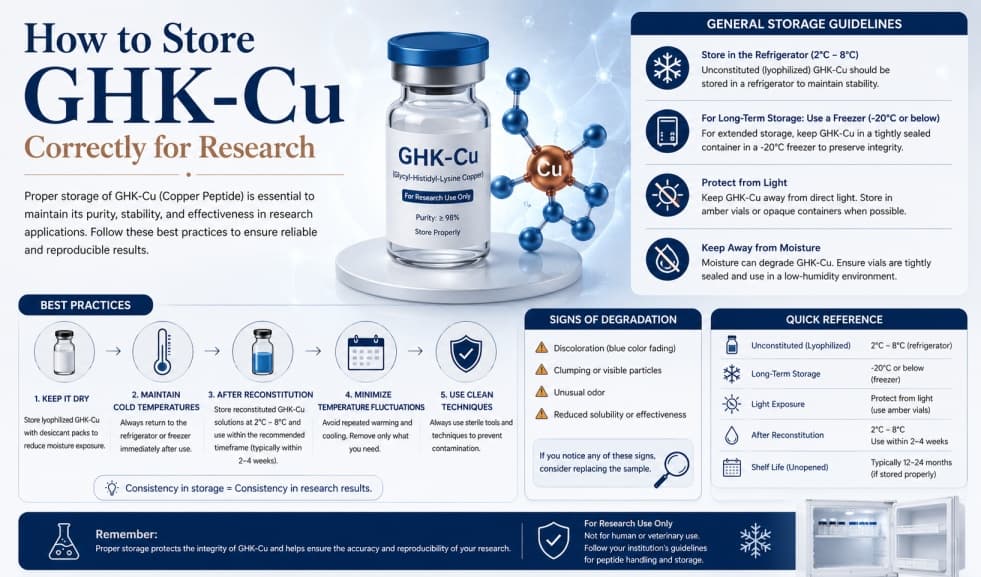
Proper storage is essential to maintain the stability and integrity of GHK-Cu for research. Learn recommended storage conditions, handling practices, and tips to help preserve peptide quality and ensure consistent, reliable laboratory research results.
Correct storage of research peptides is essential for maintaining their structural integrity, biological activity, and research validity. GHK-Cu — as a copper-complexed tripeptide — has specific storage requirements that differ in some respects from larger synthetic peptides. Improper storage can lead to copper dissociation, peptide degradation, and loss of the biological activity that makes GHK-Cu scientifically valuable.
This guide provides UK researchers with clear, technically accurate guidance on storing GHK-Cu in both its lyophilised and reconstituted forms.
Always consult the Certificate of Analysis and product documentation supplied with your GHK-Cu batch. Specific guidance may vary by batch formulation and supplier. The information below represents general best practice for research-grade lyophilised copper peptides.
Understanding GHK-Cu's Chemical Stability
GHK-Cu can be destabilised by factors that disrupt the coordination bond between the GHK peptide and the Cu(II) ion. These include:
1.Extremes of pH — both highly acidic and highly alkaline conditions can promote copper dissociation
2.Oxidative conditions — which may alter the copper oxidation state from Cu(II) to Cu(I)
3.High temperatures — which accelerate both peptide hydrolysis and copper dissociation
4.Light exposure — particularly UV, which can drive photochemical degradation
5.Repeated freeze- thaw cycling of reconstituted solutions
Storing Lyophilised GHK-Cu Powder
Preferred Storage Conditions
Temperature: -20°C (standard laboratory freezer) for long-term storage of 12 months or more. Short-term storage of up to 4 weeks at 4°C is acceptable if the vial remains sealed and desiccated.
Light: Store in amber vials or opaque packaging, away from direct light. UV exposure should be avoided entirely.
Humidity: Keep vials tightly sealed with the original closure. Store in the presence of a desiccant (silica gel) to prevent moisture ingress.
Container: Borosilicate glass vials with rubber stoppers are preferred. Avoid extended contact with reactive metals or low-grade plastics.
What to Avoid
Do not store lyophilised GHK-Cu at room temperature for extended periods
Do not expose to direct light — photodegradation can occur even through standard clear glass
Do not repeatedly open and reseal vials if the powder is unused
Do not store near strong oxidising agents or acidic/alkaline compounds
Reconstituting GHK-Cu for Research Use
Choosing the Right Solvent
GHK-Cu is water-soluble and dissolves readily in aqueous solvents. The following solvents are commonly used:
1.Sterile water (distilled or deionised) — the simplest option; produces a clear solution at research-relevant concentrations
2.Bacteriostatic water (0.9% benzyl alcohol) — preferred if the reconstituted solution will be stored for days to weeks
3.Phosphate-buffered saline (PBS, pH 7.4) — useful where buffer composition needs to match physiological conditions
Avoid highly acidic (pH < 4) or highly alkaline (pH > 9) solvents. Avoid solvents containing chelating agents such as EDTA, which will strip copper from the GHK complex.
Reconstitution Procedure
Allow the lyophilised vial to equilibrate to room temperature before opening, to prevent condensation from entering the vial
Prepare the chosen solvent at room temperature
Add solvent slowly and gently to the powder — do not vortex vigorously; gentle swirling is preferred
Allow the solution to dissolve fully before use
Inspect for clarity — a properly reconstituted GHK-Cu solution should be clear or very slightly blue-tinted due to the copper complex
Storing Reconstituted GHK-Cu Solution
Short-term (up to 2 weeks): 4°C in the dark, in a sealed borosilicate glass vial. Minimise vial openings.
Medium-term (2 weeks to 3 months): Aliquot into single-use volumes before freezing at -20°C to avoid repeated freeze-thaw cycles.
Avoid: -80°C for routine storage of copper peptides — mechanical stress of ultra-low-temperature storage can affect the copper complex in some formulations.
Avoiding Freeze-Thaw Degradation
Best practice for UK researchers working with GHK-Cu solution is to aliquot into volumes representing a single research session before freezing, label each aliquot with date, batch number, and concentration, and discard any aliquot that has been thawed and not used within a single research session rather than re-freezing.
Quick Reference Storage Summary
Form Temperature Duration Light Key Risk
Lyophilised powder -20°C 12+ months Protect Moisture
(sealed) ingress
Lyophilised powder 4°C Up to 4 weeks Protect Humidity
(short-term)
Reconstituted 4°C Up to 2 weeks Dark Microbial
solution growth
Reconstituted -20°C Up to 3 months Dark Freeze-thaw
(aliquoted, frozen) cycling
FlexPeptides.co.uk dispatches GHK-Cu in appropriate insulated packaging to maintain peptide stability during UK transit. Each order includes storage guidance specific to the supplied batch.
Continue Reading
What Is GHK-Cu? A Complete Guide to Copper Peptides | FlexPeptides
GHK-Cu Explained: Why Researchers Are Interested | FlexPeptides
GHK-Cu FAQs: Everything You Need to Know | FlexPeptides
Disclaimer: Storage guidance is for research purposes only. GHK-Cu products from FlexPeptides.co.uk are not medicines and must not be used for human administration. Always consult product documentation and relevant regulatory requirements.