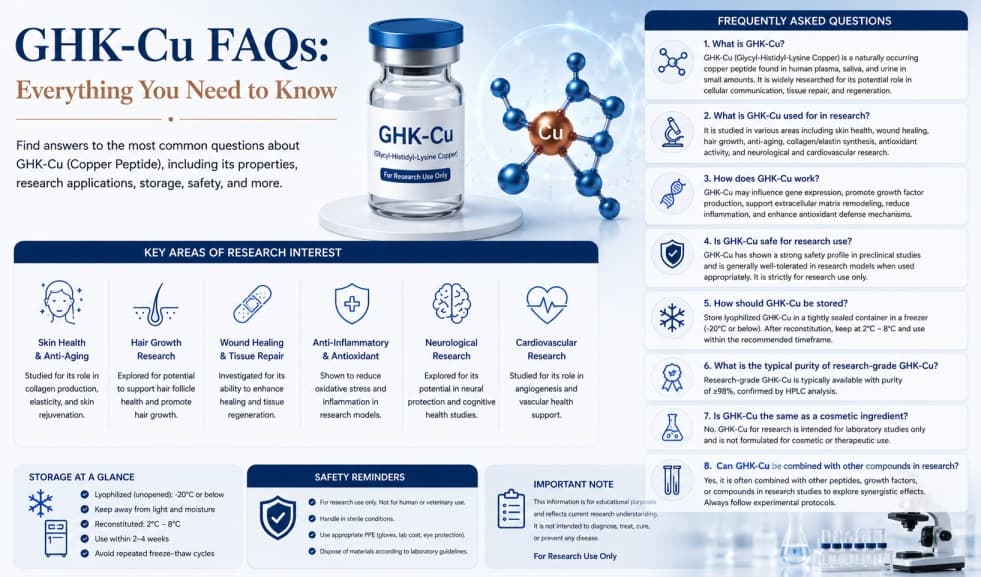
Find answers to the most common questions about GHK-Cu, including its structure, research applications, storage, handling, and purchasing considerations. This FAQ guide provides clear, research-focused information for scientists and laboratory researchers.
GHK-Cu is one of the most researched yet frequently misunderstood peptides in the UK market. This FAQ article addresses the most common questions about GHK-Cu — what it is, how to source it, how it works, and what UK buyers need to know.
About GHK-Cu
Q: What does GHK-Cu stand for?
GHK-Cu is the abbreviation for glycyl-L-histidyl-L-lysine copper complex. GHK refers to the three amino acids in the tripeptide — glycine (G), histidine (H), and lysine (K) — and Cu is the chemical symbol for copper (from the Latin 'cuprum'). The complex is formed when the GHK tripeptide coordinates with a copper(II) ion.
Q: Is GHK-Cu natural or synthetic?
GHK is naturally occurring — it is found in human blood plasma, saliva, and urine. The copper complex GHK-Cu forms naturally in the body when free GHK binds to available copper ions. Research-grade GHK-Cu used in laboratory studies is synthetically produced to match the naturally occurring copper complex, allowing researchers to work with consistent, well-characterised material.
Q: What is GHK-Cu used for in research?
GHK-Cu is used in research investigating wound healing and tissue repair, collagen and extracellular matrix synthesis, anti-inflammatory and antioxidant biology, gene expression modulation, age-related tissue deterioration, angiogenesis, neuroprotection, and stem cell biology. It is not used for metabolic research (unlike GLP-1 agonists) or growth hormone axis research (unlike GH secretagogues). Its research domain is primarily tissue biology, repair, and ageing.
Q: How is GHK-Cu different from BPC-157?
GHK-Cu and BPC-157 are both researched in tissue repair contexts but are mechanistically distinct. BPC-157 is a synthetic peptide studied primarily for musculoskeletal and gastrointestinal repair via nitric oxide and angiogenic pathways is a naturally derived copper complex studied for skin biology, collagen synthesis, gene expression modulation, and broad tissue repair. They are complementary tools for different research questions, not interchangeable compounds.
Q: What is the difference between GHK and GHK-Cu?
GHK is the tripeptide alone — glycyl-L-histidyl-L-lysine without copper. GHK-Cu is GHK coordinated with a copper(II) ion. Research consistently shows that GHK-Cu exhibits substantially greater biological activity than GHK alone in most assays. For rigorous research purposes, GHK-Cu — the copper complex — is the correct and scientifically established form. Cosmetic products sometimes contain GHK without copper coordination, which is a different compound from a research perspective.
Sourcing and Quality
Q: Is GHK-Cu legal to buy in the UK?
Yes, GHK-Cu is legal to purchase in the UK for research and laboratory purposes. It is not a controlled substance under the Misuse of Drugs Act 1971 and does not require a prescription. It is not, however, a licensed medicine — it cannot be sold with therapeutic or medicinal claims for human use under the Human Medicines Regulations 2012. UK suppliers must designate it as a research compound for research use only.
Q: What purity should research-grade GHK-Cu be?
For rigorous research applications, GHK-Cu purity of 98% or above is the accepted benchmark. This figure should be confirmed by an independent third-party Certificate of Analysis (COA) — not just a supplier's internal claim. The COA should specify the analytical method used (typically HPLC with mass spectrometric confirmation), the purity result, and the batch or lot number.
Q: What should I look for in a GHK-Cu COA?
A credible GHK-Cu Certificate of Analysis should include:
- Compound name — GHK-Cu or glycyl-L-histidyl-L-lysine copper complex
- CAS number — 49557-75-7
- Molecular formula — C14H23CuN6O4
- Purity result — 98%+ by HPLC
- Confirmation of copper coordination
- Batch or lot number
- Date of analysis
- Name and accreditation of the issuing laboratory
Q: Can I buy GHK-Cu from a UK supplier?
Yes. FlexPeptides.co.uk is a UK-based supplier of research-grade GHK-Cu. We stock the full copper complex form — GHK-Cu, not GHK alone — verified by independent third-party COA with purity at 98%+. All products are clearly designated for research use only, dispatched from the UK with appropriate packaging, and supplied with full technical documentation.
Q: Why is some GHK-Cu much cheaper than other suppliers?
Price variation in the GHK-Cu market typically reflects differences in purity, synthesis quality, testing standards, and supplier location. Very low prices often indicate material sourced from manufacturers with lower quality control standards, missing or inadequate COA documentation, purity below the research-grade 98% benchmark, or the absence of copper coordination — i.e., GHK without the copper complex. Always verify the COA before purchasing.
Storage and Handling
Q: How should I store GHK-Cu powder?
Lyophilised GHK-Cu powder should be stored at -20°C for long-term storage (12+ months) or at 4°C for short-term storage (up to 4 weeks). Keep vials sealed, protected from light, and stored with a desiccant to prevent moisture ingress. Do not store near oxidising agents or chelating chemicals such as EDTA.
Q: How do I reconstitute GHK-Cu?
GHK-Cu powder reconstitutes readily in sterile water, bacteriostatic water, or PBS (pH 7.4). Add solvent slowly with gentle swirling — avoid vigorous vortexing. Do not use highly acidic or alkaline solvents, and avoid chelating agents (EDTA, citrate), which will strip the copper from the complex. A properly reconstituted GHK-Cu solution should be clear to very slightly blue-tinted.
Q: How long does reconstituted GHK-Cu solution last?
Reconstituted GHK-Cu solution is stable for up to 2 weeks at 4°C in the dark, or up to 3 months at -20°C if aliquoted and stored in single-use volumes to avoid freeze-thaw cycling. Aliquoting before freezing is strongly recommended. Discard any aliquot that has been thawed and not used within a research session — do not refreeze thawed solution.
Research and Safety
Q: Is GHK-Cu safe for research use?
GHK-Cu has demonstrated a generally favourable safety profile in preclinical research at physiologically relevant concentrations. No significant toxicity has been reported at these concentrations in the published literature. However, preclinical safety data does not automatically translate to human safety, and all research use should be conducted within appropriate ethical frameworks and institutional oversight.
Q: What research disciplines find GHK-Cu most useful?
GHK-Cu is most actively used in dermatology and skin biology research, wound healing and regenerative medicine, gerontology and ageing biology, molecular biology (gene expression studies), neuroscience (neuroprotection and neuroinflammation), and inflammation biology. It is not typically used in metabolic, hormonal, or musculoskeletal-specific research, where other compounds are more appropriate.
Q: Where can I find peer-reviewed research on GHK-Cu?
PubMed (pubmed.ncbi.nlm.nih.gov) is the primary source for peer-reviewed GHK-Cu literature. Search 'GHK-Cu', 'GHK copper peptide', or 'glycyl-histidyl-lysine copper'. Key contributors include Dr Loren Pickart, who has published extensively on GHK-Cu since its discovery in 1973. Google Scholar also provides access to the broader citation network.
Continue Reading
What Is GHK-Cu? A Complete Guide to Copper Peptides | FlexPeptides
GHK-Cu Explained: Why Researchers Are Interested | FlexPeptides
How to Store GHK-Cu Correctly for Research | FlexPeptides
GHK-Cu vs Other Research Peptides: What's the Difference? | FlexPeptides
The Science Behind GHK-Cu: An Introduction for Researchers | FlexPeptides
Disclaimer: All GHK-Cu products sold by FlexPeptides.co.uk are for research and laboratory use only. They are not licensed medicines and must not be used for human administration outside of appropriately authorised clinical or research settings. Always consult a qualified medical professional for clinical enquiries.