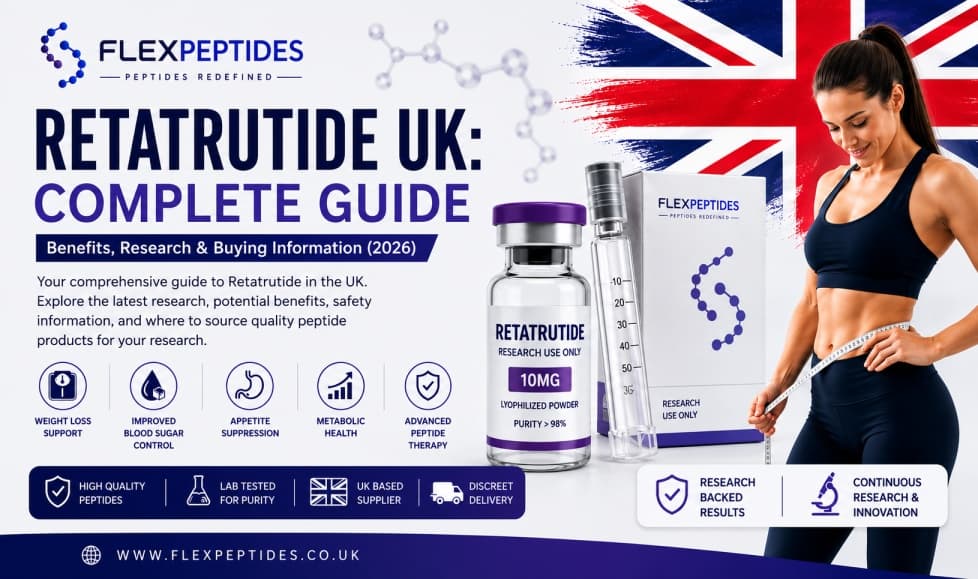
Discover everything you need to know about Retatrutide in the UK, including its research-backed benefits, weight management potential, safety information, and buying considerations for 2026.
Retatrutide is one of the most talked-about research compounds in the peptide space right now. As a triple receptor agonist — simultaneously targeting GLP-1, GIP, and glucagon (GCG) receptors — it represents a significant step beyond the dual-agonist mechanisms of tirzepatide and the single-agonist approach of semaglutide.
In the United Kingdom, interest in retatrutide has grown rapidly among researchers studying metabolic disease, obesity, and cardiometabolic risk. This comprehensive guide covers everything UK buyers and researchers need to know about retatrutide in 2026: its mechanism of action, current research landscape, how it compares to other peptides in its class, its legal status in the UK, and how to source it responsibly.
⚠️ Retatrutide is a research compound. It is not approved by the MHRA as a licensed medicine in the UK. All information in this guide is provided for educational and research purposes only. It must not be used for human administration outside of properly authorised clinical contexts.
What Is Retatrutide?
Retatrutide (also known by its development code LY3437943) is a synthetic peptide developed by Eli Lilly and Company. It is a triple incretin receptor agonist, meaning it activates three distinct hormone receptors simultaneously:
•GLP-1 receptor (glucagon-like peptide-1) — involved in insulin secretion, appetite suppression, and gastric emptying
•GIP receptor (glucose-dependent insulinotropic polypeptide) — involved in fat storage, insulin response, and energy balance
•GCG receptor (glucagon receptor) — involved in energy expenditure and hepatic glucose regulation
This triple-action mechanism is what distinguishes retatrutide from its predecessors. Tirzepatide acts on GLP-1 and GIP; semaglutide acts on GLP-1 alone. Retatrutide adds glucagon receptor activation to the profile, which theoretically enhances energy expenditure and lipid oxidation beyond what dual agonism achieves.
Retatrutide Mechanism of Action
GLP-1 Receptor Agonism
The GLP-1 pathway is now well-established in metabolic research. Activation slows gastric emptying (creating satiety), stimulates glucose-dependent insulin secretion, suppresses glucagon secretion, and reduces appetite via central nervous system pathways. This is the mechanism shared with semaglutide and tirzepatide.
GIP Receptor Agonism
GIP receptor activation, added by tirzepatide and retained in retatrutide, enhances the insulin response, improves beta-cell function, and appears to synergise with GLP-1 effects on body weight. Research also suggests GIP receptor activity may reduce the gastrointestinal side effects associated with GLP-1 agonism alone.
Glucagon Receptor Agonism
The third and differentiating component of retatrutide is glucagon receptor agonism. Glucagon is traditionally understood as a counter-regulatory hormone that raises blood glucose — seemingly counterproductive in metabolic research. However, at the right level of activation in combination with GLP-1 agonism, glucagon receptor stimulation has been shown in preclinical and early clinical research to increase energy expenditure, enhance fat oxidation, and reduce hepatic lipid accumulation. This is the mechanism hypothesised to drive retatrutide's potentially superior weight-reduction profile compared to dual agonists.
Retatrutide Research: 2026 Overview
The most significant clinical data on retatrutide comes from a Phase 2 trial published in the New England Journal of Medicine in 2023. The randomised, double-blind, placebo-controlled trial evaluated multiple doses of retatrutide against placebo in adults with obesity. Key findings included substantial mean body weight reductions at 24 and 48 weeks that exceeded what had been previously observed with GLP-1 or GLP-1/GIP agonists in equivalent timeframes, significant reductions in fasting blood glucose and insulin levels, and a dose-dependent response, with the higher-dose groups achieving the most pronounced outcomes.
Phase 3 trials under the TRIUMPH programme were initiated following these results, with multiple ongoing studies across diverse populations including those with obesity, type 2 diabetes, and non-alcoholic steatohepatitis (NASH). As of mid-2026, full Phase 3 data is expected to become available in stages, with regulatory submissions anticipated in major markets. The MHRA in the UK has not yet received or approved a regulatory dossier for retatrutide.
ℹ️ As of 2026, retatrutide does not have MHRA approval in the UK as a licensed medicine. It remains an investigational compound in clinical development.
Retatrutide vs the Competition: A Summary
Understanding where retatrutide sits relative to other metabolic research peptides is important for UK researchers designing studies or evaluating the research landscape.
Compound Receptors Phase (2026) Research Focus
Semaglutide GLP-1 Approved (UK) T2D, obesity
Tirzepatide GLP-1 + GIP Approved (UK) T2D, obesity
Retatrutide GLP-1 + GIP + GCG Phase 3 Obesity, NASH, T2D
Mazdutide GLP-1 + GCG Phase 3 Obesity, NAFLD
Dedicated comparison articles are available in our supporting blog series — see the internal links section below.
Potential Research Applications of Retatrutide
Obesity and Body Composition Research
The most active research area for retatrutide is obesity pharmacology. Researchers are studying its dose-response characteristics, durability of effect, and comparative performance against established compounds. Its triple agonism makes it particularly useful for studies aiming to understand the relative contributions of each receptor pathway to metabolic outcomes.
Type 2 Diabetes Research
Retatrutide's multi-receptor profile makes it a relevant subject for studies on glycaemic control, insulin sensitivity, and beta-cell preservation. The glucagon receptor component is of particular interest in the context of glucose metabolism research, as it adds a layer of complexity not present in approved
GLP-1 drugs.
Hepatic Research (NASH/NAFLD)
Non-alcoholic steatohepatitis and fatty liver disease represent a growing area of unmet clinical need. Early data suggests that retatrutide's combination of lipid-lowering and anti-inflammatory mechanisms — driven partly by the glucagon receptor pathway — may make it a useful tool in hepatic disease research.
Cardiovascular Research
GLP-1 agonists have demonstrated cardiovascular benefits in large outcome trials. Whether retatrutide confers additional benefit through its GIP and GCG components is a key research question. Dedicated cardiovascular outcome research is ongoing as part of the broader development programme.
Legal Status of Retatrutide in the UK
In the UK, retatrutide is not a controlled substance under the Misuse of Drugs Act 1971. It does not currently have MHRA marketing authorisation and is therefore not a licensed medicine. It may not be sold or marketed with therapeutic or medicinal claims for human use.
Retatrutide sold as a research compound must be designated 'For Research Use Only — Not for Human Consumption.' UK suppliers providing it for legitimate research purposes do so within this framework.
Researchers working with retatrutide in a clinical or laboratory context should ensure they have appropriate ethical approvals, institutional oversight, and, where applicable, MHRA/HRA authorisation.
⚠️ UK buyers should always verify the legal status of research compounds with a qualified solicitor or healthcare professional before purchasing or using them in any context.
What to Look For When Buying Retatrutide in the UK
Given retatrutide's growing profile, it is essential that UK buyers source it with care. The following checklist applies:
1.Certificate of Analysis from an independent third-party laboratory confirming purity (98%+) and sequence identity
2.Batch-specific documentation traceable to the synthesis lot
3.UK-based supplier with verifiable Companies House registration
4.Clear research-use-only labelling and no unlicensed medicinal claims
5.Appropriate cold-chain storage and dispatch procedures
6.Accessible and knowledgeable customer support
Sourcing Retatrutide for Research in the UK
FlexPeptides.co.uk supplies retatrutide as a research peptide to qualified UK researchers and licensed professionals. Every batch is independently tested and supplied with a Certificate of Analysis. Our UK-based dispatch ensures fast, reliable delivery with appropriate packaging for peptide stability.
We maintain full compliance with UK trading standards and operate with clear research-use designations across all product listings. Our team can answer technical questions about our retatrutide stock, documentation, and storage requirements.
Further Reading: Supporting Articles
→ Retatrutide Research: Current Scientific Interest in 2026 | FlexPeptides
→ Retatrutide vs Semaglutide: Key Differences Explained | FlexPeptides
→ Retatrutide vs Tirzepatide: Which Research Peptide Is More Popular? | FlexPeptides
→ Retatrutide vs Other Metabolic Research Peptides | FlexPeptides
Related FlexPeptides Resources
→ Best Weight Loss Peptides Available in the UK | FlexPeptides
→ Legal Peptides in the UK: Regulations Explained | FlexPeptides
→ Peptides for Sale in the UK: What Buyers Should Know | FlexPeptides
Disclaimer: Retatrutide sold by FlexPeptides.co.uk is for research and laboratory use only. It is not an MHRA-approved medicine and must not be used for human administration outside of properly authorised clinical or research settings.