Discover what GHK-Cu (Copper Peptide) is, how it works, and why it has become a popular research peptide. This guide explores its structure, potential applications in skin and hair research, regenerative properties, and key considerations for researchers. Learn the latest insights into GHK-Cu and its growing role in peptide-based scientific studies.
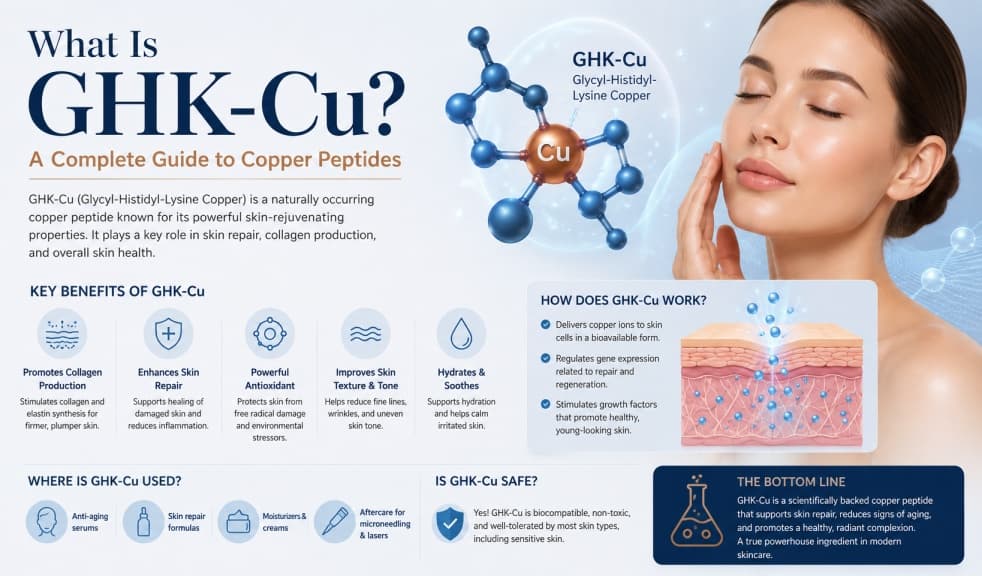
GHK-Cu is the copper complex of the tripeptide GHK (glycyl-L-histidyl-L-lysine) — a compound that occurs naturally in human plasma, saliva, and urine, and was first isolated by Dr. Loren Pickart in 1973. It has since become one of the most widely studied peptides in tissue-repair and dermal research, and one of the most frequently misunderstood, because the same three letters describe both a research-grade laboratory compound and a much lower-grade cosmetic ingredient. This guide covers the research side.
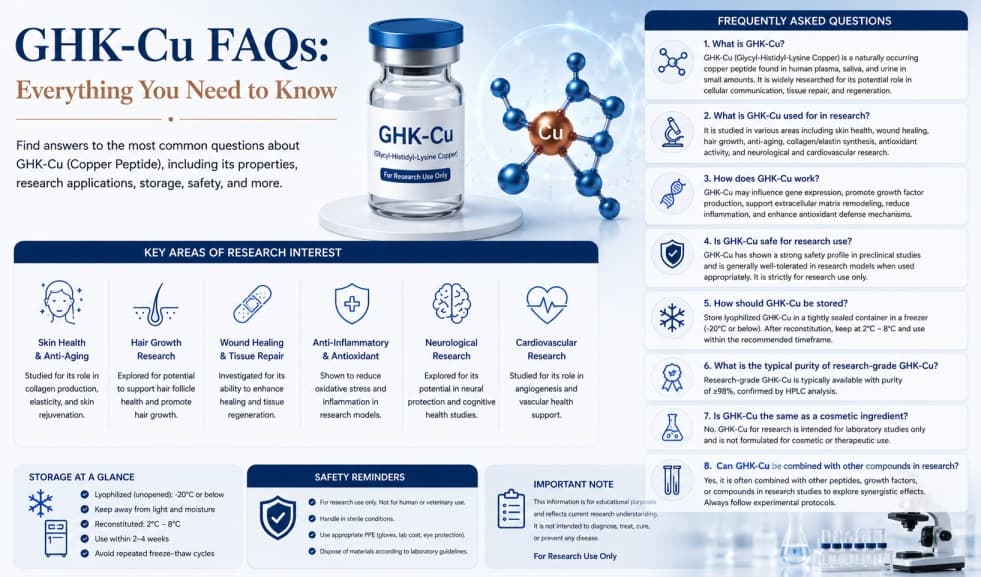
In short: GHK-Cu is a copper-complexed tripeptide (C₁₄H₂₃CuN₆O₄, MW 403.9 g/mol, CAS 49557-75-7) studied for its roles in collagen synthesis, wound-healing research, anti-inflammatory activity, and — per a 2017 bioinformatics analysis — modulation of over 4,000 human genes. Research-grade material should come with a batch-specific COA at 98%+ purity, verified by HPLC and mass spectrometry.
The role of copper in GHK-Cu
Copper is an essential trace element that supports enzymatic activity and connective-tissue synthesis throughout the body — but within GHK-Cu specifically, copper appears to be structurally integral to the molecule's activity, not just a supporting mineral. Published research indicates that free GHK (without the copper complex) shows substantially reduced biological activity compared to GHK-Cu, which is why nearly all serious research literature on this peptide studies the copper-complexed form rather than GHK alone.
Natural occurrence, and why it declines with age
Plasma GHK-Cu concentrations in young adults run around 200 ng/mL. By age 60 and beyond, that typically falls below 80 ng/mL. This age-related decline is part of what drives research interest in the compound — researchers have hypothesised a connection between falling GHK-Cu levels and the reduced tissue-repair and inflammatory-regulation capacity associated with ageing, though this remains an active area of study rather than settled science.
What the research covers
Wound healing and tissue repair. Preclinical studies have documented GHK-Cu's effects on collagen synthesis, angiogenesis (new blood vessel formation), and reduction of oxidative damage at wound sites.
Collagen and extracellular matrix modulation. In-vitro research has shown increases in fibroblast proliferation and in the production of structural proteins that make up the extracellular matrix.
Anti-inflammatory activity. Research has demonstrated modulation of inflammatory cytokines, with particular attention to TNF-alpha reduction.
Gene expression. A 2017 bioinformatics analysis found that GHK-Cu appeared to modulate the expression of more than 4,000 human genes, spanning pathways involved in metabolism, DNA repair, and nervous-system function — one of the more striking findings in the GHK-Cu literature, and a large part of why it continues to attract broad research interest well beyond dermatology.
Nervous system and neuroprotection. Emerging preclinical work is exploring neuroprotective potential and modulation of nerve growth factor, though this is an earlier-stage area than the wound-healing literature.
GHK-Cu vs. GHK: why the distinction matters
If you're designing a study, be precise about which form you mean. GHK-Cu (copper-complexed) is what almost all of the published research above refers to, and it's the form with demonstrated biological activity in the literature. Plain GHK, without the copper complex, is a different research subject with a much thinner evidence base.
Research forms available in the UK
- Lyophilised (freeze-dried) powder — the standard form for maximum shelf stability before reconstitution.
- Pre-made solution in bacteriostatic water or an equivalent buffer, for labs that prefer to skip the reconstitution step.
Storage and handling
Store lyophilised GHK-Cu at –20°C or below, protected from light, heat, and moisture until you're ready to reconstitute it. Once reconstituted, stability is time-limited — check the storage window stated on your batch's Certificate of Analysis rather than assuming a generic timeframe, since it can vary by formulation and reconstitution solvent.
Legal status in the UK
GHK-Cu is not controlled under the Misuse of Drugs Act 1971, and it does not hold MHRA licensing as a medicine. It's supplied and sold under a research-use-only designation, which is a distinct legal category from cosmetic-grade GHK-Cu formulated for topical consumer products — the two should not be conflated, and a supplier that doesn't clearly separate them in their labelling is a signal worth noticing.
Sourcing GHK-Cu for UK research
Look for the same criteria that apply to any research peptide: independent batch-specific testing confirming 98%+ purity via HPLC and mass spectrometry, UK-based dispatch, and full technical documentation (molecular formula, sequence, CAS number, storage conditions) published on the product listing itself — not just available on request. See our full supplier checklist for the complete vetting process.
Frequently asked questions
Is GHK-Cu the same as GHK?
No. GHK-Cu is the copper-complexed form of the tripeptide GHK, and the research literature indicates the copper complex is substantially more biologically active than GHK alone — most published studies are studying GHK-Cu specifically, not GHK.
What purity should I expect from a research-grade supplier?
99% or higher, independently verified via HPLC and mass spectrometry, and documented per batch — not a single generic reference COA reused across production runs.
Is research-grade GHK-Cu the same as what's used in cosmetics?
No. Cosmetic-grade GHK-Cu is formulated for topical consumer products under a completely different regulatory pathway. Research-grade material sold for laboratory use carries its own documentation and purity standards, and the two shouldn't be treated as interchangeable.
Should I order the 50mg or 100mg size?
That depends on the concentration and volume your protocol requires, not on price per milligram alone — check the COA for each size rather than assuming the two are identical beyond dose.
Related reading
How to Choose a Trusted Peptide Supplier in the UK
GHK-Cu vs. GLOW Blend: A Comparative Overview
Understanding Certificates of Analysis (COAs)