Compare GHK-Cu with other popular research peptides and explore how they differ in structure, research focus, and laboratory applications. This guide highlights the unique characteristics of GHK-Cu and its role in ongoing scientific research.
The UK research peptide market offers a broad range of compounds, each with distinct mechanisms, research applications, and scientific histories. GHK-Cu occupies a unique position in this landscape — as a naturally occurring copper complex with a well-established research literature, it differs meaningfully from the synthetic growth hormone peptides, tissue repair compounds, and metabolic agonists that make up the bulk of the UK research peptide market.
This article positions GHK-Cu against the most commonly researched peptide compounds available in the UK, helping researchers understand where it fits, where it overlaps, and where it diverges from other tools in the research toolkit.
The Key Distinguishing Feature of GHK-Cu
GHK-Cu's single most important distinguishing feature is that it is a naturally occurring copper complex, not a purely synthetic research molecule. GHK is found in human plasma, saliva, and urine. Its copper-bound form, GHK-Cu, appears to function as a biological signal molecule — one that the body produces naturally and that declines with age. This natural origin, combined with its apparent role as a broad gene expression modulator, sets GHK-Cu apart from most other research peptides.
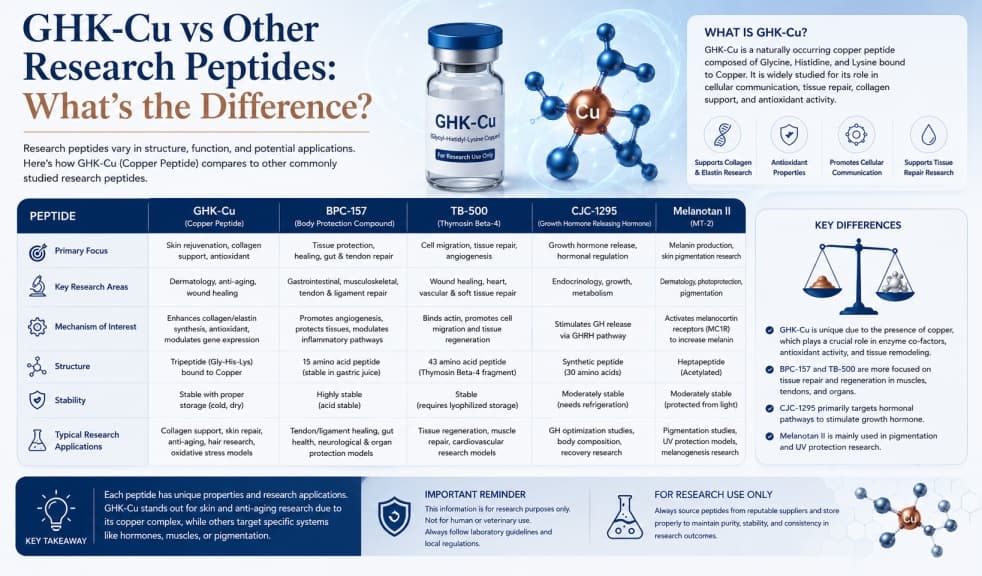
GHK-Cu vs BPC-157
Mechanism
BPC-157 is a synthetic pentadecapeptide derived from body protection compound found in gastric juice. It has been extensively studied in animal models for tendon-to-bone healing, gastrointestinal repair, and muscle tissue recovery, primarily acting via nitric oxide pathways, angiogenesis stimulation, and growth hormone receptor interaction.
GHK-Cu operates via copper-dependent modulation of gene expression, collagen synthesis, and extracellular matrix remodelling. Both compounds have been studied for tissue repair, but the pathways, tissue targets, and research evidence bases differ significantly.
Research Overlap
Both GHK-Cu and BPC-157 have been studied in wound healing and tissue repair contexts. However, BPC-157's research is more focused on musculoskeletal and gastrointestinal repair in animal models, while GHK-Cu's research spans skin biology, collagen production, neurological contexts, and gene expression modulation. The compounds are not interchangeable research tools.
GHK-Cu vs TB-500 (Thymosin Beta-4)
TB-500 is a synthetic analogue of Thymosin Beta-4, a naturally occurring peptide involved in actin polymerisation and cell migration. It operates primarily through actin dynamics and cellular motility. GHK-Cu's mechanism is copper-mediated and gene expression-focused. The research questions these compounds address are complementary rather than overlapping.
GHK-Cu vs CJC-1295 / Ipamorelin
CJC-1295 and Ipamorelin are growth hormone axis peptides — they stimulate GH release from the pituitary and are studied primarily in body composition and metabolic research. They have no meaningful mechanistic overlap with GHK-Cu, which does not interact with the growth hormone axis. These compounds exist in entirely different research domains.
GHK-Cu vs Epithalon
Epithalon (Epitalon) is a synthetic tetrapeptide studied in gerontology research, primarily for its reported effects on telomere length and telomerase activity. Like GHK-Cu, Epithalon is studied in the context of ageing biology and longevity research. Some researchers investigating biological ageing use both compounds in parallel, as their mechanisms appear complementary — Epithalon focused on telomere maintenance, GHK-Cu focused on repair gene activation and extracellular matrix support.
Comparison Summary Table
Peptide
Primary Research Area
Mechanism
Overlap with GHK-Cu
GHK-Cu
Tissue repair, skin, gene expression
Copper complex, ECM modulation
—
BPC-157
Musculoskeletal, GI repair
NO pathway, angiogenesis
Tissue repair (different mechanism)
TB-500
Wound healing, recovery
Actin dynamics, cell migration
Wound healing (different mechanism)
CJC-1295/Ipamorelin
Body composition, GH
GHRH/ghrelin receptor
None
Retatrutide
Obesity, metabolic disease
GLP-1/GIP/GCG agonism
None
AOD-9604
Fat metabolism
GH receptor fragment
None
Epithalon
Ageing, telomere biology
Telomerase, gene expression
Ageing research (complementary)
What This Means for UK Researchers
GHK-Cu is not a substitute for BPC-157 or TB-500, nor are those compounds substitutes for GHK-Cu. Researchers studying tissue repair should evaluate which specific aspect of repair biology is most relevant — structural matrix remodelling (GHK-Cu), musculoskeletal healing (BPC-157), or cellular migration (TB-500) — and select compounds accordingly. For researchers interested in ageing biology, GHK-Cu is arguably the most well-studied naturally occurring peptide available in the UK research market, with a published literature spanning five decades
Continue Reading
What Is GHK-Cu? A Complete Guide | FlexPeptides
GHK-Cu Explained: Why Researchers Are Interested | FlexPeptides
The Science Behind GHK-Cu | FlexPeptides
GHK-Cu FAQs | FlexPeptides
Disclaimer: All research peptides sold by FlexPeptides.co.uk are for laboratory and research use only. Not for human administration. Always consult the relevant literature and regulatory frameworks before designing research protocols.