Explore the science behind GHK-Cu and discover why this copper peptide is widely studied in research. Learn about its structure, biological mechanisms, and potential applications across regenerative, skin, and tissue-related scientific investigations.
GHK-Cu is one of the most biologically multifaceted research peptides studied in the UK and globally. Unlike compounds with a single, well-defined receptor target, GHK-Cu's biological activity appears to operate through multiple converging pathways — which is both what makes it scientifically compelling and what makes fully characterising it a significant research challenge.
This article provides a structured introduction to the science behind GHK-Cu, covering its discovery, molecular biology, key signalling pathways, and the state of evidence across its main areas of research application.
Discovery and Early Research History
GHK-Cu research begins with Dr Loren Pickart, who in 1973 identified a small fraction of human albumin that stimulated liver tissue repair in vitro. He isolated the active component — the tripeptide glycyl-L-histidyl-L-lysine (GHK) — and subsequently discovered that its biological activity was dramatically enhanced when complexed with copper(II) ions. Early research focused primarily on wound healing and tissue repair in animal models. Over subsequent decades, the research base expanded to encompass collagen biology, angiogenesis, anti-inflammatory signalling, hair follicle biology, and ultimately, through computational approaches, broad gene expression modulation.
Molecular Structure and Copper Coordination
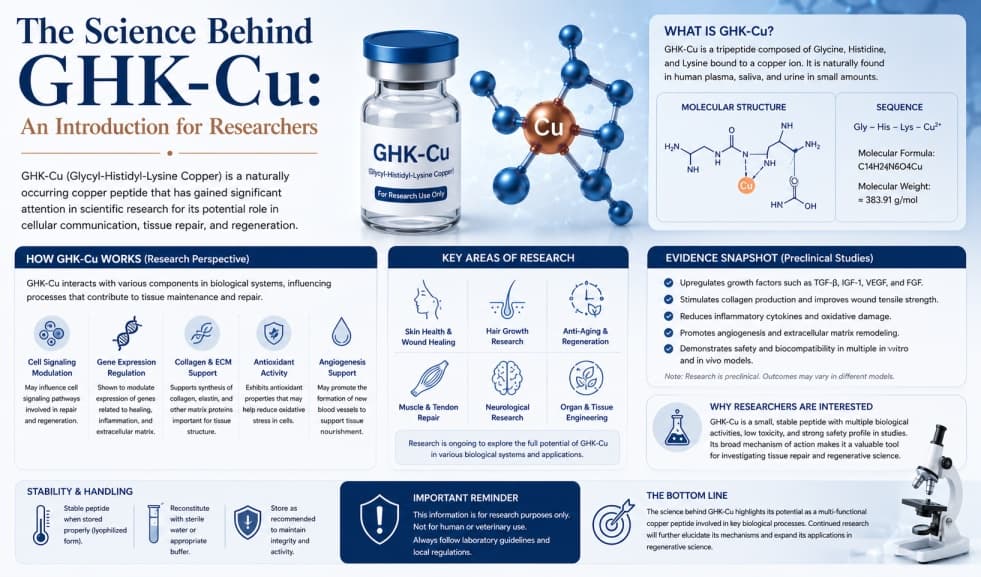
GHK-Cu consists of the tripeptide glycyl-L-histidyl-L-lysine coordinated to a single Cu(II) ion. The histidine residue's imidazole group and the N-terminal amine of glycine are the primary copper-binding sites, forming a stable square-planar coordination complex. This coordination geometry determines the compound's stability, its interaction with biological targets, and its susceptibility to degradation by chelating agents.
The Cu(II) oxidation state is important for GHK-Cu's activity. Reduction to Cu(I) — which can occur under highly oxidative conditions or incorrect storage — alters the compound's coordination chemistry and may affect its biological activity profile.
Mechanism of Action: Key Pathways
1. Extracellular Matrix Remodelling
GHK-Cu stimulates fibroblast proliferation and the synthesis of extracellular matrix (ECM) components, including:
- Type I and Type III collagen — the structural proteins of skin, tendon, ligament, and bone
2, Elastin — responsible for tissue elasticity and recoil
3.Proteoglycans and glycosaminoglycans (including decorin and versican) — which regulate water retention and matrix organisation
Simultaneously, GHK-Cu modulates matrix metalloproteinase (MMP) activity — the enzymes responsible for ECM degradation. Research has reported both stimulation of specific MMPs involved in removing damaged matrix components and inhibition of MMPs associated with excessive tissue breakdown. This balanced remodelling activity — removing damaged tissue while promoting new matrix synthesis — is considered a key feature of GHK-Cu's wound healing biology.
2. Angiogenesis
GHK-Cu has been shown to promote angiogenesis — the formation of new blood vessels — in preclinical research. Research suggests GHK-Cu upregulates vascular endothelial growth factor (VEGF) expression and stimulates endothelial cell migration and tube formation in vitro.
3. Anti-Inflammatory and Antioxidant Activity
GHK-Cu modulates inflammatory signalling at multiple levels. Published research has reported reductions in the expression of pro-inflammatory cytokines including TNF-alpha, IL-1 beta, and IL-6 in the presence of GHK-Cu. Additionally, the copper centre confers superoxide dismutase-like activity — the ability to catalyse the conversion of superoxide radicals to hydrogen peroxide and oxygen — providing a direct antioxidant mechanism.
4. Gene Expression Modulation
Using connectivity map analysis, Pickart and Margolina (2017) proposed that GHK-Cu modulates the expression of over 4,000 human genes. The proposed gene regulation pattern includes upregulation of genes involved in DNA repair, mitochondrial energy production, anti-oxidant defence systems, neurotrophic signalling, and ubiquitin-proteasome pathway components. Simultaneously, GHK-Cu appears to downregulate genes associated with inflammatory pathways and tissue destruction enzymes.
The gene expression data is computational (connectivity mapping) and requires further direct experimental validation. Researchers should interpret this data as hypothesis-generating rather than conclusively established.
5. Stem Cell and Progenitor Cell Modulation
Emerging research has explored GHK-Cu's effects on stem cell populations. Some studies have reported that GHK-Cu promotes the differentiation of mesenchymal stem cells toward osteogenic and chondrogenic lineages — potentially relevant to bone and cartilage repair research. These findings are preliminary but represent an area of growing investigative interest.
Research Evidence Quality: What to Know
In vitro studies (cell culture) — extensive; GHK-Cu's effects on fibroblasts, endothelial cells, and keratinocytes are well-documented
Animal model studies — substantial body of work, particularly in wound healing; methodology and reporting quality varies
Human clinical data — limited; some small studies in wound care and dermatology, but rigorous RCT-level evidence in human subjects is sparse
4.Computational/bioinformatics data — the gene expression dataset; methodologically valid but requires experimental follow-up
Current Research Frontiers in 2026
Experimental validation of the gene expression modulation dataset — moving from computational prediction to direct assay
Neurological applications — neuroprotection, nerve regeneration, and neuroinflammation modulation
Ageing and longevity biology — the relationship between declining GHK-Cu and age-associated tissue deterioration
Combination studies — GHK-Cu alongside other peptides in multi-mechanism repair protocols
5.Delivery systems research — optimal formulations for topical, systemic**, and localised delivery in research models
Continue Reading
What Is GHK-Cu? A Complete Guide | FlexPeptides
GHK-Cu Explained: Why Researchers Are Interested | FlexPeptides
How to Store GHK-Cu Correctly | FlexPeptides
Disclaimer: Scientific information is provided for educational purposes. GHK-Cu is sold by FlexPeptides.co.uk for research use only. Not a licensed medicine. Consult a qualified medical professional for clinical applications.