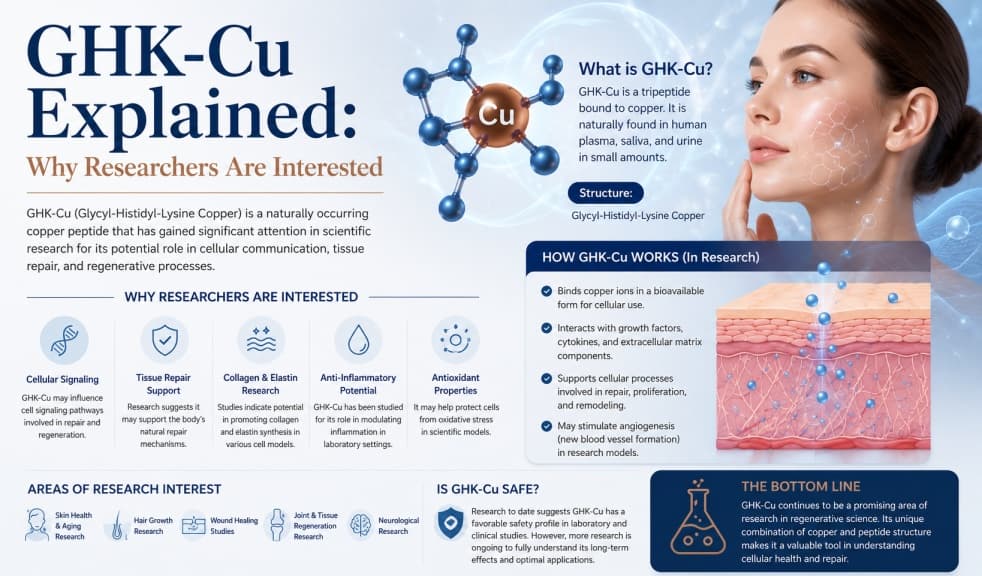
Learn why GHK-Cu has attracted scientific interest in regenerative research. This guide explains its structure, potential mechanisms, and key areas of ongoing study, including skin, hair, and tissue-related research, while emphasizing its role as a research peptide.
GHK-Cu has been the subject of scientific investigation for over five decades — an unusually long research history for a peptide compound. Yet despite this, it remains less well-known to the general public than newer compounds like BPC-157 or the GLP-1 agonist family. Among specialist researchers, however, GHK-Cu commands serious attention.
This article explores the specific reasons why researchers across multiple disciplines — dermatology, wound biology, molecular biology, gerontology, and neuroscience — continue to find GHK-Cu a compelling subject of investigation in 2026.
Reason 1 — It Is Naturally Occurring and Age-Dependent
Unlike most synthetic research peptides, GHK-Cu is not an invented compound. It occurs naturally in the human body, forming when the tripeptide GHK binds to copper ions — a process that happens continuously in healthy tissue. This natural origin is scientifically meaningful for several reasons.
First, it suggests that GHK-Cu plays a genuine physiological role, rather than being a foreign molecule introduced into a biological system. Second, the well-documented age-related decline in plasma GHK concentrations — from around 200 ng/mL in young adults to below 80 ng/mL in older individuals — provides a clear biological hypothesis: that declining GHK-Cu may contribute to age-associated deterioration in tissue repair and inflammatory regulation. This hypothesis is intrinsically testable, which is part of what makes GHK-Cu so attractive as a research subject.
Reason 2 — An Exceptionally Broad Research Literature
Very few peptides of GHK-Cu's size (a simple tripeptide) have generated a research literature of comparable breadth. Published studies have explored GHK-Cu's activity across wound healing, collagen and elastin synthesis, angiogenesis, anti-inflammatory signalling, oxidative stress, stem cell differentiation, hair follicle biology, nerve regeneration, and gene expression modulation.
This breadth reflects the compound's apparent position as a broad biological signal molecule, one that appears to influence a wide range of cellular responses simultaneously. For researchers, this means GHK-Cu can serve as a useful tool in studies spanning multiple biological domains.
Reason 3 — The Gene Expression Data
The most discussed and controversial aspect of GHK-Cu research in recent years is the gene expression data. A bioinformatics analysis published in 2017 identified GHK-Cu as a potential modulator of the expression of over 4,000 human genes — including genes associated with DNA repair, anti-oxidant pathways, mitochondrial function, and neurological health.
This finding, if confirmed and extended by direct experimental work, would suggest that GHK-Cu operates less like a targeted signalling molecule and more like a broad biological reset signal — one that appears to shift gene expression profiles from stress and damage patterns toward repair and maintenance patterns.
The 2017 Pickart and Margolina analysis used connectivity mapping — a computational tool that compares gene expression signatures — rather than direct experimental assays. Follow-up experimental validation remains an active area of investigation.
Reason 4 — Relevance Across Multiple Research Fields
GHK-Cu does not belong exclusively to any single research domain. Its literature spans:
1.Dermatology and skin biology — collagen synthesis, wound healing, photoageing
2.Regenerative medicine — tissue repair, stem cell modulation, angiogenesis
3.Gerontology — age-related decline in healing capacity, longevity biology
4.Neuroscience — neuroprotection, nerve growth factor modulation
5.Inflammation biology — cytokine modulation, oxidative stress reduction
6.Oncology-adjacent research — some studies have explored GHK-Cu's effects on tumour suppressor gene expression, though this remains preliminary
Reason 5 — Favourable Safety Profile in Preclinical Research
Copper peptides including GHK-Cu have generally demonstrated a favourable safety profile in preclinical studies, with no significant toxicity reported at physiologically relevant concentrations in cell culture and animal model research. This relative safety — combined with its natural occurrence in the body — makes it an attractive candidate for longer-duration or higher-dose research protocols.
It is important to note that preclinical safety data does not automatically translate to human safety, and all research use should be conducted within appropriate ethical and regulatory frameworks.
Reason 6 — The Ageing Biology Connection
One of the most intellectually compelling aspects of GHK-Cu research is its connection to ageing biology. The age-related decline in GHK-Cu, the compound's apparent role in stimulating repair processes, and the gene expression data suggesting a shift from damage to maintenance gene expression have collectively positioned GHK-Cu as a subject of growing interest in the longevity and gerontology research community.
Reason 7 — Low Molecular Weight and Tissue Penetration
GHK-Cu is a tripeptide — one of the smallest peptides studied in a research context. Its low molecular weight has implications for tissue penetration and bioavailability in research models. Smaller peptides generally penetrate tissues more readily than larger proteins, which has made GHK-Cu useful in topical and local delivery research models as well as systemic studies.
Why UK Researchers Are Specifically Interested
In the UK, GHK-Cu research interest is being driven by several converging factors: the growing academic focus on ageing biology and longevity science, expanded university and NHS research programmes in regenerative medicine, the increasing availability of high-purity research-grade GHK-Cu from UK suppliers, and growing interest in peptide biology as a research tool following the high-profile success of GLP-1 agonists in clinical medicine.
Source Research-Grade GHK-Cu from FlexPeptides.co.uk
FlexPeptides.co.uk supplies independently tested, research-grade GHK-Cu to UK researchers. Our stock is the full copper complex form — GHK-Cu, not GHK alone — verified by third-party COA analysis for sequence identity and purity. UK dispatch, comprehensive documentation, and technical support are[ available for all orders.
Continue Reading
- What Is GHK-Cu? A Complete Guide to Copper Peptides | FlexPeptides
- The Science Behind GHK-Cu: An Introduction for Researchers | FlexPeptides
- GHK-Cu vs Other Research Peptides | FlexPeptides
- GHK-Cu FAQs | FlexPeptides
Disclaimer: GHK-Cu is sold by FlexPeptides.co.uk for research and laboratory use only. Not for human administration. Consult a qualified professional for clinical applications.