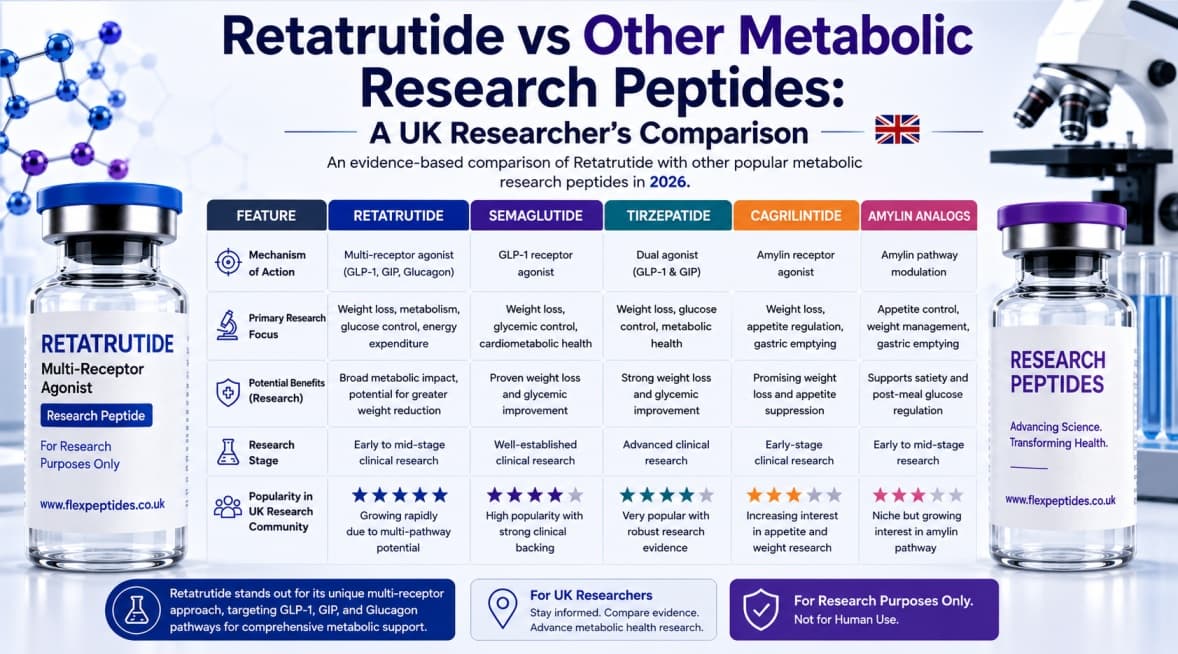
Retatrutide is gaining attention among UK researchers for its unique multi-receptor approach to metabolic health. Compare Retatrutide with other leading research peptides, including Semaglutide and Tirzepatide, to understand their mechanisms, research focus, and scientific potential in 2026.
The metabolic research peptide space in the UK encompasses a wide range of compounds — from established growth hormone secretagogues to next-generation incretin receptor agonists. Retatrutide represents the leading edge of this landscape in 2026, but how does it compare to the other metabolic research peptides commonly used by UK researchers?
This article provides a structured comparison of retatrutide against the other key metabolic research peptides available in the UK, helping researchers understand which compounds are most relevant to different investigative objectives.
⚠️ All peptides discussed in this article are research compounds. They are not approved medicines (unless otherwise noted) and must not be used for human administration outside of appropriately authorised settings.
Metabolic research peptides in the UK broadly fall into three categories: incretin receptor agonists (GLP-1, GIP, GCG pathway compounds), growth hormone axis peptides (GHRH analogues, GH secretagogues), and fat metabolism peptides (GH fragments, lipolysis-focused compounds). Retatrutide sits firmly in the first category but intersects with the third through its glucagon receptor mechanism.
Retatrutide vs Tirzepatide
Tirzepatide is retatrutide's closest comparator — a GLP-1/GIP dual agonist versus retatrutide's GLP-1/GIP/GCG triple agonism. The key difference is the addition of glucagon receptor activation in retatrutide, which may enhance energy expenditure and hepatic fat reduction beyond what tirzepatide achieves. Tirzepatide has full MHRA approval (Mounjaro); retatrutide remains investigational. For UK researchers, tirzepatide serves as an important active comparator. Full comparison in: Retatrutide vs Tirzepatide | FlexPeptides.
Retatrutide vs Semaglutide
Semaglutide is a single GLP-1 agonist — the established gold standard in metabolic medicine that retatrutide aims to surpass. Retatrutide adds GIP and GCG activation beyond semaglutide's mechanism. Clinical comparison data is indirect; Phase 2 results suggest retatrutide may achieve greater weight reduction, but rigorous head-to-head evidence is awaited from Phase 3 programmes. Full comparison in: Retatrutide vs Semaglutide | FlexPeptides.
Retatrutide vs CJC-1295 / Ipamorelin
CJC-1295 (a GHRH analogue) and Ipamorelin (a GH secretagogue) operate via an entirely different pathway from retatrutide. They stimulate growth hormone release from the pituitary, which secondarily increases IGF-1 levels. This pathway influences body composition — lean mass preservation and fat oxidation — but is mechanistically distinct from incretin receptor agonism. CJC-1295/Ipamorelin is widely studied for general body composition and anti-ageing research, whereas retatrutide is specifically oriented toward metabolic disease, appetite regulation, and hepatic fat. These compounds are not directly comparable but may be of combined interest to researchers studying body composition from multiple angles.
Retatrutide vs AOD-9604 and HGH Fragment 176-191
AOD-9604 and HGH Fragment 176-191 are growth hormone-derived peptide fragments studied specifically for their lipolytic (fat-burning) properties. They target fat metabolism through the GH receptor pathway, with minimal effect on blood glucose or the incretin system. Compared to retatrutide, these compounds have a narrower, more targeted mechanism. They are relevant for studies focused specifically on adipose tissue biology and fat cell metabolism, whereas retatrutide addresses a broader metabolic profile including glycaemic control, appetite, and hepatic fat. Their evidence base is largely preclinical; retatrutide has significantly more robust clinical data.
Retatrutide vs BPC-157 and TB-500
BPC-157 and TB-500 are tissue-repair and recovery peptides — they operate in a completely different domain from retatrutide and have no direct overlap in research application. BPC-157 is studied in the context of healing, gut health, and connective tissue repair. TB-500 is associated with recovery and cellular regeneration. Neither has a metabolic or glycaemic mechanism, and neither would be considered a comparator to retatrutide in any metabolic research context.
Retatrutide vs Mazdutide
Mazdutide is a GLP-1 and glucagon dual agonist (without GIP), in late-stage development primarily in China and Asian markets. It shares the glucagon receptor component with retatrutide but lacks GIP agonism. Comparative data is limited, but retatrutide's triple mechanism is considered more comprehensive. UK researchers interested in the glucagon receptor's contribution to metabolic outcomes may find both compounds of interest as mechanistic comparators.
Summary Comparison Table
Peptide Mechanism Primary Research Use vs Retatrutide
Tirzepatide GLP-1 + GIP Obesity, T2D Direct comparator
Semaglutide GLP-1 Obesity, T2D Direct comparator
CJC-1295 GHRH analogue Body composition, GH Different pathway
AOD-9604 GH fragment Fat metabolism Narrower, preclinical
BPC-157 Tissue repair Recovery, healing No overlap
Mazdutide GLP-1 + GCG Obesity (Asia focus) Partial overlap
Choosing the Right Peptide for Your Research
The right metabolic research peptide depends entirely on your investigative objectives. If you are studying incretin receptor biology, appetite regulation, or obesity pharmacology, retatrutide's triple-agonist profile makes it uniquely valuable as a research compound in 2026. If you are studying GH axis biology, body composition, or recovery mechanisms, CJC-1295, Ipamorelin, BPC-157, or TB-500 may be more appropriate.
Many UK researchers work with multiple compounds across different protocol arms, using each peptide to illuminate a different facet of the same broader research question.
Source All These Peptides from FlexPeptides.co.uk
FlexPeptides.co.uk stocks a comprehensive range of metabolic and research-grade peptides for UK buyers, including retatrutide, tirzepatide, CJC-1295, Ipamorelin, BPC-157, TB-500, AOD-9604, and more. Every product ships with a Certificate of Analysis and clear res[earch-use labelling.
Read More in This Series
→ Retatrutide UK: Complete Guide | FlexPeptides
→ What Is Retatrutide? Everything You Need to Know | FlexPeptides
→ Retatrutide Research: Current Scientific Interest in 2026 | FlexPeptides
→ Retatrutide vs Semaglutide | FlexPeptides
→ Retatrutide vs Tirzepatide | FlexPeptides
→ Best Weight Loss Peptides Available in the UK | FlexPeptides
Disclaimer: All peptides sold by FlexPeptides.co.uk are for research and laboratory use only. None are approved UK medicines unless explicitly stated. Consult a qualified healthcare professional for any clinical or therapeutic application.