Discover what Retatrutide is, how it works, and why it is gaining attention in weight management and metabolic health research. Learn the latest insights and research developments in 2026.
Retatrutide is one of the most scientifically significant research peptides to emerge in recent years. If you have been following the metabolic research space — particularly around obesity, type 2 diabetes, and body composition — you will likely have encountered the name. But what exactly is retatrutide, and why is it generating so much interest?
This article provides a complete, accessible explanation of retatrutide: what it is, how it works, where it comes from, and why the UK research community is paying close attention.
The Basic Definition
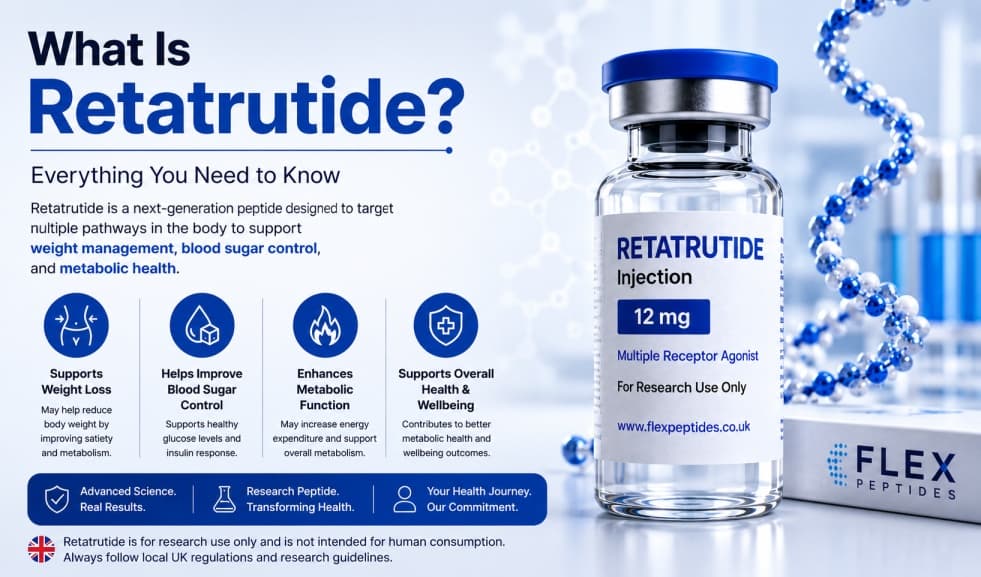
Retatrutide is a synthetic peptide — a chain of amino acids — developed by Eli Lilly and Company under the research designation LY3437943. It belongs to a class of compounds called incretin receptor agonists, meaning it mimics and amplifies the effects of naturally occurring hormones involved in blood glucose regulation and appetite control.
What makes retatrutide unique is that it is a triple receptor agonist: it activates three distinct hormone receptors simultaneously. No approved medicine currently on the market achieves this combination.
The Three Receptors: GLP-1, GIP, and GCG
GLP-1 (Glucagon-Like Peptide-1)
GLP-1 is a gut hormone released in response to food intake. It stimulates insulin secretion, suppresses glucagon, slows gastric emptying, and signals satiety to the brain. GLP-1 receptor agonists (like semaglutide) are now widely used in the management of type 2 diabetes and obesity. Retatrutide includes this as one of its three mechanisms.
GIP (Glucose-Dependent Insulinotropic Polypeptide)
GIP is another gut hormone that enhances insulin secretion and appears to complement GLP-1's effects on weight and glycaemic control. Tirzepatide was the first approved drug to combine GLP-1 and GIP agonism, demonstrating superior outcomes compared to GLP-1 agonists alone. Retatrutide also includes GIP receptor activation.
GCG (Glucagon Receptor)
This is retatrutide's distinguishing feature. Glucagon is traditionally viewed as a blood-sugar-raising hormone — the opposite of insulin. However, when glucagon receptor activation is combined with GLP-1 agonism, research suggests a net beneficial effect: increased energy expenditure, enhanced fat oxidation, and reduced hepatic fat. The glucagon component of retatrutide is hypothesised to be a key driver of its potentially superior weight-reduction profile.
Where Did Retatrutide Come From?
Retatrutide was developed as part of Eli Lilly's continuing research into incretin-based therapies following the success of tirzepatide (marketed as Mounjaro). The scientific rationale was to explore whether adding glucagon receptor agonism to an already successful dual-agonist framework could produce further improvements in metabolic outcomes.
The first major clinical results were published in the New England Journal of Medicine in June 2023, reporting outcomes from a Phase 2 trial. The data was considered significant enough to prompt Phase 3 development across multiple indications.
Is Retatrutide the Same as Ozempic or Mounjaro?
No. These are distinct compounds. Ozempic and Wegovy contain semaglutide — a GLP-1 agonist only. Mounjaro contains tirzepatide — a GLP-1 and GIP dual agonist. Retatrutide is the next step: a GLP-1, GIP, and GCG triple agonist. While all three operate in the same general therapeutic space, their mechanisms and research profiles differ.
What Stage of Development Is Retatrutide At?
As of mid-2026, retatrutide is in Phase 3 clinical trials across multiple indications under Eli Lilly's TRIUMPH development programme. These include studies in obesity, type 2 diabetes, cardiovascular risk, and non-alcoholic steatohepatitis (NASH). It has not yet received marketing authorisation from the MHRA in the UK or from the FDA in the United States as a licensed medicine.
ℹ️ Retatrutide is an investigational compound. It is not available as a prescription medicine in the UK as of 2026.
Why Is the UK Research Community Interested?
UK researchers studying metabolic disease, obesity pharmacology, and endocrinology have shown growing interest in retatrutide as a research compound because it represents a novel mechanism profile, it offers a useful comparison point for studies evaluating GLP-1 versus dual versus triple agonism, and the Phase 2 data has generated sufficient scientific curiosity to support a range of investigative protocols.
Academic institutions, specialist clinics, and independent researchers across the UK are incorporating retatrutide into their investigative work where appropriate ethical and regulatory frameworks are in place.
Where Can UK Researchers Source Retatrutide?
FlexPeptides.co.uk supplies retatrutide as a research-grade peptide for UK-based researchers. Every batch is independently tested and accompanied by a Certificate of Analysis confirming sequence identity and purity. Our team can provide full technical documentation on request.
Read More in This Series
→ Retatrutide UK: Complete Guide | FlexPeptides
→ Retatrutide Research: Current Scientific Interest in 2026 | FlexPeptides
→ Retatrutide vs Semaglutide: Key Differences Explained | FlexPeptides
→ Retatrutide vs Tirzepatide: Which Research Peptide Is More Popular? | FlexPeptides
Disclaimer: Retatrutide is sold by FlexPeptides.co.uk for research and laboratory use only. Not for human administration. Consult a qualified medical professional for any clinical enquiry.