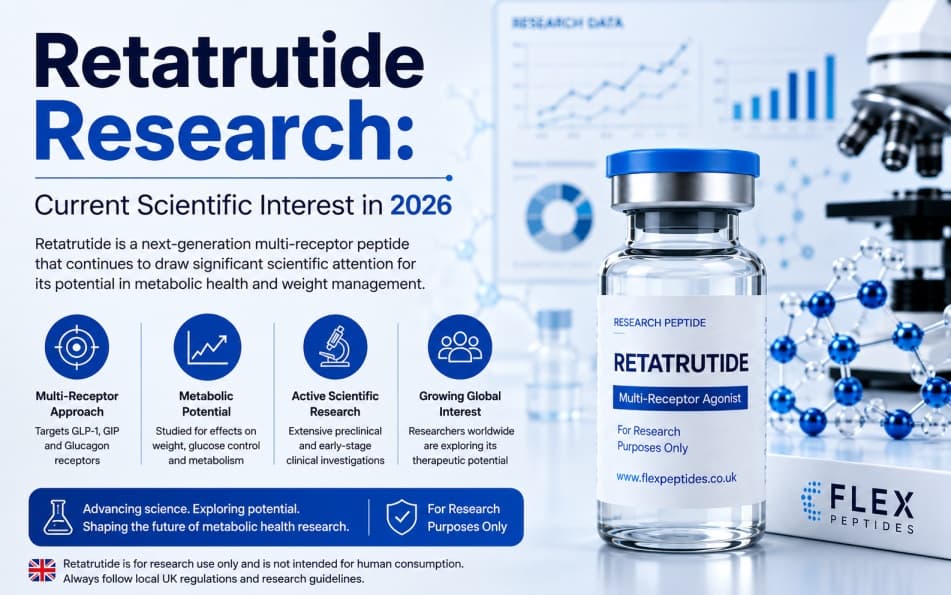
Retatrutide remains a major focus of scientific research in 2026 due to its unique multi-receptor mechanism and potential role in metabolic health, weight management, and glucose regulation studies. Discover the latest research developments and growing scientific interest.
Scientific interest in retatrutide has accelerated considerably since the publication of Phase 2 trial data in mid-2023. As Phase 3 development progresses across multiple indications, the UK research community is paying close attention to what may become one of the most important compounds in metabolic medicine.
This article provides an up-to-date overview of the retatrutide research landscape in 2026 — covering key trial findings, active research programmes, and the questions the scientific community is most actively investigating.
The Phase 2 Foundation: What We Know
The landmark Phase 2 trial of retatrutide (NCT04881760) enrolled adults with a body mass index of 27 or above. The randomised, double-blind, placebo-controlled study assessed three doses of retatrutide against placebo over 48 weeks. The trial was published in the New England Journal of Medicine in June 2023 and generated significant scientific discussion.
Key outcomes from the trial included the following observations. Body weight reductions were dose-dependent and substantial, with the highest dose group achieving mean reductions that exceeded the benchmark results previously associated with tirzepatide. Fasting blood glucose and insulin levels improved meaningfully across all active dose groups. Waist circumference and systolic blood pressure reductions were also reported. The most common adverse effects were gastrointestinal — consistent with the GLP-1 agonist class — and were largely described as mild to moderate and transient.
These findings supported progression to Phase 3 development across multiple indications.
The TRIUMPH Phase 3 Programme
Eli Lilly's Phase 3 programme for retatrutide is collectively known as TRIUMPH. As of mid-2026, the programme encompasses several distinct trial arms:
•TRIUMPH-1: Obesity without diabetes — evaluating weight reduction over 72 weeks
•TRIUMPH-2: Type 2 diabetes — evaluating glycaemic control and weight outcomes
•TRIUMPH-3: Obesity with cardiovascular risk factors — a cardiovascular safety and outcomes study
•TRIUMPH-4: Non-alcoholic steatohepatitis (NASH) — evaluating liver fat reduction and histological improvement
•TRIUMPH-5: Obesity with chronic kidney disease — a renal outcomes sub-study
Full data readouts from these trials are expected on a rolling basis through 2026 and into 2027, with regulatory submission timelines dependent on the completeness of the safety and efficacy datasets.
What Are Researchers Most Interested In?
Comparative Efficacy vs Tirzepatide and Semaglutide
The central research question for many investigators is whether retatrutide's triple agonism translates into meaningfully superior outcomes compared to currently approved dual and single agonists. Head-to-head trials are limited, but indirect comparisons from Phase 2 data have been extensively discussed in the literature. UK researchers designing metabolic studies are particularly interested in understanding the incremental contribution of glucagon receptor activation.
The Role of Glucagon in Weight Regulation
Retatrutide has reignited academic interest in the glucagon receptor as a therapeutic target. Historically, glucagon was associated with counter-regulatory glucose release — something to be suppressed, not stimulated, in metabolic disease. Retatrutide's Phase 2 data has contributed to a more nuanced understanding of how glucagon receptor activation, when balanced with GLP-1 agonism, may promote energy expenditure and hepatic lipid clearance without meaningful glycaemic cost.
Durability and Long-Term Outcomes
A key question with any weight-loss peptide is whether outcomes are maintained over time or whether weight regain occurs upon discontinuation. The 72-week Phase 3 data from TRIUMPH-1 will provide important insights into the durability of retatrutide's effects. Researchers are also examining whether retatrutide produces lasting changes in metabolic set points or whether effects are strictly pharmacological and reversible.
NASH and Hepatic Outcomes
NASH is an area of significant unmet medical need, and retatrutide's glucagon receptor component is of particular interest given the hormone's role in hepatic lipid metabolism. Early data has suggested meaningful reductions in liver fat. TRIUMPH-4 is expected to provide histological data assessing whether retatrutide can reverse or arrest NASH progression — a clinically significant endpoint.
Retatrutide in UK Academic Research
UK universities and NHS research units involved in metabolic medicine and endocrinology have incorporated retatrutide into investigational studies as a reference compound and as a subject of mechanistic enquiry. The compound is of particular relevance to researchers within the NIHR (National Institute for Health and Care Research) funded obesity and diabetes research networks.
Independent researchers working with retatrutide as a research peptide must operate within appropriate ethical and regulatory frameworks, including HRA approval for human subjects research and MHRA notification where applicable.
Sourcing Retatrutide for UK Research
For researchers requiring retatrutide as a laboratory compound, FlexPeptides.co.uk supplies research-grade retatrutide with full batch documentation. We maintain appropriate storage standards and offer detailed technical support for researchers formulating study protocols.
Read More in This Series
→ Retatrutide UK: Complete Guide | FlexPeptides
→ What Is Retatrutide? Everything You Need to Know | FlexPeptides
→ Retatrutide vs Tirzepatide: Which Research Peptide Is More Popular? | FlexPeptides
→ Retatrutide vs Other Metabolic Research Peptides | FlexPeptides
Disclaimer: All content is for educational purposes only. Retatrutide is not an approved medicine in the UK. Products sold by FlexPeptides.co.uk are for research use only.