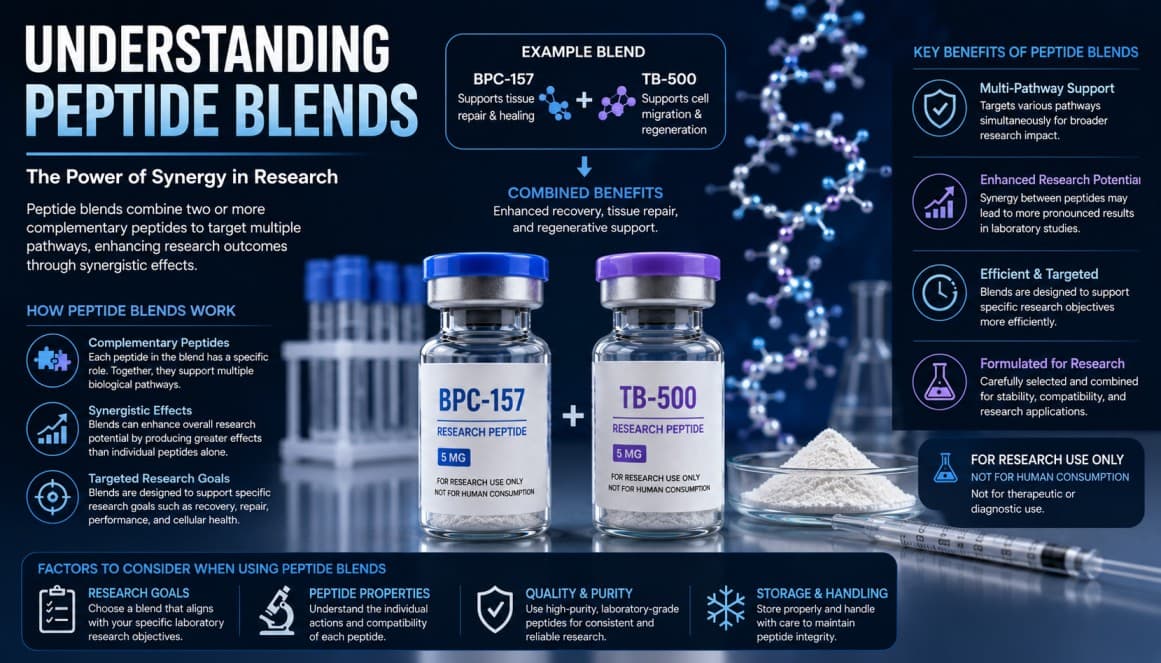
Peptide blends combine multiple research peptides into a single formulation for laboratory investigations. Learn how blends are developed, their potential research advantages, and the importance of product quality, purity, and accurate specifications.
For research use only. Not for human consumption.
Introduction
As peptide research has expanded, so has interest in studying peptides in combination rather than in isolation. Pre-formulated blends — vials containing two or more peptides at fixed ratios — have become a common feature of the research supply landscape. This guide explains what peptide blends are, the scientific rationale researchers typically cite for combining compounds, the interpretive challenges blends introduce, and what to look for when evaluating a blend's documentation and quality.
What Is a Peptide Blend?
Peptide stacking — the practice of combining multiple peptides within the same research protocol — is one of the more complex and nuanced areas of peptide research. In the world of research peptides, "stacking" refers to the deliberate combination of two or more peptide compounds within a single research protocol, undertaken to investigate complementary or synergistic biological pathways. A "blend," in the commercial sense used by research suppliers, is simply a pre-mixed formulation of two or more of these compounds combined at a fixed ratio within a single vial, rather than requiring a researcher to source, reconstitute, and combine each compound separately.
Rather than studying one molecule in isolation, researchers use combinations to explore how parallel signaling cascades interact — for instance, how a tissue-repair peptide behaves when studied alongside a peptide acting through a distinct but complementary pathway.
The Scientific Rationale Behind Combining Peptides
Research literature generally points to a small number of legitimate rationales for studying peptides in combination, rather than combination for its own sake:
Complementary receptor pathways. Different peptides activate different receptors and signaling pathways, and some of the most well-characterized combinations exploit this directly. The clearest example in the literature is the pairing of a GHRH analog with a ghrelin-receptor agonist (GHRP).Growth hormone release is regulated by two distinct hypothalamic signals: GHRH, which is stimulatory, and ghrelin/GHRPs, which amplify that signal. A GHRH analog tells the pituitary to release GH, while a ghrelin-receptor agonist amplifies that release through a complementary pathway, and together the two produce larger, more physiologic GH pulses than either compound alone. This GHRH-plus-GHRP synergy is considered one of the stronger examples in the field, with multiple studies confirming that combining these pathways produces GH output exceeding the sum of the individual responses.
Complementary biological functions within a single process. A second common rationale involves pairing peptides that act on different aspects of the same broader biological process, such as tissue repair. One frequently cited example pairs a peptide studied for localized repair processes with a second peptide studied for its influence on systemic cellular migration — the idea being that combining the two provides broader pathway coverage than either compound alone. In this type of combination, one peptide's proposed mechanism (for example, promoting angiogenesis and tissue healing through nitric-oxide and VEGF-related pathways) is studied alongside a second peptide's distinct but related mechanism (facilitating cellular migration), on the theory that the two processes are complementary components of tissue recovery.
Standardization across a study. A combined formulation can simplify evaluation by standardizing ratios across batches, making comparisons more consistent across repeated trials than if a researcher were separately reconstituting and combining individual compounds by hand for each run.
Where Combinations Are Scientifically Weaker
Not every proposed combination has a clear mechanistic basis, and the research literature is fairly direct about this. Not all peptide combinations are mechanistically logical, and some raise specific concerns for research design: combining peptides that act on the same receptor may produce competition rather than synergy, and combining compounds with opposing mechanisms may produce null results that are difficult to interpret. Combining peptides with overlapping toxicological profiles also warrants careful safety assessment before proceeding.
Broad, "everything" blends — formulations combining many peptides marketed toward simultaneously addressing several unrelated goals — draw particular skepticism from researchers. Such all-in-one combinations are sometimes criticized for destroying signal quality, since a study design cannot cleanly attribute an observed effect to any single component when many compounds with different mechanisms are administered together.
The Core Trade-off: Convenience Versus Interpretability
The central methodological trade-off with any blend is straightforward: convenience versus attribution.
Blends can offer practical advantages in some research contexts — for example, allowing researchers to examine more than one peptide signal within the same conceptual model, or avoiding the need to source separate vials when a study design already assumes a paired framework. However, a blend is often harder to interpret than a single peptide, because multiple ingredients make attribution of any observed effect more difficult and increase overall interpretive complexity. A blend only makes sense as a research tool when there is a clear rationale for the specific combination, the formulation is transparently disclosed, the material is well documented, and the researcher accepts the added interpretive complexity that comes with studying more than one active compound at once.
The trade-off works both ways: every additional peptide in a combination adds reconstitution steps, stability considerations, potential cross-reactivity, and cost, which is precisely the practical burden that pre-formulated blends are designed to reduce — at the cost of the researcher having less granular control over the exact ratio and sourcing of each individual component.
Regulatory and Documentation Considerations
Working with blends adds a layer of complexity beyond what's required for single-compound research. Research protocols involving multiple experimental compounds require institutional review and approval for each component, and the combined use of multiple research peptides adds complexity to ethics submissions, which must be justified by clear scientific rationale. Researchers designing a combination study should review available toxicology and adverse-event data for each individual compound, particularly when combining three or more peptides.
From a quality standpoint, the same principles that apply to single-compound research apply with added importance to blends: documentation should specify the identity, concentration, and ratio of each constituent peptide, supported by third-party analytical verification. Because most combinations lack formal, controlled clinical safety data even when the individual compounds are individually well studied, a blend's value as a research tool depends heavily on transparent, verifiable formulation documentation — not marketing claims about the combination's effects.
What to Look for When Evaluating a Blend
Based on the considerations above, researchers evaluating a pre-formulated blend for a study should generally confirm:
- A clear, stated mechanistic rationale for why the specific compounds are combined, rather than a vague claim of "synergy."
- Transparent formulation disclosure — the identity and ratio of each peptide in the vial, not a proprietary or undisclosed blend.
- Independent analytical verification (HPLC/LC-MS) confirming both the identity and relative concentration of each constituent.
- Awareness of the individual compounds' documented profiles, including any known overlapping toxicology, before incorporating the blend into a study design.
- A study design that accounts for the interpretive limits of combination data — that is, a clear plan for how the study will (or will not) attempt to attribute observed effects to individual components.
Summary
Peptide blends are a practical response to a real feature of contemporary peptide research: many of the most interesting biological questions involve how multiple signaling pathways interact, not how a single molecule behaves in isolation. Well-designed combinations — particularly ones built around clearly complementary mechanisms, such as GHRH-plus-GHRP pairings or tissue-repair pairings — have real mechanistic grounding in the literature. At the same time, blends introduce genuine interpretive complexity, and not every commercially available combination is scientifically well justified. Researchers should evaluate any blend on the strength of its documented rationale and analytical transparency, not on marketing language alone.
A Note on Responsible Research Use
All peptide blends referenced on this site are supplied strictly for laboratory and in-vitro research use by qualified professionals and institutions. They are not intended for human or animal administration outside of a controlled research setting, and this article should not be read as guidance for personal or therapeutic use. Researchers should consult the primary literature for each constituent compound and follow their institution's protocols for any multi-compound study.
Disclaimer: This article summarizes publicly available research and research-methods considerations for general scientific and educational purposes. It is not medical advice, and FlexPeptides does not sell products intended for human consumption.