SS-31 is the base molecule behind FORZINITY, the first-ever FDA-approved mitochondria-targeted drug. Here's the real trial history behind that headline — and why the approval doesn't change SS-31's UK research status.
SS-31, known clinically as elamipretide, is a synthetic mitochondria-targeted peptide that binds cardiolipin in the inner mitochondrial membrane. In October 2025, it became the first FDA-approved mitochondria-targeted drug in history, licensed as FORZINITY for a rare disease called Barth syndrome. That approval is narrow and US-only — it does not extend to the UK, and it does not change the regulatory status of the unlicensed, research-grade SS-31 sold for laboratory use.
Of everything in the Flex Peptides catalogue right now, SS-31 is the one compound that's just had genuine, front-page regulatory news attached to it. That's not marketing spin — it's an actual first-in-history FDA approval, and it's worth understanding properly, because it's also very easy to misread if you only catch the headline.
The headline, stated precisely
In October 2025, the FDA approved elamipretide — SS-31's clinical name — under the brand name FORZINITY (elamipretide hydrochloride). This is the first FDA-approved mitochondria-targeted therapeutic of any kind, for any condition, ever. Read that again, because it's a genuinely significant milestone in the broader field of mitochondrial medicine, not just for this one compound.
But the approval itself is narrow. FORZINITY is indicated specifically to improve muscle strength in adult and paediatric patients weighing at least 30kg who have Barth syndrome — a rare genetic mitochondrial cardioskeletal disease affecting an estimated 150 people in the entire United States. The supporting evidence came from the open-label portion of the TAZPOWER clinical trial, which recorded improvement in knee extensor muscle strength from baseline. The most commonly reported adverse effects were injection-site reactions.
So: a landmark approval, yes — but for one specific rare disease, in one specific country, based on one specific trial measure. That distinction matters a great deal for how this compound should be discussed and researched, and we'll come back to it.
Where SS-31 actually came from
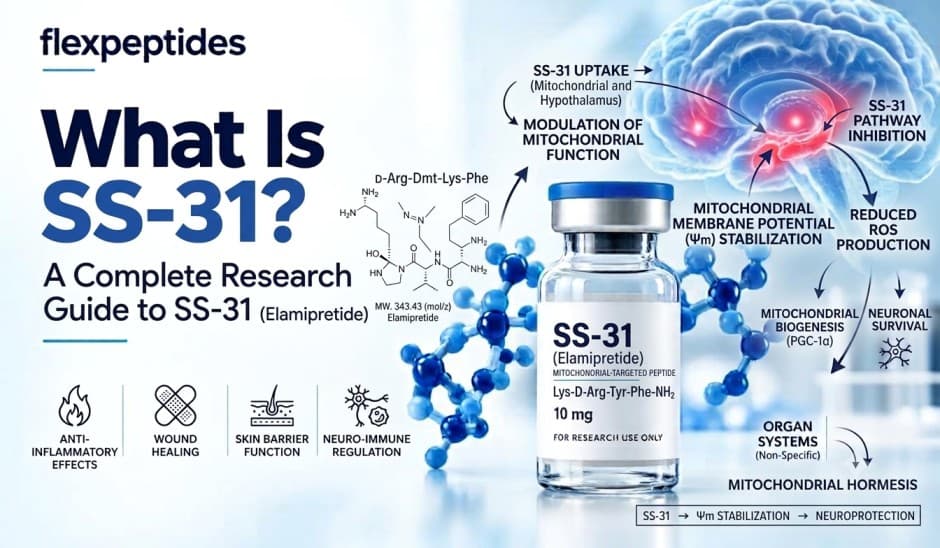
SS-31 is a synthetic aromatic-cationic tetrapeptide, originally developed through research led by Dr Hazel Szeto at Weill Cornell Medicine. Its design goal was specific and elegant: get the peptide to selectively concentrate in the inner mitochondrial membrane, where it binds cardiolipin — a phospholipid that's structurally essential to the electron transport chain. By stabilising cardiolipin, SS-31 is proposed to reduce electron transport chain dysfunction and limit the excess production of reactive oxygen species (ROS) that follows when that chain breaks down. That mechanism is exactly why SS-31 shows up so often in ageing research, cardiology research, and neurodegeneration research — reactive oxygen species and mitochondrial dysfunction sit near the centre of all three fields.
The trial history is longer, and messier, than the headline suggests
Clinical development was carried forward by Stealth BioTherapeutics under the name elamipretide, and it's worth knowing the full trial history — not just the successful endpoint — because it's genuinely informative about how this compound behaves across different conditions.
Elamipretide was studied in a Phase 3 trial for primary mitochondrial myopathy, a broader condition than Barth syndrome specifically, and that trial did not meet its primary endpoint on a composite measure of distance walked and fatigue. A separate Phase 2 trial in heart failure with preserved ejection fraction (HFpEF) produced similarly mixed results against its own primary endpoints. A geographic atrophy programme — targeting an advanced form of dry age-related macular degeneration — also reported results that fell short on primary measures, despite some positive secondary signals in each of these programmes.
The eventual, narrower Barth syndrome approval was based on open-label TAZPOWER data on knee extensor strength specifically, not a placebo-controlled primary endpoint across a broad trial population, and it went through an accelerated approval pathway available for serious rare diseases with unmet medical need. That's not a reversal of the earlier mixed results in larger indications — it's a different, narrower approval built on a different evidentiary standard, applied to a different, much smaller patient population. If you're citing the FORZINITY approval in your own research writing, it's worth being precise about exactly which trial population and endpoint it's actually based on, rather than treating it as blanket validation of elamipretide across every condition it's been studied in.
Why this actually matters for the wider research field
Here's the bigger picture, and it's genuinely a big one: after roughly two decades of a mixed trial record across multiple conditions, "mitochondria as a druggable target" now has a real, FDA-approved proof of mechanism behind it. That's a meaningfully stronger evidentiary position than almost any other compound currently sitting in preclinical mitochondrial research occupies. For researchers working in oxidative stress, cardiolipin chemistry, or ageing science, this approval is likely to shape the direction of the field for years — not because it proves elamipretide works everywhere, but because it proves the underlying target class can, in the right disease and the right trial design, produce an approvable clinical result.
The distinction that matters most for UK researchers
This needs stating plainly, because the approval headline makes it very easy to blur: FORZINITY is a licensed, prescription-only medicine, approved by the FDA in the United States, for one specific rare disease. It has not been evaluated or licensed for any use in the UK — not for Barth syndrome, not for anything else. The SS-31 sold by Flex Peptides is an unlicensed, research-grade compound intended strictly for laboratory and in-vitro use. It is not FORZINITY. It is not sold or marketed as a medicine. It is not intended for human administration of any kind, under any circumstances. The FDA's approval of elamipretide as a US prescription drug does not change, extend, or imply anything about the UK legal or compliance status of research-grade SS-31 — the two exist in entirely separate regulatory universes, even though the underlying molecule is the same.
Key takeaways
- SS-31 (elamipretide) became the first-ever FDA-approved mitochondria-targeted drug in October 2025, under the brand name FORZINITY.
- The approval is narrow: Barth syndrome only, based on open-label knee-strength data from the TAZPOWER trial.
- Earlier Phase 2/3 trials in primary mitochondrial myopathy, HFpEF, and geographic atrophy did not meet their primary endpoints.
- FORZINITY has no UK licence and is not approved for any use in the UK.
- Research-grade SS-31 is an entirely separate, unlicensed compound from the approved drug — same molecule, completely different regulatory status.
Sourcing research-grade SS-31 in the UK
With mitochondrial research interest in this compound only growing since the FORZINITY approval, demand for well-documented SS-31 has picked up noticeably. Flex Peptides supplies SS-31 (10mg, £24.95) as a COA-tested, batch-verified lyophilised peptide, dispatched from within the UK — worth noting given this is, again, a research-grade compound entirely separate from the licensed pharmaceutical formulation.
Browse SS-31 (10mg) in our shop → for current stock and Certificate of Analysis details.
Handling and purity
Flex Peptides' SS-31 is supplied lyophilised and COA-tested, reconstituted the same way as the rest of our lyophilised peptide range — see our storage and reconstitution guide.
All Flex Peptides products, including SS-31, are supplied strictly for laboratory and in-vitro research purposes. Not for human or veterinary use. Not for diagnostic or therapeutic use. Research-grade SS-31 is not FORZINITY and is not an approved or licensed medicine in the UK.
Frequently asked questions
Is SS-31 the same as FORZINITY?
They're the same underlying molecule (elamipretide), but FORZINITY is a specific, FDA-approved pharmaceutical formulation licensed for one rare disease in the US. Research-grade SS-31 is a distinct, unlicensed compound — not the approved drug product.Is elamipretide/SS-31 approved for use in the UK?
No. FORZINITY's approval comes from the FDA in the United States only. It has no licence or approval of any kind in the UK.What is SS-31 studied for in research?
Mainly mitochondrial biology — cardiolipin stabilisation, electron transport chain function, and reactive oxygen species reduction — relevant to ageing, cardiology, and neurodegeneration research.Did elamipretide succeed in all of its clinical trials?
No. Earlier Phase 2/3 trials in primary mitochondrial myopathy, HFpEF, and geographic atrophy did not meet their primary endpoints. The Barth syndrome approval used a narrower, rare-disease trial population and an accelerated approval pathway.Does the FDA approval mean SS-31 is safe for general human use?
No. The approval covers one specific prescription formulation, for one rare disease, under direct medical supervision. It says nothing about the safety of unlicensed, research-grade SS-31 used outside a laboratory setting.Is it legal to buy SS-31 in the UK for research purposes?
Yes, as an unlicensed research compound sold strictly for laboratory and in-vitro use, under the same research-use-only framework applied across the Flex Peptides catalogue.