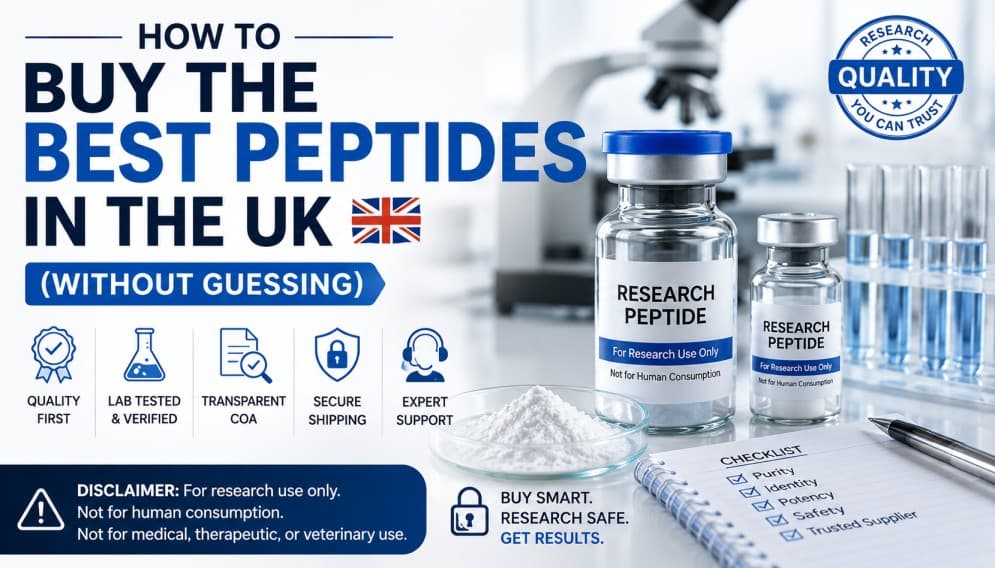
Discover how to buy the best research peptides in the UK with confidence. This guide covers quality indicators, third-party testing, Certificates of Analysis (COAs), supplier transparency, and other essential factors to help researchers source reliable compounds for laboratory use.
Searching to buy best peptides in UK listings usually turns up dozens of near-identical product pages, all claiming "premium" or "highest quality." The problem is that almost none of them show their work. This guide breaks down what actually separates a genuinely high-purity supplier from one that's just using the right adjectives.
This article covers products intended solely for laboratory and in-vitro research. None of the peptides discussed are approved or intended for human or veterinary use.
"Best" Should Mean Verifiable, Not Just Marketed
A top rated peptide supplier UK researchers actually return to isn't the one with the flashiest homepage — it's the one whose claims hold up under scrutiny. When evaluating who to buy from, look past the copy and check:
- Does every product list a specific purity percentage, or just "high quality"?
- Is there a batch-matched COA, or a single generic certificate reused site-wide?
- Is the testing done by an independent third party, or only in-house?
- Is storage and handling guidance specific, or a vague one-liner?
What Defines High Purity Peptides UK Suppliers Should Offer
High purity peptides UK researchers rely on are typically verified at 98% or above via HPLC or mass spectrometry, with results published per batch rather than per product. Purity below this threshold introduces more variability into experimental results, which matters considerably in dose-response or binding-affinity studies where small deviations compound quickly.
Reputation Signals Worth Checking
Before deciding where to buy, a few practical checks go a long way:
- Direct contact channels — a supplier reachable by email or messaging (rather than a contact form that vanishes into a void) suggests actual accountability.
- A dedicated quality or COA page, not just certificates buried in product descriptions.
- Consistent stock and restocking cadence — frequent "best sellers restocked weekly" listings suggest genuine turnover rather than dead stock sitting on a shelf.
- Clear, unambiguous research-use disclaimers throughout the site, not just in the small print.
Premium Peptides UK: Product Range to Expect
A supplier positioning itself around premium peptides UK researchers want should offer more than a handful of SKUs. Look for a organised catalogue spanning single-compound peptides, pre-mixed blends for streamlined protocols, and the lab supplies (like bacteriostatic water) needed for correct reconstitution — all under one roof, with purity data visible at a glance.
Why Researchers Choose a Trusted Peptide Brand UK-Wide
A trusted peptide brand UK researchers recommend to colleagues tends to share a few traits: consistent batch quality over time, fast and careful UK shipping that limits time in transit, and transparent communication when questions come up about a specific lot or certificate.
Frequently Asked Questions
What purity percentage should I look for?
98% or higher, verified independently and published per batch, is generally considered the benchmark for research-grade peptides.
Does a higher price always mean better quality?
Not necessarily — price should be cross-checked against COA transparency and independent testing, not taken as a quality signal on its own.
How can I verify a supplier's claims before ordering?
Request the COA for the specific batch you're considering and check that the lot number matches what you'll receive.
Buy the Best Peptides in the UK from Flex Peptides
Flex Peptides publishes a third-party COA on every batch, verifies 98%+ purity across its range, and dispatches from a UK facility in 1–3 days. Explore the catalogue and see the testing data for yourself before you buy.
Disclaimer: This content is provided for informational and educational purposes only. Products available from Flex Peptides are intended exclusively for laboratory and scientific research and are not for human consumption, medical treatment, diagnosis, prevention of disease, or veterinary use. Users are responsible for complying with all applicable UK laws, regulations, and institutional requirements before purchasing or using research compounds.