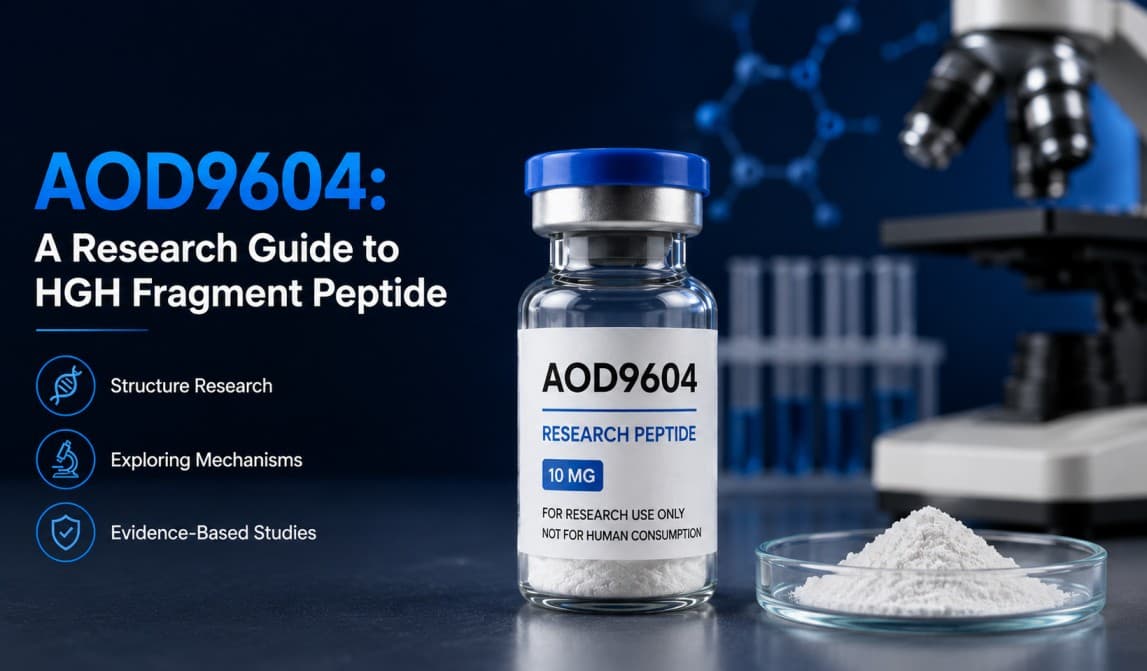
Learn about AOD9604 and its role in peptide research. This guide covers laboratory studies, potential research applications, storage recommendations, and what researchers should know before selecting high-quality research materials.
For research use only. Not for human consumption.
Introduction
AOD9604 is one of the most extensively studied peptides in the fat-metabolism research space, with a research history stretching back more than two decades. Unlike many newer peptides, AOD9604 was originally developed and taken through formal pharmaceutical trials before continuing on as a widely used laboratory research compound. This guide walks through what AOD9604 is, the proposed mechanisms behind its research interest, what preclinical and clinical trial data have shown, and where the science currently stands.
What Is AOD9604?
AOD9604 — also referred to as HGH Fragment 176-191 — is a synthetic analog of human growth hormone, derived by modifying the final sixteen amino acids of the HGH molecule, from positions 176 to 191. The peptide incorporates an additional tyrosine residue at its N-terminus, which researchers believe contributes to its stability in laboratory settings. Because it corresponds to only a small fragment of full HGH, it was designed by its original developers to isolate the fat-metabolizing region of the growth hormone molecule while leaving out the regions responsible for HGH's broader effects on tissue growth and insulin-like signaling.
Proposed Mechanisms
The research interest in AOD9604 centers on its apparent ability to influence fat cell (adipocyte) behavior through pathways that are at least partly distinct from the rest of the growth hormone molecule.
Lipolysis stimulation. Researchers have proposed that AOD9604 may stimulate lipolysis directly within adipose cells and indirectly increase overall energy expenditure, potentially through modulation of β3-adrenergic receptor (β3-AR) expression — a receptor type understood to be central to fat breakdown in adipocytes. In studies using obese murine models, AOD9604 administration was associated with increased lipolysis that coincided with elevated β3-AR mRNA expression, supporting the hypothesis that the peptide sensitizes fat cells to lipolytic signaling rather than simply forcing fat breakdown through a separate pathway.
Reduced lipogenesis. Beyond promoting the release of existing fat stores, research indicates AOD9604 may also help limit the formation of new fat, suggesting a role in reducing fat storage overall rather than only accelerating its breakdown.
Selectivity versus full-length HGH. A recurring theme across the literature is AOD9604's apparent selectivity. Studies suggest the peptide may induce lipolysis without significantly affecting insulin or IGF-1 levels in laboratory models, which would, in principle, reduce the glucose-intolerance risk associated with full HGH exposure. Its structural similarity to native HGH is also thought to lower the likelihood of antibody formation in research models, an important consideration for any peptide intended for repeated experimental administration.
What the Foundational Studies Showed
Much of the mechanistic foundation for AOD9604 traces back to early 2000s pharmacology research. A study published in the Journal of Endocrinology demonstrated that AOD9604 produced lipolysis and increased fat oxidation in obese mice through the beta-adrenergic pathway, with effects comparable to full-length HGH but without the insulin-disrupting effects associated with the intact hormone. This early mechanistic work provided the rationale for moving AOD9604 into human clinical trials.
Subsequent research examined the compound's action in isolated human tissue as well. Studies report that AOD9604 enhanced lipolysis in human adipose tissue samples, producing roughly a threefold increase in glycerol release — a standard marker of active fat breakdown — through activation of β3-adrenergic receptor signaling.
The Human Clinical Trial History
AOD9604's history is somewhat unusual among research peptides because it underwent formal drug-development trials in humans. In an early trial, participants receiving 1 mg per day of AOD9604 lost approximately 2.6 kg, compared with 0.8 kg in the placebo group, a statistically significant difference. However, a larger follow-up pivotal trial, known as METAOD006 (or OPTIONS), enrolled a bigger cohort and failed to replicate statistically significant weight loss, leading the sponsoring company, Metabolic Pharmaceuticals, to halt the formal drug-development program in 2007.
Following the end of that development program, AOD9604 received a GRAS (Generally Recognized As Safe) designation from the FDA for use as a food ingredient — a regulatory category that is separate from, and does not equate to, approval as a pharmaceutical drug. It remains classified as an investigational peptide rather than an approved medicine. This regulatory history is worth understanding for context: the compound has more human safety and pharmacokinetic data behind it than many newer research peptides, but the pivotal efficacy trial ultimately did not succeed, which is why AOD9604 never reached the market as an approved obesity drug.
Research Beyond Fat Metabolism
While AOD9604's primary research focus remains fat metabolism, the literature extends into a few adjacent areas:
Cartilage and joint tissue. Early exploratory studies have examined whether AOD9604's signaling properties could support connective tissue repair under mechanical stress, and a rabbit osteoarthritis model study investigated intra-articular injection of AOD9604, in some cases alongside hyaluronic acid, as a research approach to joint tissue changes.
Cardiovascular and metabolic risk markers. Scientific literature has also explored AOD9604 in relation to cardiovascular risk factors, hypercholesterolemia, and broader features of metabolic syndrome, in addition to its central role in cartilage and fat-metabolism research.
Interpreting the Evidence Responsibly
It's worth being direct about where the evidence base is strong and where it is still developing. The mechanistic and animal-model data for AOD9604 are relatively mature compared with many newer peptides, given the compound's formal drug-trial history. At the same time, reviewers note that evidence for many of AOD9604's proposed effects in humans remains limited and preclinical, and the pivotal human efficacy trial did not confirm the weight-loss signal seen in the earlier, smaller study. Claims that AOD9604 is a proven fat-loss solution outrun what the clinical trial record actually shows.
Summary
AOD9604 is a growth-hormone-derived peptide fragment with one of the longer and more clinically documented research histories in the peptide space. Preclinical work points to a mechanism centered on β3-adrenergic receptor modulation, enhanced lipolysis, and reduced lipogenesis, largely independent of the insulin- and IGF-1-related pathways associated with full-length HGH. Early human trials showed a promising signal that a larger pivotal trial did not replicate, and the compound today sits in an unusual regulatory position: GRAS-designated as a food ingredient, but not an approved drug. Ongoing research continues to explore its potential role in cartilage and joint biology alongside its established fat-metabolism focus.
A Note on Responsible Use
AOD9604, as offered on this site, is supplied strictly for laboratory and in-vitro research use by qualified professionals and institutions. It is not intended for human or animal administration outside of a controlled research setting, and nothing in this article should be read as guidance for personal use, dosing, or self-administration. Anyone designing a study involving AOD9604 should consult the primary literature cited here and follow their institution's research protocols.
Disclaimer: This article summarizes publicly available research for general scientific and educational purposes. It is not medical advice, and FlexPeptides does not sell products intended for human consumption.