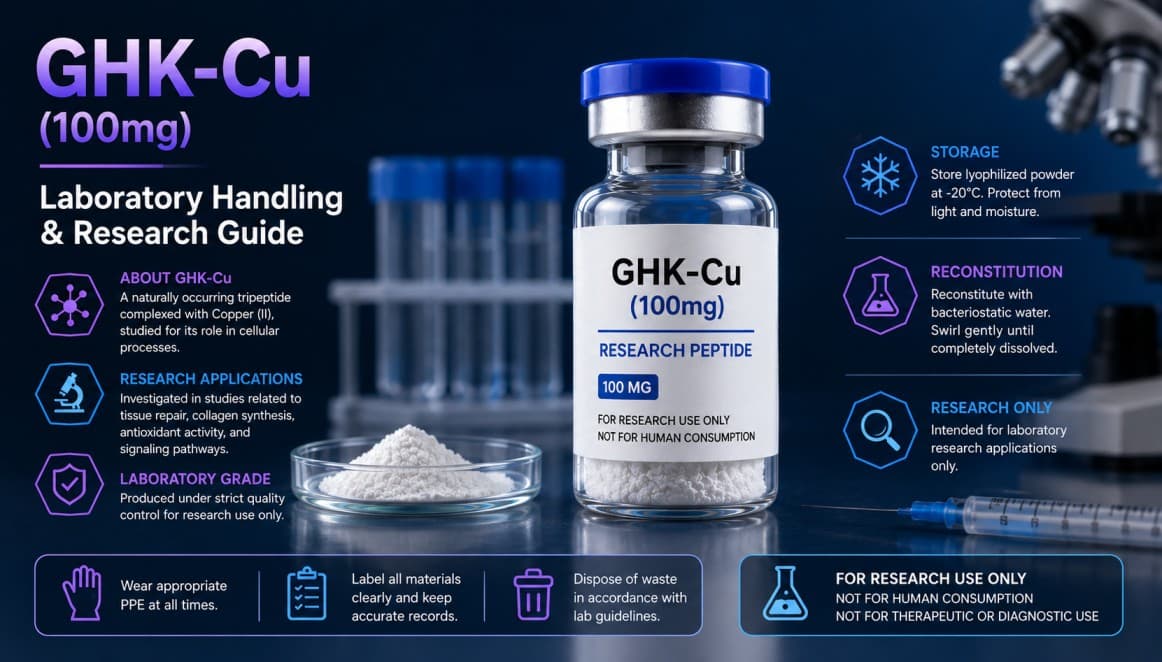
This guide provides an overview of GHK-Cu 100mg, including its research uses, quality considerations, storage practices, and the importance of sourcing research-grade peptides for reliable laboratory studies.
For research use only. Not for human consumption.
Introduction
For laboratories running extended cell-culture series, multi-arm animal studies, or repeat in-vitro assays, the 100mg format of GHK-Cu is a common choice — it offers more working material per vial and reduces the frequency of reordering for ongoing protocols. This guide focuses on the practical side of working with GHK-Cu at this scale: its chemical identity, how it behaves in solution, storage and stability considerations that affect reproducibility, and an overview of the research areas where higher quantities of material are typically needed. It complements our companion piece, the GHK-Cu Research Overview, which covers the peptide's mechanisms and clinical trial literature in more depth.
Chemical Identity
GHK-Cu consists of three amino acids — glycine, histidine, and lysine — complexed with a copper(II) ion, giving it the molecular formula C₁₄H₂₄CuN₆O₄ and a molecular weight of approximately 403.9 Da. The histidine residue provides the primary copper-binding site within the tripeptide structure. This small size and simple structure make GHK-Cu relatively straightforward to synthesize at high purity, but its copper-binding chemistry does introduce handling considerations that don't apply to unbound peptides.
Purity Verification
Research-grade GHK-Cu should always come with documented purity analysis. Reversed-phase HPLC is the standard method used to quantify purity, typically against a ≥99% threshold for research-grade material, while liquid chromatography–mass spectrometry (LC-MS) is used to confirm peptide identity by verifying molecular weight. A certificate of analysis (COA) reporting both HPLC purity and LC-MS identity confirmation should accompany any batch used in reproducible research, and researchers are encouraged to request or review this documentation before beginning a study.
Storage: Lyophilized Powder
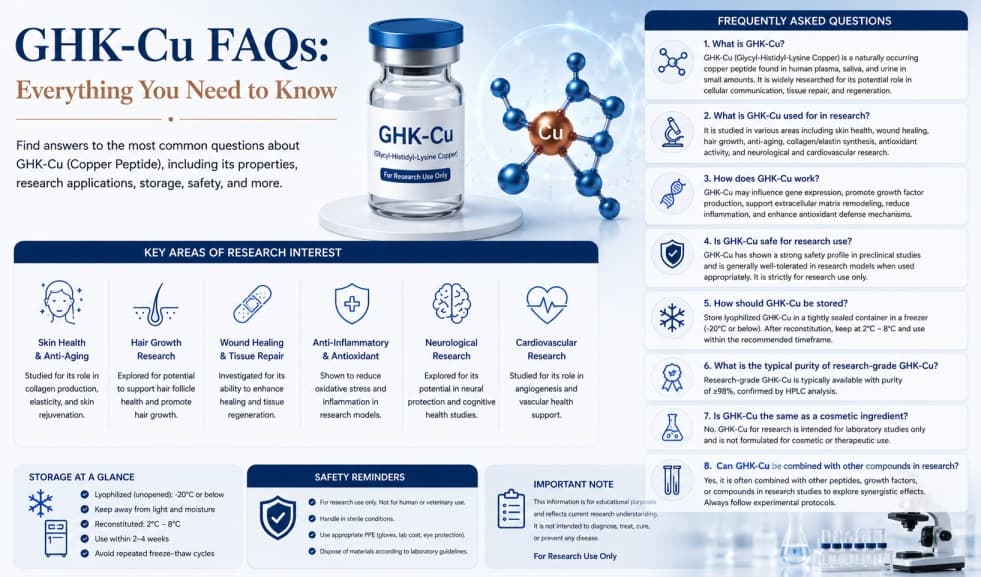
Proper storage is one of the most common sources of inconsistent results in GHK-Cu research, largely because its copper-binding chemistry is more sensitive to environmental conditions than many unbound peptides. The core storage principle is straightforward: lyophilized powder should be kept cold, dry, dark, and sealed. Lyophilized GHK-Cu should be stored at -20°C for maximum stability, where it can remain viable for up to 24 months, and should be kept in sealed vials with desiccant, protected from light, to retain stability for 24 or more months under typical research-storage conditions.
Storage: Reconstituted Solutions
Once GHK-Cu is dissolved for use in an assay, its stability profile changes considerably. The introduction of water creates conditions for hydrolysis, microbial growth, and oxidative degradation that are not present during dry storage, so reconstituted material should be handled with more care than the lyophilized powder.
Key handling points from the research-methods literature:
- Reconstitution should be performed under aseptic technique — ideally in a biosafety cabinet or clean bench — to prevent microbial contamination of the sample.
- GHK-Cu is generally stable in neutral to mildly acidic aqueous buffers, while strongly basic conditions, elevated temperatures, and prolonged light exposure can compromise the copper coordination and degrade the peptide.
- Reconstituted solution should be refrigerated at 2–8°C immediately and kept refrigerated throughout the storage period; it should not be frozen, since ice-crystal formation physically damages peptide structure — one of the more common handling errors in research settings.
- Buffered solutions held at 2–8°C are typically used within 14–28 days for sensitive in-vitro work, with longer-term storage moved to -20°C aliquots. Aliquoting reconstituted material helps minimize freeze-thaw cycles, which is one of the most reliable ways to preserve activity across a multi-week study.
Because a 100mg vial typically yields more usable solution than a 50mg vial, aliquoting becomes especially important at this scale — splitting the reconstituted stock into single-use portions immediately after preparation reduces the number of times any one aliquot is exposed to room temperature or repeated freeze-thaw cycling.
Working Concentrations Reported in the Literature
For researchers designing in-vitro protocols, published concentration ranges provide a useful starting reference point (though any specific protocol should be validated against the relevant primary literature for the assay in question). Published in-vitro work commonly uses GHK-Cu at concentrations between 10 nM and 10 μM in fibroblast culture, with 1 μM representing a frequently reported working concentration. Animal-model topical studies, separately, have used solutions ranging from 0.05% to 0.2% (w/v). A 100mg vial provides substantially more flexibility for researchers who need to prepare a range of concentrations across multiple experimental arms, or who are running dose-response curves as part of a mechanistic study.
Research Applications That Benefit From Larger Quantities
While the mechanistic and clinical background on GHK-Cu is covered in our companion overview article, a few specific research areas commonly draw on larger quantities of material due to the number of replicates or extended timelines involved:
Extended fibroblast and extracellular matrix studies. Multi-week culture studies examining collagen, elastin, and proteoglycan gene expression often require repeat dosing of cultures across several passages, which draws down stock material more quickly than a single-endpoint assay.
Hair follicle and dermal papilla research. A growing body of research literature has examined GHK-Cu's effects on hair follicle biology, building on its established role in extracellular matrix remodeling and its upregulation of genes associated with extracellular matrix remodeling, such as decorin and TGF-β receptors, alongside downregulation of inflammatory cytokines including IL-6 and TNF-α — pathways relevant to follicle miniaturization research models. Studies in this area often run multiple concentration arms across cultured follicle or dermal papilla cell models, which similarly benefits from a larger quantity of starting material.
Radiobiology and fibroblast-protection studies. As covered in our GHK-Cu research overview, studies examining GHK-Cu's protective effects on irradiated fibroblasts often involve multiple treatment groups and control arms, another context where a 100mg format reduces the need for mid-study reordering.
Safety Profile in the Research Literature
GHK-Cu has a favorable safety profile across decades of research, and the FDA's cosmetic ingredient database does not list it as a restricted ingredient, reflecting its established safety record in topical cosmetic contexts. That said, as noted in our companion overview article, higher concentrations of GHK-Cu can produce irritation in experimental models, and copper itself is a toxic element at sufficient concentrations — a reminder that careful attention to concentration and handling protocol matters regardless of how much total material a lab has on hand.
Summary
The 100mg format of GHK-Cu is best suited to labs running extended, multi-arm, or replicate-heavy protocols where reordering smaller quantities mid-study would be impractical. Getting reliable, reproducible results at this scale comes down to three fundamentals: verifying purity via HPLC/LC-MS documentation, storing lyophilized powder cold, dry, dark, and sealed, and handling reconstituted solution with aseptic technique, refrigeration, and aliquoting to minimize freeze-thaw exposure.
A Note on Responsible Research Use
The GHK-Cu (100mg) product referenced on this site is supplied strictly for laboratory and in-vitro research use by qualified professionals and institutions. It is not intended for human or animal administration outside of a controlled research setting, and the handling information in this guide describes laboratory sample preparation only — it is not instruction for personal or therapeutic use. Researchers should consult the primary literature and follow their institution's biosafety and chemical-handling protocols.
Disclaimer: This article summarizes publicly available research and standard laboratory handling practices for general scientific and educational purposes. It is not medical advice, and FlexPeptides does not sell products intended for human consumption.