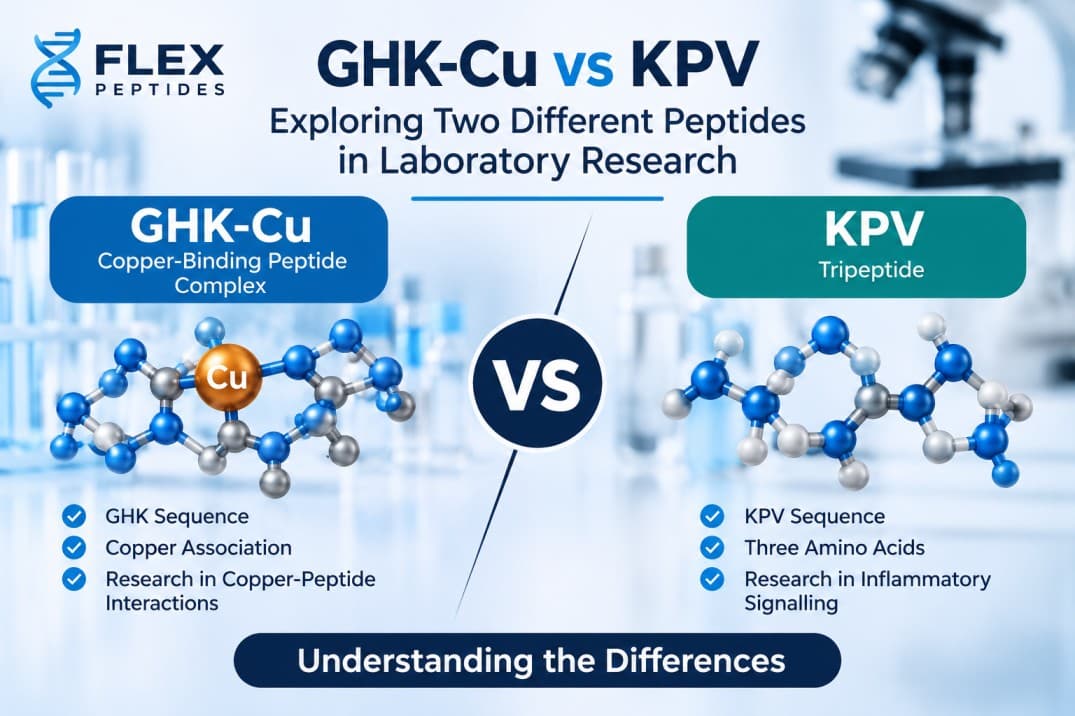
Discover the key differences between GHK-Cu and KPV, exploring their molecular structures, copper-binding properties and individual research backgrounds.
Introduction
Peptides are widely explored in scientific research because of their different structures and biological properties. Among the compounds attracting attention are GHK-Cu and KPV.
Although both are short peptide-based compounds, they have different molecular characteristics and research backgrounds. GHK-Cu is a copper-binding peptide complex, while KPV is a short tripeptide made up of three amino acids.
In this article, we explore GHK-Cu vs KPV, their differences, individual research areas and the importance of understanding their molecular identities.
What Is GHK-Cu?
GHK-Cu is a copper-binding peptide complex consisting of the tripeptide glycyl-L-histidyl-L-lysine (GHK) associated with a copper ion.
It is frequently discussed in scientific literature concerning copper-peptide interactions and biological research.
GHK-Cu has attracted interest in several areas, including copper-binding research, cellular signalling investigations, extracellular matrix research, studies involving biological tissue models and research into peptide-metal interactions.
Its distinctive copper-binding characteristics make it different from many other short peptides.
What Is KPV?
KPV is a short tripeptide consisting of three amino acids: lysine (K), proline (P) and valine (V).
It is associated with research into inflammatory signalling pathways and cellular processes. Its small molecular structure makes it an interesting compound for scientific investigations involving peptide sequences and biological signalling.
GHK-Cu vs KPV: Understanding the Differences
One of the most noticeable differences between GHK-Cu and KPV is their molecular composition. GHK-Cu consists of the GHK peptide associated with a copper ion, whereas KPV is made up of three amino acids without a copper component.
Their research backgrounds are also different. GHK-Cu is frequently discussed in copper-related biological research, while KPV has attracted attention in investigations involving inflammatory signalling and related cellular processes.
These differences demonstrate why the two compounds should be identified and evaluated separately in laboratory research.
Four Important Differences
1. Their molecular composition
GHK-Cu contains a copper-associated peptide structure, while KPV consists of three amino acids. This is one of the most important differences when examining their molecular identities.
2. Their research backgrounds
GHK-Cu is frequently discussed in copper-related biological research. KPV, on the other hand, has attracted attention in investigations involving inflammatory signalling.
3. Their product characteristics
The compounds have different molecular compositions and should be identified and documented separately. Researchers should not assume that similar product categories indicate identical chemical properties.
4. Their analytical documentation
Accurate product identification is important when evaluating either compound. Batch-specific documentation should clearly identify the material being examined and provide relevant analytical information.
Why Are GHK-Cu and KPV Popular Research Topics?
One reason these peptides attract scientific interest is that they represent different areas of peptide-related research.
GHK-Cu provides an example of a peptide associated with metal binding, while KPV provides an example of a short peptide investigated in relation to cellular signalling.
Their differences also make them useful subjects for educational discussions about peptide structures and research classification.
What Should Be Considered When Evaluating These Peptides?
Before examining research materials, it is useful to consider correct peptide identification, accurate amino acid sequence information, product labelling, batch-specific quality documentation, available analytical reports and appropriate laboratory storage guidance.
These details help researchers understand exactly which material is being evaluated and support more accurate laboratory records.
Frequently Asked Questions
Are GHK-Cu and KPV the same?
No. GHK-Cu is a copper-binding peptide complex, whereas KPV is a tripeptide consisting of lysine, proline and valine.
What does GHK-Cu stand for?
GHK represents glycyl-L-histidyl-L-lysine, while Cu represents copper.
What does KPV stand for?
KPV represents lysine, proline and valine.
Do both peptides have the same research background?
No. GHK-Cu is associated with copper-peptide research, while KPV is investigated in relation to inflammatory signalling.
Why is peptide identification important?
Correct identification helps distinguish individual compounds and supports accurate scientific documentation.
Conclusion
GHK-Cu and KPV are two distinct peptides with different molecular characteristics and research backgrounds. Their comparison provides a useful introduction to the diversity of compounds explored in modern peptide research.
Understanding their composition, identity and individual research areas helps create a clearer picture of the wider peptide research landscape.
Explore Flex Peptides
Flex Peptides offers research-grade GHK-Cu and KPV products with product information and available batch documentation.
Research Use Only: All products are intended strictly for qualified laboratory and in-vitro research. They are not intended for human or veterinary use, consumption, administration, diagnosis or treatment.