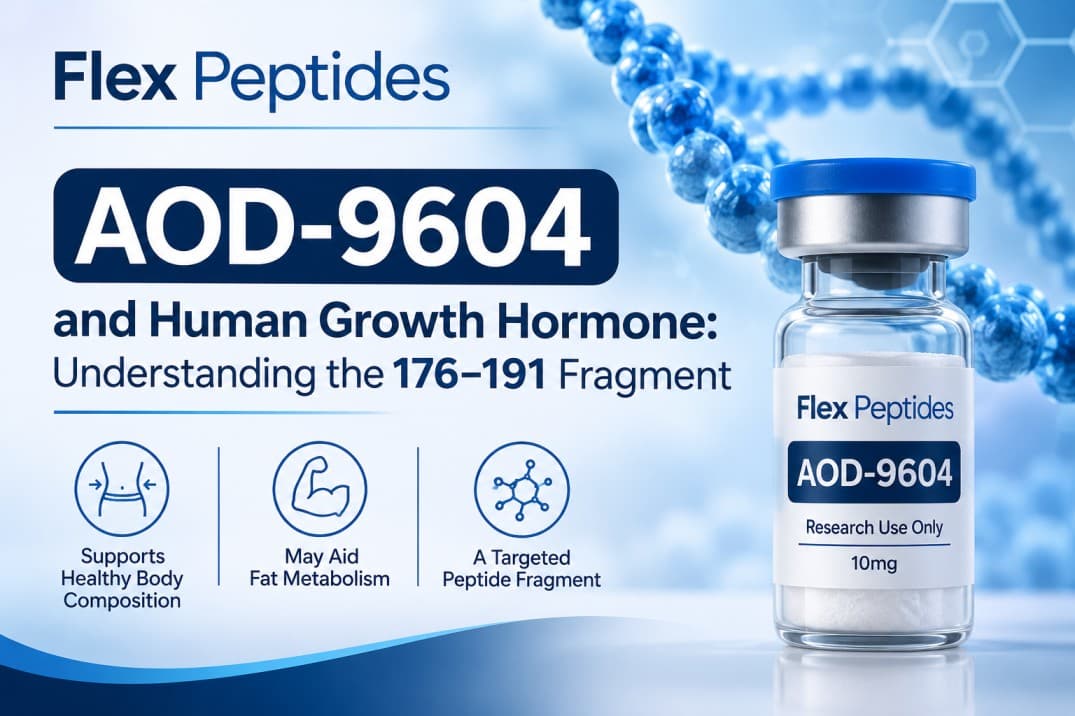
Discover the AOD-9604 176–191 fragment, its amino acid sequence and its relationship with human growth hormone. Learn about its molecular structure and analytical characterisation.
Introduction
AOD-9604 is a synthetic peptide associated with research into a specific region of human growth hormone. Its molecular design is based on a short sequence near the C-terminal region of the hormone rather than the complete growth hormone molecule.
Understanding this relationship helps explain how AOD-9604 differs structurally from human growth hormone and why researchers describe it as a peptide fragment.
This article explores its molecular background, sequence and analytical characterisation while distinguishing structural information from evidence of clinical effectiveness.
What Is AOD-9604?
AOD-9604 is a synthetic 16-amino-acid peptide developed from the C-terminal region of human growth hormone.
It is commonly described in research literature as a modified form of the hGH 176–191 region. Its commonly reported sequence is:
YLRIVQCRSVEGSCGF
The sequence contains two cysteine residues. These are associated with an intramolecular disulfide bond, an important structural feature to consider when characterising the molecule.
How Is AOD-9604 Related to Human Growth Hormone?
Mature human growth hormone contains 191 amino acid residues.
AOD-9604 is based on a much shorter region near the C-terminal end. Therefore, it is not full-length human growth hormone.
This distinction matters when interpreting scientific research. Findings relating to the complete growth hormone molecule should not automatically be attributed to AOD-9604. Similarly, a study involving AOD-9604 should be interpreted according to the exact material and experimental conditions used.
Understanding the AOD-9604 Sequence
The commonly reported sequence is:
YLRIVQCRSVEGSCGF
Its notable structural features include:
- Sixteen amino acid residues.
- Two cysteine residues.
- An intramolecular disulfide bond associated with the cysteine residues.
- A modified relationship to the corresponding human growth hormone region.
The disulfide bond is particularly relevant because it contributes to the molecule's structure. A sequence written using one-letter amino acid codes does not, by itself, demonstrate whether the expected bond has formed correctly.
Therefore, complete characterisation should consider both the amino acid sequence and the relevant chemical structure.
Why Is the Disulfide Bond Important?
A disulfide bond forms when the sulphur-containing side chains of two cysteine residues connect.
In peptides containing two appropriately positioned cysteines, this bond creates a structural connection within the molecule.
For AOD-9604, the expected cysteine linkage is an important consideration when evaluating molecular identity. Analytical assessment may therefore need to go beyond checking the expected molecular mass.
How Can Researchers Characterise AOD-9604?
Researchers can use complementary analytical methods to investigate the compound.
HPLC separates sample components and provides information about chromatographic purity.
Mass spectrometry helps determine whether the measured mass is consistent with the expected molecular composition.
Tandem mass spectrometry provides fragmentation information that supports sequence identification.
Disulfide-bond analysis may be used where necessary to investigate whether the expected cysteine linkage is present.
Batch-specific certificates of analysis document the tested material, analytical methods and reported results.
No single analytical result proves every quality attribute. The appropriate methods depend on the material specification and the requirements of the research.
What Does the Research Say About AOD-9604?
AOD-9604 has been investigated in preclinical and human research settings. However, the existence of published research does not establish that a compound is safe or effective for a particular purpose.
Researchers should review the original study design, participant characteristics, measured outcomes and limitations before interpreting any findings.
It is also important to distinguish experimental observations from established clinical conclusions. Molecular structure alone cannot demonstrate therapeutic effectiveness.
Frequently Asked Questions
Is AOD-9604 the same as human growth hormone?
No. AOD-9604 is a synthetic 16-amino-acid peptide based on a region of human growth hormone. It is not the complete 191-amino-acid hormone.
How many amino acids are in AOD-9604?
Its commonly reported sequence contains 16 amino acid residues.
Does AOD-9604 contain a disulfide bond?
Its two cysteine residues are associated with an intramolecular disulfide bond.
Why is AOD-9604 called a growth hormone fragment?
Its sequence is based on a short region near the C-terminal end of human growth hormone.
Does its structure prove its effectiveness?
No. Molecular structure describes chemical identity. It does not independently demonstrate clinical effectiveness or safety.
Conclusion
AOD-9604 is a synthetic peptide based on a short region of human growth hormone. Its 16-amino-acid sequence and cysteine-linked structure are important features when investigating its molecular identity.
For accurate research documentation, scientists should distinguish AOD-9604 from full-length human growth hormone and assess its identity using appropriate analytical methods.
Research-use notice: Flex Peptides products are supplied for laboratory research purposes only. They are not medicines and are not intended for human or veterinary consumption, diagnosis or treatment.