Explore the TB-500 peptide sequence, its molecular structure and its relationship with thymosin beta-4. Understand why sequence identification and acetylation matter in laboratory research.
Introduction
Peptide identification depends on more than a product name. The amino acid sequence, molecular mass and chemical modifications all contribute to defining a peptide's structure.
TB-500 is commonly discussed in connection with thymosin beta-4. However, the terminology can cause confusion, particularly when researchers compare scientific publications with commercial product descriptions.
This guide explains the TB-500 sequence, its relationship with thymosin beta-4 and why understanding the difference matters when reviewing laboratory documentation.
What Is the TB-500 Peptide Sequence?
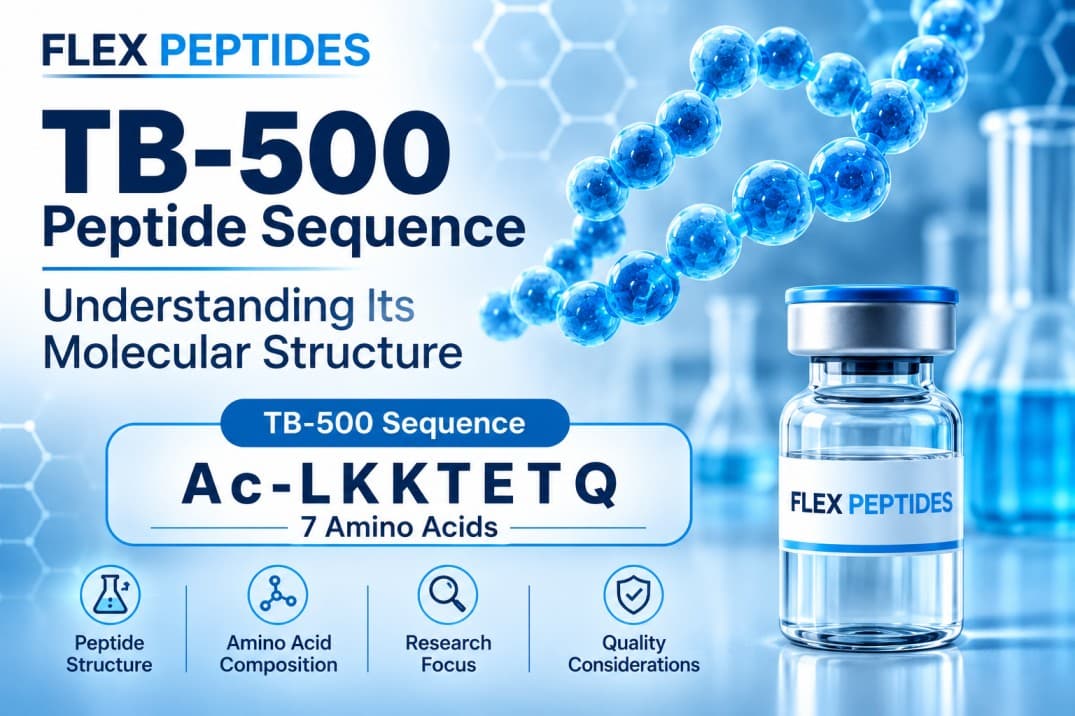
The seven-residue, N-terminally acetylated thymosin beta-4 fragment commonly identified as TB-500 in analytical literature has the sequence:
Ac-LKKTETQ
The seven amino acids are leucine, lysine, lysine, threonine, glutamic acid, threonine and glutamine.
The prefix Ac- represents an acetyl group attached to the N-terminal end. This modification forms part of the molecular description and should be considered when interpreting analytical results.
TB-500 and Thymosin Beta-4: Understanding the Difference
One important distinction in peptide research is the difference between a short peptide fragment and a full-length protein.
Mature thymosin beta-4 contains 43 amino acid residues. The seven-residue fragment described above corresponds to a short region within that protein.
Consequently, the fragment and the full-length protein are not interchangeable molecular entities.
This distinction is important when interpreting scientific publications. A study investigating full-length thymosin beta-4 cannot automatically be treated as evidence about a shorter TB-500 fragment. Researchers should check the precise material used in each study.
Why Does N-Terminal Acetylation Matter?
N-terminal acetylation is a chemical modification in which an acetyl group attaches to the amino end of a peptide.
For the fragment described above, the acetylated form is written as Ac-LKKTETQ. This modification contributes to the compound's molecular mass and chemical identity.
When comparing a reference standard with a test sample, laboratories should account for this modification. Otherwise, a difference in measured mass may be incorrectly interpreted.
How Is TB-500 Identity Analysed?
Researchers can use several analytical techniques to investigate peptide identity.
Mass spectrometry helps establish whether the measured molecular mass is consistent with the expected acetylated peptide.
Tandem mass spectrometry provides fragmentation information that can support sequence identification.
HPLC separates components in a sample and helps assess chromatographic purity under defined conditions.
Batch-specific documentation connects the analytical findings to a particular batch and should clearly identify the tested material.
A chromatographic purity result alone cannot confirm every structural feature. Combining suitable analytical methods provides a more complete assessment.
What Should Researchers Check in a TB-500 Specification?
A useful material specification should clearly identify the amino acid sequence, any N-terminal modification, expected molecular mass and chemical form.
Researchers should also review batch identification, analytical methods and the results recorded in the relevant certificate of analysis.
This is particularly important when different suppliers use similar terminology for materials that may not have identical molecular structures.
Frequently Asked Questions
What is the TB-500 amino acid sequence?
The seven-residue, N-terminally acetylated fragment described in analytical literature has the sequence Ac-LKKTETQ.
How many amino acids are in this TB-500 fragment?
The fragment contains seven amino acid residues.
Is TB-500 the same as full-length thymosin beta-4?
No. The seven-residue fragment and the full-length 43-residue protein have different molecular structures.
Why is acetylation important?
Acetylation is part of the chemical identity of the fragment and affects its molecular mass.
Can HPLC alone confirm the TB-500 sequence?
No. HPLC helps assess chromatographic purity, while mass spectrometry and appropriate fragmentation analysis provide additional evidence of molecular identity.
Conclusion
Understanding the TB-500 peptide sequence helps clarify its relationship with thymosin beta-4 and supports accurate interpretation of laboratory documentation.
The acetylated seven-residue fragment, Ac-LKKTETQ, should be distinguished from the complete thymosin beta-4 protein. Researchers should verify the exact molecular form and review appropriate analytical evidence rather than relying on the product name alone.
Research-use notice: Flex Peptides products are supplied for laboratory research purposes only. They are not medicines and are not intended for human or veterinary consumption, diagnosis or treatment.