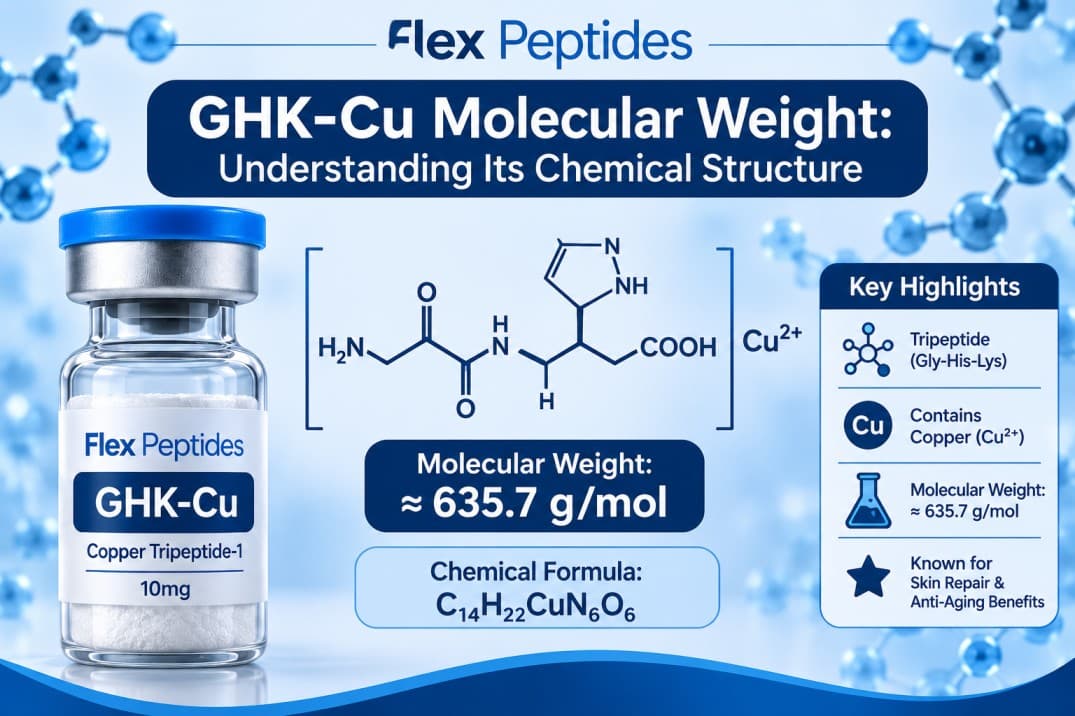
GHK-Cu is a copper-binding tripeptide made from glycine, histidine and lysine. Explore its molecular weight, chemical formula and structural features, including why different chemical records can report different values.
GHK-Cu is a copper-binding peptide that attracts interest in peptide chemistry and laboratory research. Its name refers to three amino acids—glycine, histidine and lysine—associated with a copper ion.
Understanding the molecular weight of GHK-Cu requires more than looking at the peptide sequence. The presence of copper and differences in how the chemical complex is represented can affect the molecular formula and reported mass.
This guide explores the GHK-Cu molecular weight, chemical formula, amino acid sequence and important structural characteristics.
What Is GHK-Cu?
GHK-Cu is commonly described as a copper complex of the tripeptide GHK, which stands for:
- G: Glycine
- H: Histidine
- K: Lysine
The three amino acids form a short peptide chain. Copper is associated with this structure through coordination interactions, making GHK-Cu different from the copper-free GHK peptide.
GHK-Cu is also known by names such as copper tripeptide-1 and prezatide copper. These names appear in chemical and ingredient reference databases.
What Is the Molecular Weight of GHK-Cu?
The reported molecular weight depends on the exact chemical structure and representation being referenced.
For the commonly referenced 1:1 copper–GHK complex, PubChem lists the following values for prezatide copper:
- Molecular formula: C₁₄H₂₃CuN₆O₄⁺
- Molecular weight: Approximately 402.92 g/mol
- PubChem Compound ID: 71587328
Another PubChem record for Cu-GHK lists a formula of C₁₄H₂₄CuN₆O₄ and a molecular weight of approximately 403.92 g/mol.
These values should not be treated as interchangeable without checking the underlying chemical representation. Charge state, protonation and coordination conventions can affect how a structure is recorded.
Understanding the GHK-Cu Molecular Formula
The molecular formula identifies the elements represented in a chemical structure.
For the prezatide copper record, the formula is:
C₁₄H₂₃CuN₆O₄⁺
This indicates the presence of:
- Carbon (C)
- Hydrogen (H)
- Copper (Cu)
- Nitrogen (N)
- Oxygen (O)
The copper atom is an important part of the complex. Therefore, the molecular formula and molecular weight of GHK-Cu are different from those of the copper-free GHK tripeptide.
Researchers should always identify which chemical record or structural form is being used before comparing molecular data.
What Is the Difference Between GHK and GHK-Cu?
GHK and GHK-Cu are related, but they are not identical chemical structures.
GHK refers to the copper-free tripeptide glycyl-L-histidyl-L-lysine. Its molecular formula is C₁₄H₂₄N₆O₄, and its molecular weight is approximately 340.38 g/mol.
GHK-Cu refers to a copper-associated form of the peptide. The copper component changes the overall chemical composition and molecular mass.
This distinction is important when reading scientific publications, product specifications and laboratory certificates. A molecular weight listed for GHK alone should not automatically be used as the reference value for a copper-containing complex.
Why Does Copper Matter in the Molecular Structure?
Copper is a transition metal that can form coordination complexes with molecules containing suitable binding groups.
In GHK-Cu, the peptide provides sites that can coordinate with copper. Histidine is particularly relevant because its imidazole group can participate in metal binding.
This coordination is a defining feature of the copper-peptide complex. It also explains why GHK-Cu is chemically different from an ordinary three-amino-acid peptide.
When examining its structure, researchers should consider both the peptide component and the copper coordination rather than treating the compound as a simple amino acid sequence.
How Is GHK-Cu Identified in Laboratory Research?
Analytical techniques can help investigate the identity and characteristics of copper-peptide materials.
Mass Spectrometry
Mass spectrometry can support molecular identity assessment by measuring mass-to-charge ratios. Researchers should account for the expected ion, charge state and chemical form when interpreting the results.
High-Performance Liquid Chromatography
High-performance liquid chromatography (HPLC) can help assess chromatographic profiles and evaluate purity under specified analytical conditions.
However, a chromatographic purity result does not independently establish every aspect of molecular identity or copper content.
Batch-Specific Documentation
A certificate of analysis should be reviewed for the specific material being examined. Relevant information may include:
- Product identity and stated chemical form
- Molecular formula or reference molecular weight
- Analytical identification results
- Chromatographic purity results
- Batch or lot number
- Test method and reporting conditions
This information helps researchers compare the supplied material with its stated specification.
Why Can Different Sources Report Different Molecular Weights?
One common source of confusion is that chemical databases may contain multiple records associated with the name GHK-Cu.
For example, PubChem includes a record with a molecular weight of approximately 402.92 g/mol for prezatide copper. It also contains another GHK-Cu-related record with a different molecular arrangement and a reported molecular weight of 744.3 g/mol.
The latter represents a different peptide-to-copper composition, rather than simply another rounding of the same 1:1 complex.
Salt forms, hydration and protonation conventions can introduce further differences in reported mass.
For this reason, researchers should compare the complete chemical formula and structure identifier alongside the molecular weight.
Final Thoughts
GHK-Cu is a copper-associated tripeptide based on glycine, histidine and lysine. Its molecular weight is commonly reported at approximately 402.92 g/mol for the prezatide copper structure listed by PubChem, although other records describe different chemical forms and compositions.
Understanding the distinction between GHK and GHK-Cu, as well as the role of copper coordination, helps researchers interpret chemical references and laboratory documentation more accurately.
Research Use Disclaimer: Flex Peptides provides information for educational and laboratory research reference purposes only. Peptides discussed in this article are not presented for human or veterinary consumption, diagnosis, prevention or treatment of any medical condition. This article does not constitute medical advice.