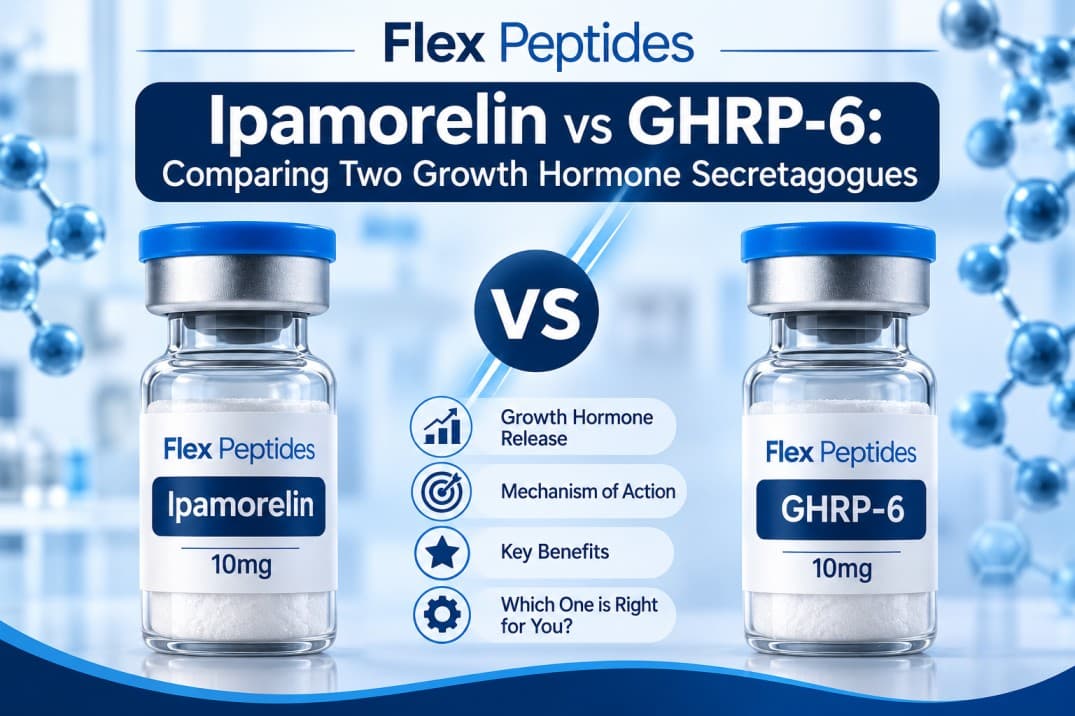
Ipamorelin and GHRP-6 are two synthetic peptides studied in growth hormone secretagogue research. Explore their molecular structures, amino acid sequences and key chemical differences in this scientific overview.
Ipamorelin and GHRP-6 are synthetic peptides investigated in research involving growth hormone secretagogues. Although both are associated with the ghrelin receptor pathway, they have different molecular structures, amino acid sequences and chemical characteristics.
Understanding these differences helps researchers distinguish between the two compounds when reviewing scientific literature, chemical references and analytical data.
What Is Ipamorelin?
Ipamorelin is a synthetic pentapeptide, meaning its structure contains five amino acid-related residues. It is also known by the research identifier NNC 26-0161.
Its molecular sequence is:
Aib–His–D-2-Nal–D-Phe–Lys–NH₂
The structure includes Aib (α-aminoisobutyric acid), a non-proteinogenic amino acid, and modified amino acid residues. These structural features distinguish Ipamorelin from many naturally occurring peptide sequences.
Ipamorelin has been investigated in relation to the growth hormone secretagogue receptor, commonly referred to as GHS-R1a. Its molecular properties make it a subject of interest in peptide and receptor research.
What Is GHRP-6?
GHRP-6, or growth hormone-releasing peptide-6, is a synthetic hexapeptide containing six amino acid residues.
Its commonly referenced sequence is:
His–D-Trp–Ala–Trp–D-Phe–Lys–NH₂
GHRP-6 has a longer peptide sequence than Ipamorelin. It contains two D-amino acid residues, D-tryptophan and D-phenylalanine, which contribute to its defined molecular configuration.
Researchers have studied GHRP-6 as a growth hormone secretagogue and as a compound associated with ghrelin receptor signalling.
Key Molecular Differences Between Ipamorelin and GHRP-6
The most noticeable difference is their peptide length. Ipamorelin is a pentapeptide, whereas GHRP-6 is a hexapeptide.
Their chemical compositions also differ. Ipamorelin has the molecular formula C₃₈H₄₉N₉O₅ and a molecular weight of approximately 711.9 g/mol. GHRP-6 has the molecular formula C₄₆H₅₆N₁₂O₆ and a molecular weight of approximately 873.0 g/mol.
Another important distinction is their amino acid composition. Ipamorelin contains Aib and a D-2-naphthylalanine residue, while GHRP-6 contains tryptophan, alanine and phenylalanine residues in its characteristic sequence.
These differences are important when identifying peptide materials and interpreting analytical results.
Understanding Their Shared Research Background
Both compounds have been investigated in relation to GHS-R1a, also known as the ghrelin receptor. This receptor is part of a signalling system studied in endocrine and molecular biology research.
However, sharing a receptor pathway does not mean that two peptides have identical molecular behaviour. Their structures, receptor interactions and experimental findings must be assessed separately.
Researchers should therefore avoid treating Ipamorelin and GHRP-6 as interchangeable compounds.
Why Molecular Identification Matters
Accurate molecular identification is essential when working with synthetic research peptides. A compound's name alone may not provide enough information to establish its exact chemical identity.
Researchers should consider several details:
- Amino acid sequence: Confirms the stated residue arrangement.
- Molecular formula: Identifies the elemental composition of the reference structure.
- Molecular weight: Provides a useful reference for analytical identification.
- Stereochemistry: Helps distinguish between standard and D-amino acid residues.
- Salt form: Identifies whether the material is supplied as a free base or a salt.
- Analytical documentation: Helps assess whether a particular batch matches its stated identity.
Mass spectrometry and chromatographic techniques can support peptide identity and purity assessments when used appropriately.
Final Thoughts
Ipamorelin and GHRP-6 are two distinct synthetic peptides with different molecular structures. Ipamorelin contains five residues, while GHRP-6 contains six. Their amino acid sequences, molecular formulas and molecular weights also differ.
Understanding these characteristics provides a useful foundation for reviewing peptide chemistry and interpreting research documentation.
Research Use Disclaimer: Flex Peptides provides information for educational and laboratory research reference purposes only. Peptides discussed in this article are not presented for human or veterinary consumption, diagnosis, prevention or treatment of any medical condition. This article does not constitute medical advice.