Explore the chemistry of GHK-Cu, including copper coordination, peptide-metal interactions, molecular geometry and analytical characterisation.
Introduction
Peptides are not only important for understanding molecular structures and cellular signalling. They can also interact with metal ions, creating complexes with distinctive chemical properties.
One well-known example is GHK-Cu, a copper-binding peptide complex that has attracted scientific interest because of its coordination chemistry and molecular structure.
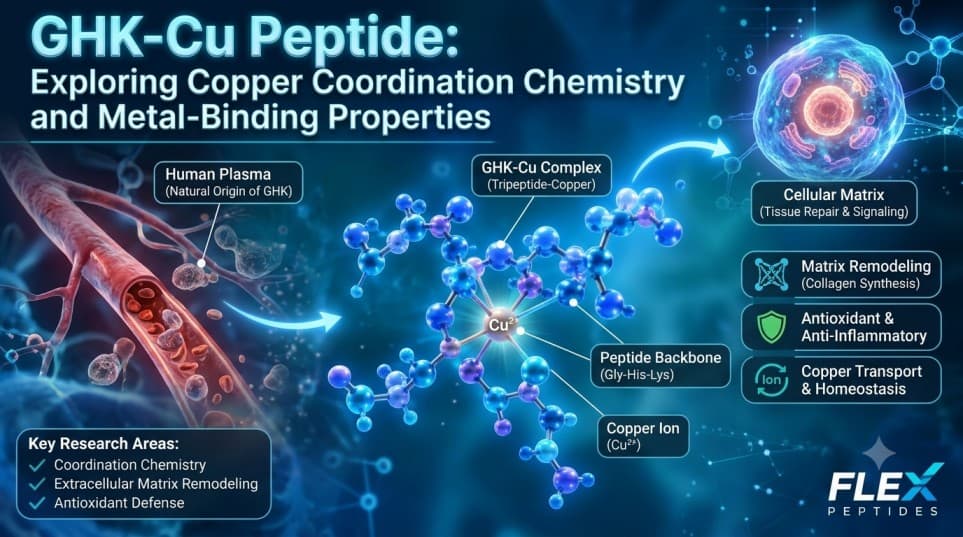
GHK-Cu consists of the tripeptide glycyl-L-histidyl-L-lysine (GHK) associated with a copper ion. The interaction between the peptide and copper provides an interesting model for studying metal coordination, ligand interactions and molecular stability.
Copper is an essential transition metal involved in numerous biological and biochemical processes. Its ability to participate in different oxidation states makes it particularly important in coordination chemistry.
This article explores the molecular structure of GHK-Cu, the chemistry of copper binding, coordination interactions and analytical techniques relevant to laboratory research.
1. What Is GHK-Cu?
GHK-Cu is a copper-peptide complex formed through the interaction of copper ions with the tripeptide glycyl-L-histidyl-L-lysine.
The GHK peptide contains three amino acid residues:
- Glycine (Gly).
- Histidine (His).
- Lysine (Lys).
The amino acid sequence provides several potential coordination sites that can interact with metal ions.
Histidine is particularly relevant because its imidazole side chain contains nitrogen atoms capable of participating in metal coordination.
The peptide's terminal groups and other potential donor atoms also contribute to its coordination chemistry.
GHK-Cu is therefore an interesting model for studying how short peptide sequences interact with transition-metal ions.
2. Understanding the GHK Molecular Structure
The structure of GHK is relatively small, consisting of three amino acid residues connected through peptide bonds.
Despite its short sequence, the peptide contains multiple chemical groups that influence its molecular behaviour.
These include:
Amino Group
The N-terminal amino group can participate in chemical interactions and may contribute to metal coordination depending on the molecular environment.
Peptide Bonds
The peptide bonds connect the three amino acid residues and contribute to the overall molecular structure.
Histidine Imidazole Ring
Histidine contains an imidazole side chain with nitrogen atoms that are important in metal-binding chemistry.
Lysine Side Chain
Lysine contains an amino group within its side chain, influencing the peptide's charge characteristics and molecular interactions.
The arrangement of these functional groups contributes to the ability of GHK to interact with copper ions.
3. What Is Copper Coordination Chemistry?
Coordination chemistry examines how metal ions interact with surrounding molecules known as ligands.
A ligand is a molecule or ion capable of donating electron density to a metal centre.
Copper ions can form coordination complexes with ligands containing electron-donating atoms, including nitrogen, oxygen and sulphur.
In peptide-metal complexes, certain amino acid residues provide suitable donor atoms.
Copper coordination is influenced by several factors:
- Metal oxidation state.
- Ligand structure.
- pH conditions.
- Donor atom availability.
- Molecular geometry.
- Solvent environment.
- Competition from other coordinating molecules.
In the case of GHK-Cu, the peptide provides a molecular environment in which copper coordination can be investigated.
4. How Does GHK Interact with Copper?
The interaction between GHK and copper is associated with coordination through donor atoms present within the peptide.
Histidine plays an important role because its imidazole ring contains nitrogen atoms that can interact with copper.
Other coordination contributions may involve nitrogen atoms associated with the peptide backbone and terminal functional groups.
The precise coordination arrangement depends on the chemical environment and experimental conditions.
It is important to recognise that metal-peptide complexes do not always exist as one fixed structure under every condition.
Changes in pH, ligand concentration and solvent composition can influence the distribution of coordination species.
Consequently, researchers use appropriate analytical and spectroscopic methods to investigate the structure and behaviour of GHK-Cu complexes.
5. Copper Oxidation States and Chemical Behaviour
Copper is particularly interesting in coordination chemistry because it commonly exists in two oxidation states:
Copper(I) – Cu+
Copper(I) contains a lower oxidation state and commonly forms coordination complexes with different geometries depending on the ligand environment.
Copper(II) – Cu2+
Copper(II) is widely investigated in coordination chemistry and commonly forms complexes with nitrogen- and oxygen-containing ligands.
The electronic configuration and coordination environment influence the chemical properties of these copper species.
GHK-Cu is commonly discussed as a copper(II)-associated peptide complex.
However, copper coordination behaviour can be influenced by the surrounding chemical environment, including the presence of other ligands and redox-active components.
This makes oxidation-state analysis an important consideration in advanced copper-peptide research.
6. Molecular Geometry and Coordination Sites
The geometry of a metal complex describes how coordinating atoms are arranged around the central metal ion.
Copper coordination complexes can exhibit several geometries, including:
- Square planar.
- Tetrahedral.
- Square pyramidal.
- Distorted octahedral.
The geometry depends on the oxidation state, ligand characteristics and surrounding chemical conditions.
In peptide-metal complexes, the arrangement of donor atoms can influence the overall three-dimensional molecular structure.
GHK-Cu therefore provides a useful example for examining how relatively small peptide ligands can influence metal coordination.
Researchers may investigate these interactions through spectroscopic measurements and structural modelling.
7. Factors Influencing GHK-Cu Complex Stability
The stability of a metal-peptide complex refers to how strongly the metal ion interacts with its ligand under defined conditions.
Several factors can influence this behaviour.
pH
The pH of the surrounding environment can influence the protonation state of amino acid functional groups.
This can change the availability of donor atoms for metal coordination.
Ligand Structure
The arrangement of amino acid residues influences the number and accessibility of potential coordinating groups.
Metal-to-Ligand Ratio
The relative concentrations of copper and peptide can influence the distribution of coordination species.
Competing Ligands
Other molecules capable of binding copper may influence the equilibrium between different metal complexes.
Temperature and Solvent Conditions
Environmental conditions can affect molecular interactions and the stability of coordination systems.
Understanding these factors is important when comparing experimental findings across different research conditions.
8. Analytical Techniques Used to Study GHK-Cu
The study of copper-peptide complexes often requires complementary analytical methods.
Different techniques provide information about different aspects of molecular structure and composition.
High-Performance Liquid Chromatography (HPLC)
HPLC can be used to investigate chromatographic behaviour and sample composition.
The method may require appropriate development and validation for metal-containing peptide samples.
Mass Spectrometry (MS)
Mass spectrometry can provide molecular mass information and support the investigation of peptide identity and metal-associated species.
However, metal complexes may behave differently during ionisation, so interpretation requires suitable analytical controls.
Ultraviolet-Visible Spectroscopy (UV-Vis)
UV-Vis spectroscopy can provide information about electronic transitions associated with copper complexes.
Changes in absorption characteristics may help investigate metal coordination environments.
Infrared Spectroscopy (FTIR)
FTIR can provide information about molecular vibrations and functional groups.
Comparing spectral characteristics may help investigate changes associated with complex formation.
Electron Paramagnetic Resonance (EPR)
EPR spectroscopy is particularly useful for studying paramagnetic copper(II) species.
It can provide information about the electronic environment surrounding the copper centre.
Using multiple analytical methods provides a more comprehensive understanding of GHK-Cu than relying on a single technique.
9. GHK-Cu and the Difference Between Peptide Identity and Complex Formation
An important consideration in copper-peptide research is the distinction between identifying the peptide and confirming the formation of a metal complex.
GHK is the peptide component, whereas GHK-Cu refers to the copper-associated complex.
These are related but chemically distinct materials.
Analytical investigations may therefore consider:
- Identity of the GHK peptide.
- Presence of copper.
- Metal-to-peptide composition.
- Coordination-related characteristics.
- Potential unbound peptide.
- Other copper-containing components.
- Sample stability under defined conditions.
A peptide identity result alone does not necessarily confirm the complete coordination structure of a metal-peptide complex.
Similarly, detecting copper does not independently establish that all copper is associated with the intended peptide.
This distinction is important when interpreting analytical reports.
10. Why GHK-Cu Is Interesting in Peptide Chemistry
GHK-Cu provides a valuable example of the interaction between peptide chemistry and inorganic coordination chemistry.
It combines the structural properties of a short amino acid sequence with the chemical behaviour of a transition-metal ion.
Its research relevance includes:
- Peptide-metal coordination.
- Copper-binding interactions.
- Metal-complex geometry.
- Molecular stability.
- Spectroscopic characterisation.
- Peptide identity assessment.
- Coordination chemistry of biological ligands.
These topics provide a deeper understanding of how peptides can interact with metals and form structurally distinct molecular complexes.
Conclusion
GHK-Cu is an interesting subject within the study of peptide-metal interactions and coordination chemistry.
Its molecular structure combines the tripeptide GHK with copper coordination, providing opportunities to investigate ligand interactions, metal-binding behaviour and molecular geometry.
Understanding the relationship between peptide structure, copper oxidation states and coordination environments is important when studying metal-peptide complexes.
Through complementary analytical techniques such as HPLC, mass spectrometry, UV-Vis spectroscopy and EPR, researchers can investigate different aspects of GHK-Cu molecular characterisation.
At Flex Peptides, we aim to provide research-focused information that helps readers understand peptide structures, molecular chemistry and analytical considerations.
Research-use disclaimer: GHK-Cu discussed in this article is presented exclusively for laboratory research and educational purposes. It is not intended for human or veterinary use, consumption, diagnosis or treatment. Research findings should not be interpreted as established clinical outcomes.