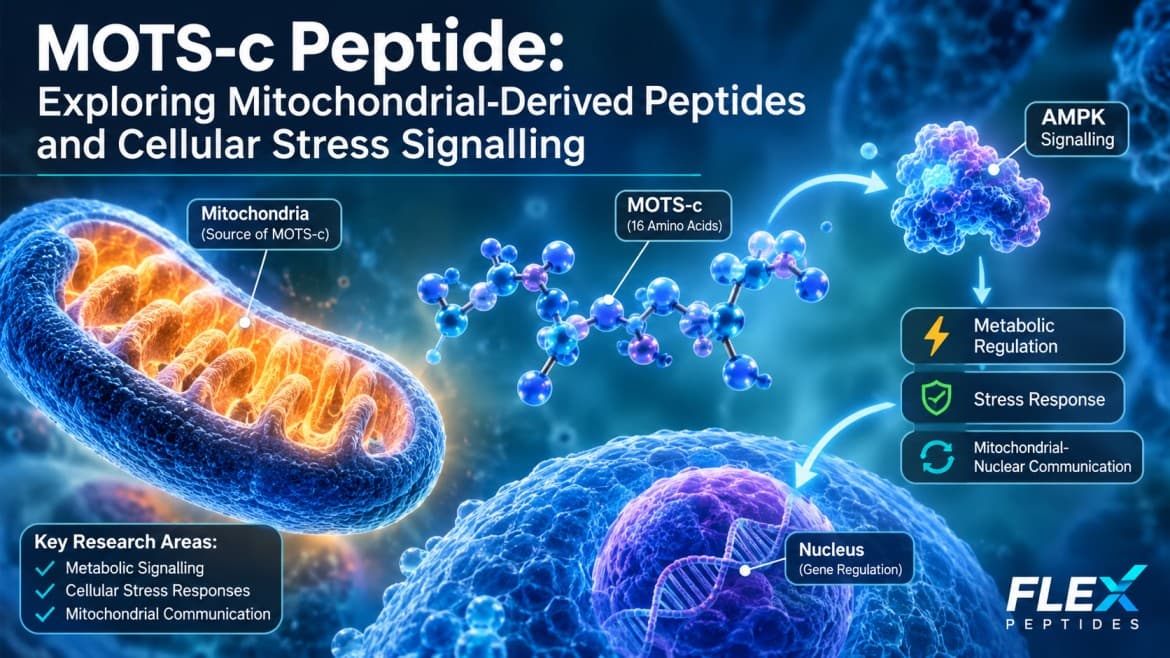
Discover MOTS-c, a mitochondrial-derived peptide investigated for its relationship with AMPK signalling, cellular stress responses and mitochondrial-nuclear communication.
Introduction
Mitochondria are widely recognised for their role in cellular energy production. However, scientific research increasingly highlights their importance in cellular communication, metabolic regulation and stress-response mechanisms. Beyond producing energy, mitochondria contain genetic material that contributes to the expression of specialised molecules involved in cellular signalling.
MOTS-c is a mitochondrial-derived peptide that has attracted scientific interest because of its proposed involvement in metabolic regulation and cellular stress responses. Unlike conventional peptides encoded by nuclear DNA, MOTS-c originates from a short open reading frame within mitochondrial DNA.
Its research significance extends beyond mitochondrial biology. Studies have investigated its relationship with AMP-activated protein kinase (AMPK), metabolic signalling and communication between mitochondria and the nucleus.
This article explores the molecular origin of MOTS-c, its structural characteristics, proposed signalling mechanisms and analytical considerations relevant to laboratory research.
1. What Is MOTS-c?
MOTS-c stands for mitochondrial open reading frame of the 12S rRNA-c. It is a mitochondrial-derived peptide consisting of 16 amino acid residues.
It was identified as part of a broader area of research examining small peptides encoded by mitochondrial DNA.
Traditionally, mitochondrial DNA has been associated primarily with genes responsible for essential components of mitochondrial function. However, the discovery of mitochondrial-derived peptides has expanded scientific understanding of mitochondrial genetic activity.
MOTS-c is particularly interesting because research has examined its association with cellular metabolic signalling and stress-response mechanisms.
Researchers investigate this peptide to better understand how mitochondrial genetic information may influence cellular processes beyond conventional energy production.
2. Mitochondrial Origin and Molecular Structure
One of the defining characteristics of MOTS-c is its mitochondrial origin.
The peptide is encoded by a short open reading frame within the mitochondrial 12S ribosomal RNA region.
Its sequence contains 16 amino acid residues, making it considerably smaller than many conventional proteins.
This relatively short structure is important when examining its molecular identity, synthesis and analytical characterisation.
The sequence of MOTS-c is:
MRWQEMGYIFYPRKLR
Its molecular characteristics provide researchers with an opportunity to investigate the relationship between mitochondrial genetic information and peptide-mediated cellular communication.
Unlike larger mitochondrial proteins, MOTS-c is studied as a signalling-related peptide rather than simply as a structural component of the mitochondrial machinery.
3. MOTS-c and AMPK Signalling
AMP-activated protein kinase (AMPK) is an important cellular energy sensor.
It responds to changes in cellular energy availability and helps coordinate metabolic processes.
AMPK activity is influenced by changes in the cellular AMP-to-ATP and ADP-to-ATP ratios, among other regulatory mechanisms.
Research involving MOTS-c has investigated its relationship with AMPK-associated signalling.
This relationship is particularly interesting because AMPK participates in several cellular processes, including:
- Regulation of energy metabolism.
- Glucose and lipid metabolic pathways.
- Cellular energy homeostasis.
- Regulation of metabolic enzyme activity.
- Coordination of cellular responses to energy stress.
In experimental research, MOTS-c has been associated with AMPK-related metabolic responses.
However, the precise molecular interactions and their significance can depend on the experimental model and conditions.
Understanding this relationship helps researchers explore how mitochondrial-derived peptides may participate in wider metabolic signalling networks.
4. Mitochondrial-Nuclear Communication
Mitochondria and the nucleus communicate through several molecular signalling mechanisms.
Although mitochondria contain their own DNA, most mitochondrial proteins are encoded by nuclear genes.
Consequently, mitochondrial activity depends on continuous communication between mitochondrial and nuclear systems.
This relationship is often described through the concept of mitochondrial retrograde signalling.
Retrograde signalling refers to the transmission of information from mitochondria towards the nucleus, influencing cellular responses and gene expression.
MOTS-c has attracted interest in this area because experimental research has investigated its ability to influence nuclear gene expression and cellular stress responses.
One particularly interesting aspect is its reported relationship with nuclear localisation under certain experimental conditions.
These observations have expanded research interest in mitochondrial-derived peptides as potential signalling molecules.
5. MOTS-c and Cellular Stress Responses
Cells continuously encounter changes in their internal and external environments.
These changes may include nutrient availability, energy demands, oxidative conditions and other forms of cellular stress.
To maintain normal cellular organisation, cells use several signalling mechanisms to detect and respond to these changes.
MOTS-c has been investigated in relation to cellular stress-response pathways.
Research has explored its relationship with adaptive cellular responses, particularly those associated with metabolic stress.
Important areas of investigation include:
Metabolic Stress Signalling
Researchers examine how cellular energy disturbances influence signalling pathways associated with MOTS-c.
Gene Expression Regulation
Studies have explored whether MOTS-c-associated signalling influences the expression of genes involved in cellular adaptation.
Mitochondrial Communication
MOTS-c provides an interesting model for examining how mitochondrial-derived signals may influence processes occurring elsewhere within the cell.
These research areas help develop a broader understanding of mitochondrial communication.
6. MOTS-c and Metabolic Regulation
Metabolic regulation involves numerous interconnected pathways responsible for maintaining cellular energy balance.
These include glucose metabolism, lipid metabolism and the regulation of energy availability.
MOTS-c has been investigated in experimental models involving metabolic signalling.
Its relationship with AMPK is particularly relevant because AMPK acts as a central regulator of several energy-related processes.
Researchers may investigate:
- Cellular energy-sensing mechanisms.
- AMPK-associated signalling.
- Glucose-related metabolic pathways.
- Mitochondrial activity.
- Metabolic gene expression.
- Responses to changes in nutrient availability.
It is important to distinguish experimental findings from established clinical conclusions. Research involving cellular or animal models does not automatically establish equivalent effects in humans.
7. MOTS-c Compared with Other Mitochondrial-Derived Peptides
MOTS-c belongs to a wider research area involving mitochondrial-derived peptides.
Other examples include humanin and the small humanin-like peptide 2 (SHLP2).
These peptides have attracted scientific attention because of their mitochondrial genetic origin and proposed roles in cellular signalling.
However, they differ in their molecular sequences and reported research associations.
MOTS-c is particularly associated with investigations into AMPK-related signalling and metabolic regulation.
Humanin has been investigated in connection with cellular survival and stress-related pathways.
SHLP2 is another mitochondrial-derived peptide studied for its potential relationship with mitochondrial and cellular regulation.
Comparing these molecules helps researchers understand the diversity of signalling-related peptides encoded by mitochondrial DNA.
8. Analytical Characterisation of MOTS-c
Analytical characterisation is an important part of laboratory peptide research.
Because synthetic peptide materials may contain related substances or unexpected molecular components, researchers use complementary analytical methods to examine their characteristics.
Several methods are relevant.
High-Performance Liquid Chromatography (HPLC)
HPLC separates compounds within a sample according to their interactions with the chromatographic system.
It can help researchers examine chromatographic profiles and estimate purity under a defined analytical method.
Mass Spectrometry (MS)
Mass spectrometry provides information about molecular mass and can support peptide identity assessment.
Sequence Verification
Sequence-related analytical approaches can help investigate whether the amino acid composition corresponds to the expected peptide structure.
Combined Analytical Assessment
Using complementary analytical techniques provides a more informative picture of sample characteristics than relying on a single measurement.
The interpretation of analytical findings should always consider the method, reference standards and limitations of the testing process.
9. Why MOTS-c Is Relevant to Mitochondrial Research
MOTS-c provides an interesting example of how mitochondrial genetic information may contribute to cellular signalling.
Its research significance includes several interconnected areas:
- Mitochondrial-derived peptide biology.
- AMPK-associated signalling.
- Cellular energy regulation.
- Mitochondrial-nuclear communication.
- Cellular stress responses.
- Metabolic gene expression.
- Peptide molecular characterisation.
These areas offer opportunities to investigate how small peptides may participate in complex cellular regulatory networks.
Conclusion
MOTS-c represents an important subject within the expanding field of mitochondrial-derived peptide research.
Its origin within mitochondrial DNA, together with its reported relationship with AMPK-associated signalling and cellular stress responses, makes it particularly interesting for molecular and metabolic research.
By investigating its molecular sequence, signalling associations and analytical characteristics, researchers can develop a more detailed understanding of the relationship between mitochondrial biology and cellular communication.
At Flex Peptides, our research-focused content aims to support a better understanding of peptide science, molecular characteristics and laboratory analytical considerations.
Research-use disclaimer: MOTS-c discussed in this article is presented exclusively for laboratory research and educational purposes. It is not intended for human or veterinary use, consumption, diagnosis or treatment. Experimental findings should not be interpreted as established clinical outcomes.