Glutathione is an important intracellular tripeptide involved in cellular redox regulation. Discover how cells synthesise glutathione, recycle its oxidised form and maintain the balance between GSH and GSSG.
Introduction
Glutathione is one of the most extensively investigated small peptides in cellular biochemistry. Although it consists of only three amino acids, it participates in several important biochemical processes, including redox regulation, enzyme activity and cellular responses to oxidative conditions.
Unlike many conventional peptides, glutathione has a distinctive molecular structure that influences its chemical behaviour. It contains glutamate, cysteine and glycine, arranged in a specific sequence with an unusual gamma-glutamyl bond.
However, understanding glutathione involves more than examining its molecular structure. Researchers also investigate how cells produce it, how its reduced and oxidised forms interact, and how specialised enzymes maintain its availability.
This article explores glutathione biosynthesis, its recycling pathways and the biochemical mechanisms involved in maintaining cellular redox balance.
1. Understanding the Molecular Structure of Glutathione
Glutathione, commonly abbreviated as GSH, is a tripeptide consisting of three amino acids:
- Glutamate
- Cysteine
- Glycine
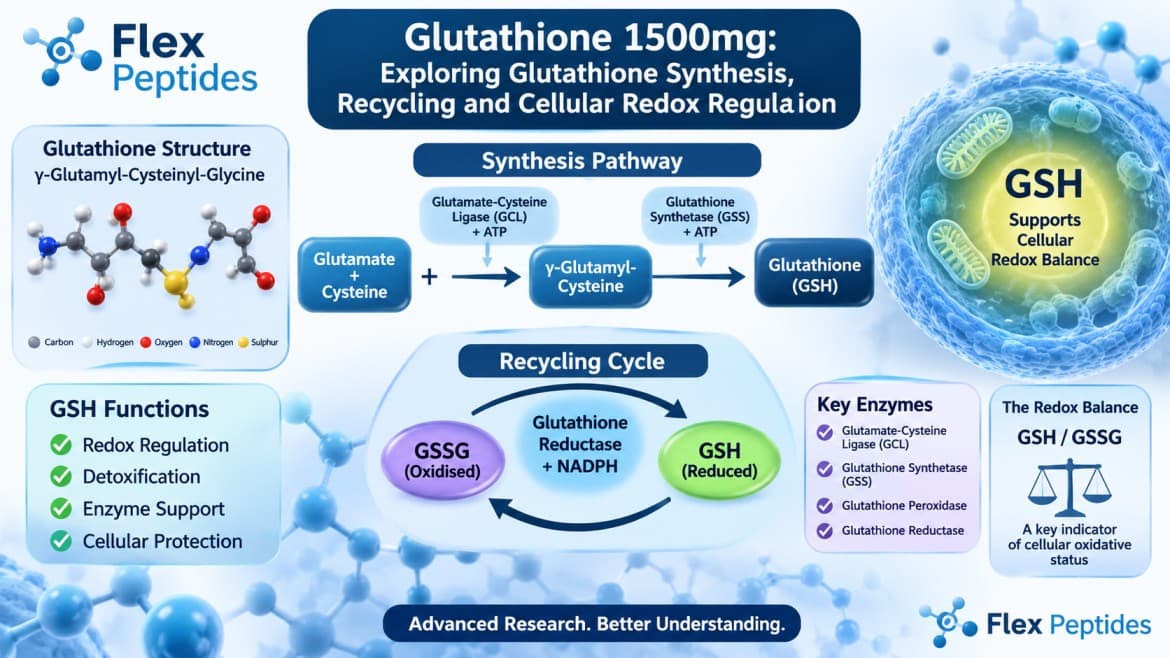
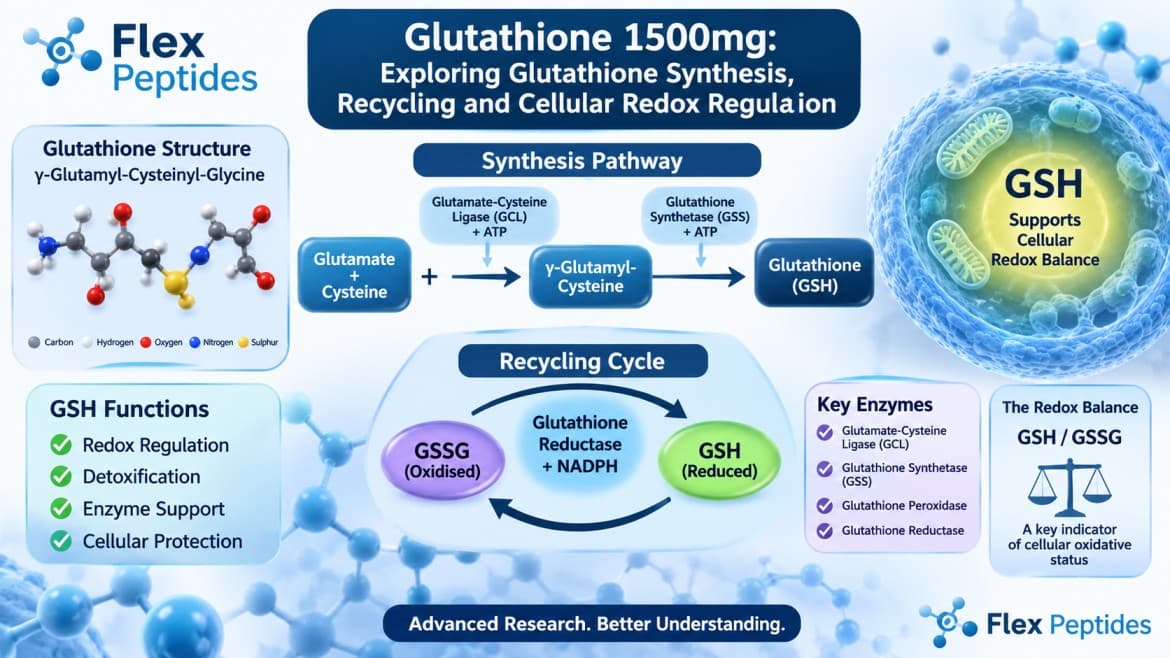
Its chemical structure is commonly represented as gamma-glutamyl-cysteinyl-glycine.
One particularly interesting feature is the bond between glutamate and cysteine. Unlike the conventional peptide bond formed through the alpha-carboxyl group of glutamate, glutathione contains a bond involving glutamate's gamma-carboxyl group.
This unusual arrangement gives glutathione distinctive structural and biochemical properties.
The cysteine residue is especially important because it contains a sulphur-containing thiol group. This group can participate in oxidation-reduction reactions, making glutathione relevant to research into cellular redox chemistry.
Researchers therefore study glutathione not simply as a short peptide, but as a chemically active component of intracellular biochemical systems.
2. The Three Amino Acids Behind Glutathione Synthesis
Each amino acid contributes a different structural feature to the glutathione molecule.
Glutamate
Glutamate is an acidic amino acid that contributes to the peptide backbone. Its gamma-carboxyl group participates in the unusual bond that distinguishes glutathione from many conventional tripeptides.
Cysteine
Cysteine contains a thiol group, represented as -SH. This functional group is central to glutathione's redox chemistry.
The sulphur atom can participate in reactions involving oxidation and reduction. Consequently, cysteine availability is an important factor in regulating glutathione production.
Glycine
Glycine is the smallest standard amino acid. It completes the tripeptide structure and contributes to the overall molecular arrangement.
Together, these three amino acids form a molecule that participates in several interconnected biochemical processes.
3. How Glutathione Is Produced Inside Cells
Glutathione is synthesised inside cells through a two-step enzymatic process.
Both steps require ATP, which provides the energy needed for the reactions.
The first reaction combines glutamate and cysteine to form gamma-glutamylcysteine.
This reaction is catalysed by the enzyme glutamate-cysteine ligase, commonly abbreviated as GCL.
The second reaction adds glycine to gamma-glutamylcysteine, producing glutathione.
This step is catalysed by glutathione synthetase, also known as GSS.
The overall pathway can be summarised as:
Step 1: Glutamate + Cysteine → Gamma-glutamylcysteine
Step 2: Gamma-glutamylcysteine + Glycine → Glutathione
Both reactions require ATP-dependent enzyme activity.
This two-stage process is important because the cell regulates glutathione production through enzyme activity and precursor availability.
4. The Role of Glutamate-Cysteine Ligase
Glutamate-cysteine ligase is particularly important because it catalyses the first and rate-limiting step of glutathione biosynthesis.
The enzyme contains two subunits:
- GCLC: The catalytic subunit.
- GCLM: The modifier or regulatory subunit.
GCLC provides the catalytic activity needed to form gamma-glutamylcysteine. GCLM influences the efficiency and regulation of the enzyme complex.
Researchers have investigated how GCL activity changes under different cellular conditions.
For example, oxidative conditions can influence the expression and activity of enzymes involved in glutathione production.
Transcriptional regulation involving Nrf2 and antioxidant response elements is also an important research area.
These mechanisms help explain why glutathione production is not a fixed process. Cells can regulate biosynthesis according to their biochemical requirements.
5. Understanding GSH and GSSG
Glutathione exists in two major redox forms.
Reduced glutathione (GSH) contains a free thiol group and can participate in redox reactions.
Oxidised glutathione (GSSG) forms when two glutathione molecules become linked through a disulphide bond.
During certain oxidation reactions, GSH donates reducing equivalents and is converted into GSSG.
The relationship between these two forms is important in studies of cellular redox balance.
Researchers often examine the GSH-to-GSSG relationship to investigate changes in the redox environment of cells.
However, the ratio must be interpreted carefully. Sample preparation, cellular compartment, analytical method and experimental conditions can all influence the measurements.
A single GSH or GSSG measurement may not provide a complete picture of the redox system.
6. How Glutathione Reductase Supports Recycling
Glutathione recycling is an important part of maintaining intracellular glutathione availability.
The enzyme glutathione reductase catalyses the reduction of GSSG back into GSH.
This reaction requires NADPH as a source of reducing equivalents.
The overall reaction can be represented as:
GSSG + NADPH + H⁺ → 2GSH + NADP⁺
This process allows cells to regenerate reduced glutathione rather than relying exclusively on newly synthesised molecules.
The availability of NADPH is therefore closely connected to glutathione recycling.
Researchers investigating this pathway often examine glutathione reductase activity alongside measurements of NADPH, GSH and GSSG.
These measurements help scientists understand how the cellular redox system responds to different experimental conditions.
7. Glutathione Peroxidase and Hydrogen Peroxide Metabolism
Glutathione peroxidases are a family of enzymes that use glutathione in reactions involving peroxides.
One important function of these enzymes is the conversion of hydrogen peroxide into water.
During this reaction, reduced glutathione is oxidised to GSSG.
A simplified reaction is:
2GSH + H₂O₂ → GSSG + 2H₂O
This demonstrates how glutathione participates in a wider enzyme network rather than functioning independently.
Glutathione peroxidase activity and glutathione reductase activity are therefore closely connected.
While glutathione peroxidase uses GSH during peroxide reduction, glutathione reductase helps regenerate GSH from GSSG.
Together, these enzymes form an important part of cellular redox regulation.
8. NADPH and the Glutathione Recycling System
NADPH is an important reducing cofactor involved in several cellular biochemical reactions.
In glutathione metabolism, it supplies the reducing equivalents required by glutathione reductase.
One important source of NADPH is the pentose phosphate pathway.
This metabolic pathway operates in the cytosol and contributes to the production of reducing power required for several cellular processes.
The relationship between NADPH and glutathione demonstrates how different biochemical pathways work together.
For example, a change in NADPH availability may influence the ability of glutathione reductase to regenerate GSH.
Researchers therefore study the interaction between:
- NADPH production
- Glutathione reductase activity
- GSH and GSSG concentrations
- Glutathione peroxidase activity
- Cellular redox conditions
This integrated approach provides more information than examining glutathione concentration alone.
9. The Nrf2 Pathway and Glutathione Biosynthesis
The nuclear factor erythroid 2-related factor 2 pathway, commonly called Nrf2, is an important regulator of cellular responses to oxidative and electrophilic conditions.
Under suitable signalling conditions, Nrf2 can influence the expression of genes associated with antioxidant response systems.
Some of these genes are involved in glutathione biosynthesis and metabolism.
Researchers investigate Nrf2 because it provides a connection between cellular stress signalling and the regulation of enzymes involved in glutathione production.
The expression of GCLC, GCLM and other related proteins may change in response to different experimental conditions.
However, Nrf2 signalling is complex. Its activation does not automatically indicate a particular biological outcome, and findings depend on the experimental model.
10. Laboratory Methods for Measuring Glutathione
Accurate glutathione analysis requires careful sample preparation and appropriate analytical methods.
Several techniques are used in biochemical research.
High-Performance Liquid Chromatography
High-performance liquid chromatography, or HPLC, separates compounds according to their interactions with the stationary and mobile phases.
It can be used in analytical methods designed to quantify glutathione and related compounds.
Liquid Chromatography-Mass Spectrometry
LC-MS combines chromatographic separation with mass spectrometry.
It can help distinguish and quantify glutathione-related molecules, depending on the analytical method and validation.
Enzyme-Based Assays
Enzyme-based methods can measure glutathione-related activity or concentrations through controlled biochemical reactions.
Some assays examine total glutathione, while others distinguish reduced and oxidised forms.
Spectrophotometric Methods
Spectrophotometric techniques measure changes in light absorbance associated with a chemical or enzymatic reaction.
They can be used in established glutathione measurement protocols.
Each method has limitations. Researchers must consider sensitivity, specificity, sample stability and interference when interpreting results.
11. Why the GSH-to-GSSG Ratio Matters in Research
The relationship between GSH and GSSG is frequently examined in studies of cellular redox biology.
A higher proportion of GSH relative to GSSG generally indicates a more reducing intracellular environment, whereas a shift towards GSSG can indicate a change in redox conditions.
However, the ratio is not a universal indicator of cellular health.
Different cellular compartments can maintain different glutathione concentrations and redox states.
Furthermore, the ratio can be affected by sample collection and processing. Oxidation occurring after collection may alter the measured GSH and GSSG values.
Researchers therefore need validated procedures that preserve the chemical state of the sample.
12. Current Research Limitations
Although glutathione metabolism is extensively studied, several analytical and biological challenges remain.
First, glutathione concentration does not necessarily represent the activity of the entire redox system.
Second, different cell types and tissues may regulate glutathione production differently.
Third, measurements can be affected by sample handling and oxidation during processing.
Finally, findings from cell-based experiments should not automatically be interpreted as evidence of clinical effectiveness.
These limitations highlight the importance of measuring multiple biochemical markers and reporting experimental conditions clearly.
Conclusion
Glutathione is a structurally distinctive tripeptide involved in a complex network of cellular biochemical reactions.
Its production involves glutamate-cysteine ligase and glutathione synthetase, while its recycling depends on glutathione reductase and NADPH.
The interaction between GSH, GSSG, glutathione peroxidase and cellular redox pathways makes glutathione an important subject in biochemical research.
Understanding these processes provides a clearer picture of how cells regulate glutathione availability and maintain redox balance under different experimental conditions.
At Flex Peptides, we recognise the importance of scientific accuracy, analytical quality and responsible research practices when discussing peptide-related materials.
Research-Use Notice: This article is intended for scientific and educational purposes only. It does not constitute medical advice or recommend human or veterinary use. Research materials should only be handled and investigated by appropriately qualified personnel in suitable laboratory settings and in accordance with applicable regulations.