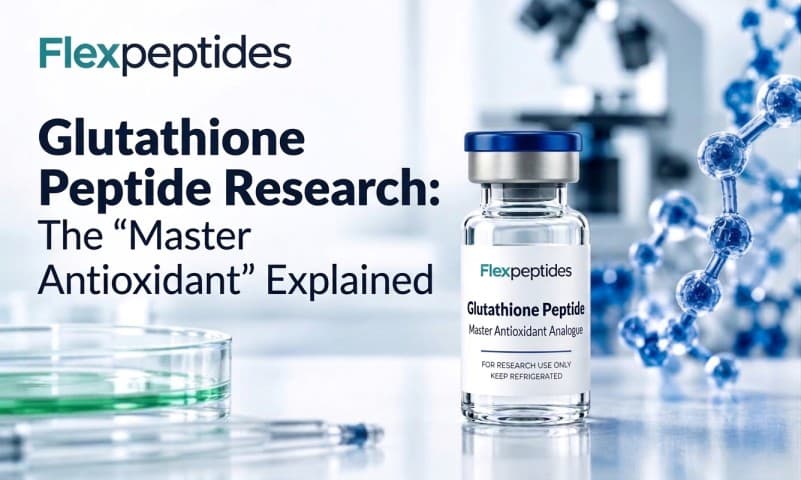
Glutathione is a naturally occurring tripeptide (glutamate-cysteine-glycine) found in nearly every cell, widely studied for its central role in the body's antioxidant defence and detoxification systems. It is sold for laboratory research use only.
What is Glutathione?
Glutathione is often called the body's "master antioxidant" in popular science writing, and while that's a simplification, it reflects a genuine biochemical fact: it's the most abundant intracellular antioxidant in the body, synthesised from three amino acids (glutamate, cysteine and glycine) in essentially every cell. It exists in both reduced (GSH) and oxidised (GSSG) forms, and the ratio between them is a commonly used laboratory marker of oxidative stress.
The proposed mechanism
Glutathione's research relevance comes from two connected roles: it neutralises reactive oxygen species directly and serves as a cofactor for glutathione peroxidase, an enzyme central to the cell's antioxidant enzyme system. It's also a key component of Phase II liver detoxification, where it conjugates with toxins and drug metabolites to make them water-soluble for excretion. Because oxidative stress is implicated in a very wide range of research areas — from cellular ageing to neurodegeneration models to general cell-culture toxicology — glutathione shows up across an unusually broad swathe of the research literature.
What the published research shows
Glutathione research spans decades and includes:
- Biochemical characterisation of the GSH/GSSG cycle and its role in cellular redox balance.
- Toxicology and detoxification studies, examining glutathione's conjugation role in Phase II liver metabolism.
- Oxidative stress models across neuroscience, ageing biology and general cell-culture research, where GSH depletion or repletion is a standard experimental variable.
- Comparative studies of oral versus other delivery routes and their effect on measurable intracellular glutathione levels, a topic of ongoing methodological debate in the literature given glutathione's poor oral bioavailability.
Research status and open questions
Glutathione's basic biochemistry is extremely well established — this is not a novel or speculative compound. What generates ongoing research interest is less "does it matter" (its role in cellular redox balance isn't disputed) and more the applied questions: how different delivery methods affect measurable tissue glutathione levels, and how oxidative stress markers relate to specific research models being studied, both active areas in current laboratory work.
UK regulatory status
Research-grade glutathione is supplied for laboratory use only and carries no UK marketing authorisation for any human therapeutic claim, separate from its unrelated use as a legally regulated food/cosmetic additive in other contexts.
Sourcing research-grade Glutathione in the UK
Glutathione is prone to oxidation during storage, so checking the reduced (GSH) percentage on a Certificate of Analysis — not just overall purity — is a meaningful quality signal specific to this peptide. Flex Peptides lists Glutathione with COA data available on request and UK-based dispatch.
Study Design Considerations for Glutathione Research
Glutathione's central role across so many research fields means the practical considerations for working with it vary a lot depending on the specific application. In oxidative-stress models, researchers typically need to decide whether to measure total glutathione, reduced glutathione (GSH) specifically, or the GSH:GSSG ratio, since each captures a slightly different aspect of the redox state being studied, and published papers are not always explicit about which measure they used — a common source of confusion when comparing results across studies. In toxicology and detoxification research, glutathione depletion is frequently used as an experimental manipulation (via agents like buthionine sulfoximine) to study downstream effects, which is a different research design entirely from studies examining glutathione supplementation or repletion.
Delivery and bioavailability are also worth flagging specifically: because oral glutathione has famously poor bioavailability due to breakdown in the gut, a meaningful part of the literature is dedicated to comparing delivery routes and precursor strategies (such as N-acetylcysteine) specifically to work around this limitation — researchers referencing "glutathione studies" for a specific delivery context should check which route the original paper actually used before assuming findings transfer to a different delivery method.
Key takeaways
- Glutathione is a naturally occurring tripeptide antioxidant found in nearly all cells.
- It plays a dual role in direct antioxidant activity and Phase II liver detoxification.
- The GSH/GSSG ratio is a standard laboratory marker of oxidative stress across many research fields.
- No UK marketing authorisation exists for therapeutic use of the research-grade compound.
- Reduced (GSH) percentage on the COA is a more specific quality check than overall purity alone.
FAQ
Is glutathione the same in supplements and research-grade peptide form?
They're the same molecule, but delivery form, purity verification and intended use differ substantially between a consumer supplement and a research-grade laboratory material.Why is glutathione studied across so many different research areas?
Because oxidative stress is a variable relevant to an unusually wide range of cell biology, toxicology and ageing research, glutathione shows up as a standard reference compound across many fields.What's the difference between GSH and GSSG in research terms?
GSH is the reduced (active antioxidant) form; GSSG is the oxidised form produced after GSH neutralises a reactive species. The ratio between them is a standard oxidative-stress marker in cell and tissue research.Why is oral glutathione bioavailability considered poor?
Digestive enzymes break down the tripeptide bond before much intact glutathione can be absorbed, which is why the research literature includes substantial work on alternative delivery routes and precursor compounds.Is glutathione research different for plant versus animal cell models?
Yes — glutathione's redox role is conserved across many organisms, but concentration ranges, related enzyme systems and experimental protocols differ meaningfully between plant and animal cell-culture research, so findings shouldn't be assumed to transfer directly between the two.
For laboratory research use only. Not for human consumption.