Just three amino acids, one genuinely elegant idea: KPV isolates alpha-MSH's anti-inflammatory signal from its pigmentation effect. Here's what the published gut-inflammation research actually shows.
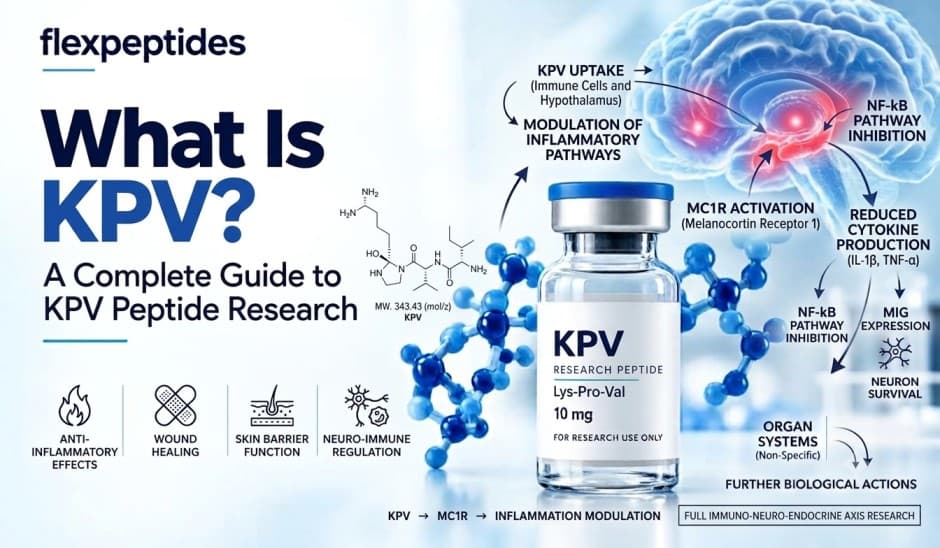
KPV is a three-amino-acid peptide — lysine, proline, valine — that forms the C-terminal fragment of alpha-melanocyte-stimulating hormone (α-MSH). Research has shown it retains α-MSH's anti-inflammatory signalling activity without triggering the pigmentation effects associated with the full hormone. It's best known from published animal studies on inflammatory bowel disease and has also been studied for oral delivery via the PepT1 intestinal transporter. It remains an unlicensed research compound with no human clinical trial evidence behind it.
KPV is the smallest peptide in the Flex Peptides catalogue — just three amino acids, which is genuinely tiny by peptide standards — and one of the more scientifically elegant, precisely because of what that small size represents: a piece of a much bigger hormone, isolated because researchers wanted to know which part of it actually did the anti-inflammatory work.
Start with the parent hormone
To understand KPV, you need a quick word on where it comes from. Alpha-melanocyte-stimulating hormone (α-MSH) is best known for one thing: skin pigmentation, via melanocortin receptor signalling. But α-MSH does more than that — it also has a genuine, independently studied anti-inflammatory function. The question researchers asked, going back to the early 2000s, was whether that anti-inflammatory activity could be separated from the pigmentation effect. In other words: could you get one without the other?
The answer, and how researchers found it
A frequently cited 2003 study set out to "dissect" α-MSH into its functional pieces, testing which fragments retained which effects. What it found was that the C-terminal tripeptide — KPV — was, on its own, sufficient to reproduce a substantial share of the parent hormone's anti-inflammatory signalling, including inhibition of NF-κB activation, a central pathway in inflammatory gene expression. Crucially, it did this without the melanogenic (pigment-triggering) activity that comes with the full-length hormone and with related MSH-family peptides. That's the whole reason KPV exists as a distinct research subject rather than just a footnote in the α-MSH literature — it isolates one function from another.
Where the research went next: the gut
The best-known downstream research on KPV moved into gastroenterology. A widely cited 2008 study, published in Inflammatory Bowel Diseases (Dalmasso and colleagues), examined KPV's anti-inflammatory effects in murine models of inflammatory bowel disease — and found a genuine, measurable reduction in colitis severity. Related work, published in Gastroenterology, looked specifically at how KPV gets into intestinal cells in the first place, via a transporter called PepT1 (peptide transporter 1), and what that uptake does to intestinal inflammation in cell and animal models.
That PepT1 angle is worth dwelling on, because it's a genuinely distinguishing feature of the KPV literature compared with most other peptides in this catalogue. PepT1 is expressed on intestinal epithelial cells, and because KPV is small enough to be recognised by it, researchers have been able to explore oral delivery — not injectable — as a route worth studying specifically in an inflammatory bowel disease research context. A locally-acting, orally-available anti-inflammatory peptide is a mechanistically different, and in some ways more elegant, proposition than a systemically delivered one. It's a large part of why KPV keeps turning up specifically in gastroenterology-adjacent research literature, rather than in general inflammation research more broadly.
What this evidence does — and very much doesn't — establish
Time for the necessary caveat. Everything described above is animal (murine) and cell-based research. It's real, it's published, it's peer-reviewed, and it shows a genuine anti-inflammatory signal for KPV in inflammatory bowel disease models specifically. What it is not: evidence of safety or efficacy in humans. There is no published human clinical trial establishing KPV as a treatment for any condition, inflammatory bowel disease included. It remains, at this point in the research timeline, a compound studied for its mechanism — not a validated therapeutic, and nothing in this article should be read as suggesting otherwise.
Why researchers keep coming back to it
A further strand of published research has looked at KPV alongside other short peptide fragments derived from larger anti-inflammatory proteins, comparing relative potency and stability across different fragment lengths. Part of KPV's appeal here is practical as much as biological: at only three residues, it's simpler to synthesise reproducibly at high purity, more resistant to certain enzymatic degradation pathways than longer fragments, and easier to characterise structurally. For labs running structure-activity relationship studies across a family of melanocortin-derived fragments — rather than working with the unwieldy full-length hormone — those are real, practical advantages.
Put those two things together — a genuinely novel mechanism (anti-inflammatory activity decoupled from pigmentation) and an unusually well-studied, non-standard delivery route (oral, via PepT1) — and you can see why KPV occupies a specific, fairly well-defined niche in gastroenterology and melanocortin-receptor research, rather than showing up everywhere the way some better-known peptides do.
Key takeaways
- KPV is the three-amino-acid C-terminal fragment of α-MSH — lysine, proline, valine.
- It retains α-MSH's anti-inflammatory signalling (including NF-κB inhibition) without the pigmentation effect.
- The best-known research is in murine inflammatory bowel disease models (Dalmasso et al., 2008), plus PepT1-mediated oral-delivery studies.
- There is no published human clinical trial data for KPV.
- Its small size makes it easier to synthesise, more stable, and simpler to study than longer melanocortin fragments.
Sourcing research-grade KPV in the UK
Because KPV's research value depends on working from a clean, well-characterised fragment rather than a degraded or impure one, batch documentation matters more here than with most peptides. Flex Peptides supplies KPV (10mg, £29.95) as a COA-tested, batch-verified lyophilised peptide, dispatched from the UK with no import delays to plan around.
Browse KPV (10mg) in our shop → to check current stock and request batch documentation.
Handling and purity
Flex Peptides' KPV is supplied lyophilised and COA-tested for purity, following the same reconstitution and storage protocol as the rest of our lyophilised peptide range — see our storage and reconstitution guide.
All Flex Peptides products, including KPV, are supplied strictly for laboratory and in-vitro research purposes. Not for human or veterinary use. Not for diagnostic or therapeutic use.
Frequently asked questions
Does KPV cause tanning or skin pigmentation, like other MSH-related peptides do?
No — that's precisely what makes it distinct in the research. KPV retains α-MSH's anti-inflammatory signalling without its melanogenic (pigmentation) effect.Is KPV related to BPC-157?
No. Both have appeared in gut-health-adjacent research, but they're structurally and mechanistically unrelated — KPV is a melanocortin/α-MSH fragment acting on NF-κB pathways, while BPC-157 is a separate synthetic peptide with a different origin and mechanism entirely.Has KPV been tested in human clinical trials?
No. The published evidence for KPV is limited to cell-based and animal (primarily murine) studies.Why is KPV studied for oral delivery when most research peptides aren't?
Because it's small enough to be recognised by PepT1, a peptide transporter expressed on intestinal epithelial cells — a delivery route researched specifically for gut-localised anti-inflammatory studies, rather than for systemic administration.Is KPV legal to purchase in the UK for laboratory research?
Yes, as an unlicensed research compound sold strictly for laboratory and in-vitro use, under the same framework that applies across the Flex Peptides catalogue.