What do 5mg, 10mg, 20mg and 100mg mean on peptide labels? Understand milligram strengths, product quantities and the difference between quantity and purity.
Introduction
When browsing a research peptide catalogue, one of the first things people notice is that products are available in different milligram strengths.
For example, some products may be listed as 5mg, 10mg, 20mg or 100mg. For someone new to peptide terminology, these numbers can be confusing.
Why are different strengths available? What does the milligram measurement actually represent? And why is it important to understand the information displayed on a product label?
This beginner-friendly guide explains the meaning of peptide milligram strengths and how to understand product labelling in a laboratory research context.
What Does Milligram Strength Mean?
A milligram (mg) is a unit of mass. One milligram is equal to one-thousandth of a gram.
In research peptide catalogues, the milligram value generally identifies the labelled quantity of peptide material supplied in a product.
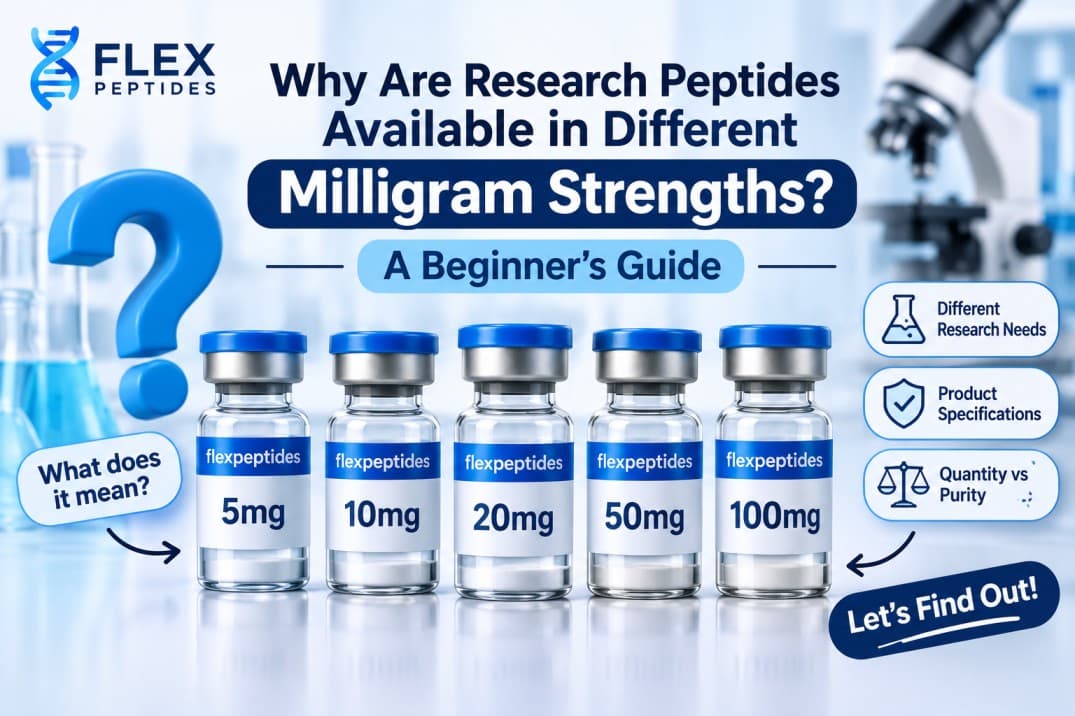
For example, 5mg represents five milligrams, 10mg represents ten milligrams, 20mg represents twenty milligrams, 50mg represents fifty milligrams and 100mg represents one hundred milligrams.
These values describe the labelled quantity, not a recommended amount for human use.
Why Are Peptides Available in Different Strengths?
1. Different research requirements
Laboratory research projects can vary significantly in their design, scale and analytical requirements. Different research settings may therefore require different quantities of a particular material.
2. Product-specific characteristics
Not every peptide is supplied in the same quantity. Product characteristics, formulation considerations and manufacturing specifications can influence the available formats.
3. Catalogue variety
Offering different labelled quantities helps research suppliers provide a wider selection of laboratory materials. It also allows researchers to identify products according to their documented specifications.
4. Different product categories
Some peptide materials are supplied individually, while others are offered as blends containing multiple components. The total labelled quantity of a blend should not automatically be interpreted as the quantity of each individual peptide.
Understanding Different Milligram Labels
When you see a 5mg label, it generally indicates five milligrams of the labelled material. Similarly, a 10mg label represents ten milligrams, while a 20mg label represents twenty milligrams.
The same principle applies to 50mg and 100mg products. These figures describe the stated quantity of material rather than its purity or overall quality.
It is important to remember that a higher milligram value does not automatically indicate higher purity, better quality or greater research suitability. These are separate product characteristics.
Milligram Strength vs Purity: What Is the Difference?
This is one of the most common points of confusion.
Milligram strength and purity describe different things. Milligram strength refers to the labelled quantity of material, while purity describes the proportion of the identified target compound in an analytical sample, according to the method used.
For example, a product labelled 10mg and a product labelled 20mg could have different purity results. The larger labelled quantity does not automatically mean that the product is purer.
This is why product documentation and batch-specific analytical reports are important.
Why Is Product Labelling Important?
Clear product labelling helps researchers identify the materials they are evaluating.
A useful product label should communicate the product name, labelled milligram quantity, batch or lot identification where applicable, relevant product information and supplier details.
These details help reduce confusion and support accurate laboratory records.
What About Peptide Blends?
Peptide blends require additional attention.
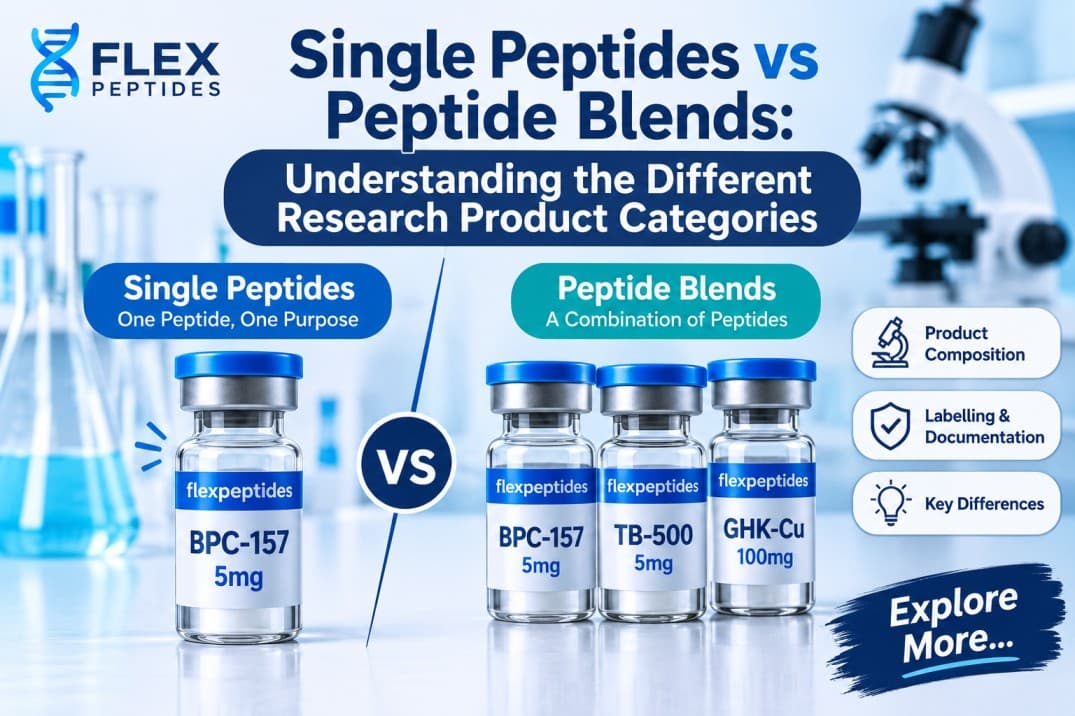
A blend may contain two or more individual peptides within one product. For example, Flex Peptides lists a BPC-157 and TB-500 research blend.
When reading a blend label, researchers should distinguish the total labelled quantity from the individual quantities of its components.
The product specification and relevant batch documentation should be checked for the exact composition.
Frequently Asked Questions
What does 10mg mean on a peptide vial?
It generally indicates that the product is labelled as containing ten milligrams of the relevant peptide material.
Is 20mg twice as pure as 10mg?
No. Milligram quantity and purity are different measurements.
Does a higher milligram value mean better quality?
No. Quality must be evaluated using appropriate product specifications and analytical documentation.
Why are some peptides available in 5mg and 10mg formats?
Different product formats may be offered to meet different laboratory research requirements and supplier specifications.
Are milligram strengths the same as recommended doses?
No. A product's labelled mass is not a dosage recommendation. Flex Peptides products are supplied strictly for laboratory and in-vitro research.
Conclusion
Understanding milligram strengths is an important first step when reading a research peptide catalogue.
The number displayed on a product label describes its stated quantity, while purity, identity and quality documentation provide separate information.
By understanding these differences, readers can interpret peptide product listings more accurately and avoid common misunderstandings.
Explore Flex Peptides
Explore the Flex Peptides catalogue to find product specifications, labelled quantities and available batch documentation.
Research Use Only: Products are intended strictly for laboratory and in-vitro research. They are not intended for human or veterinary consumption, administration, diagnosis or treatment.