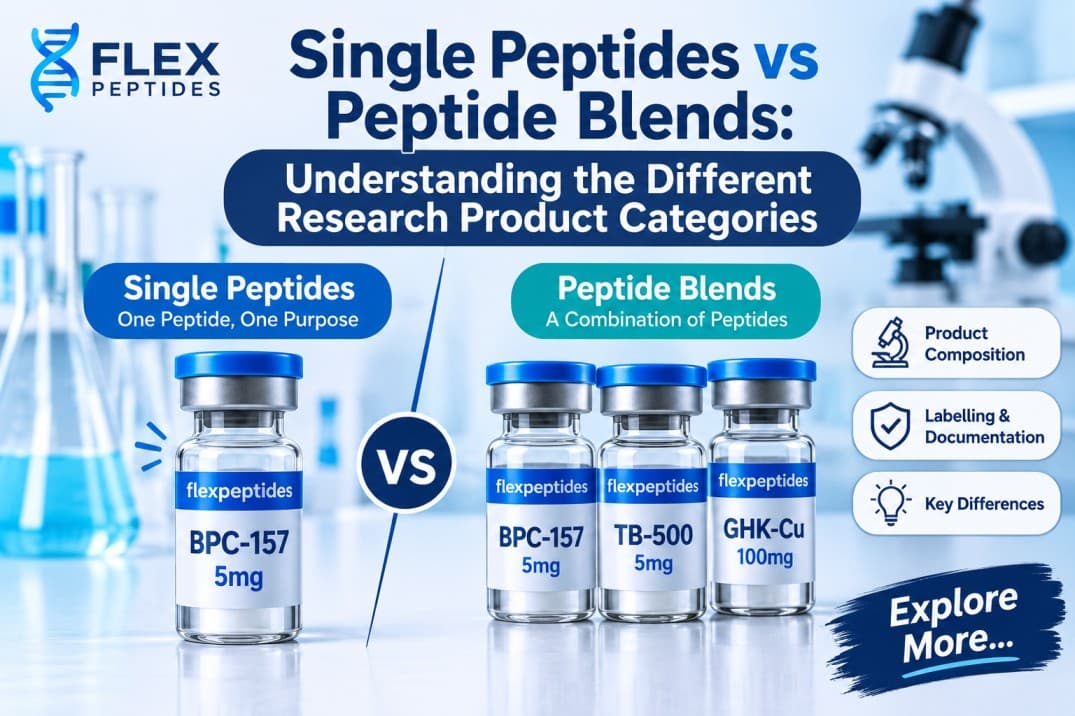
Understand the differences between single peptides and peptide blends, including product composition, milligram quantities, labelling and research documentation.
Introduction
When exploring a research peptide catalogue, you may notice two main product categories: individual peptides and peptide blends.
Some products contain one identified peptide, while others contain multiple peptide components within the same formulation.
But what exactly is the difference? How are these products described? And what information should researchers consider when reviewing them?
In this guide, we explore single peptides vs peptide blends, explain their basic differences and discuss why clear product information matters in laboratory research.
What Are Single Peptides?
A single-peptide product contains one identified peptide as its intended research component.
These products are generally labelled with the name of the individual peptide and its stated quantity.
Examples available in the Flex Peptides catalogue include BPC-157, TB-500, GHK-Cu, Ipamorelin, Tesamorelin, MOTS-c, Selank and KPV.
Each has its own molecular identity and individual research background.
What Are Peptide Blends?
A peptide blend is a product containing two or more peptide components in one formulation.
Instead of identifying just one peptide, a blend contains multiple named components.
For example, Flex Peptides offers a BPC-157 and TB-500 research blend.
The important point is that a blend is not the same as an individual peptide. It contains multiple components that should be identified separately in the relevant product documentation.
Single Peptides vs Peptide Blends: Understanding the Differences
The most obvious difference is the number of peptide components. A single-peptide product contains one identified peptide, while a blend contains multiple components.
Their product labelling also differs. Individual products generally have straightforward product labels, whereas blends require more detailed labelling because the names and quantities of their individual components should be clearly identified.
The composition of each product is another important consideration. A single-peptide product has one identified peptide component, while a blend contains multiple components within the same formulation.
These differences are important when reviewing product specifications, batch documentation and analytical information.
Five Things to Understand About These Product Categories
1. Product composition
The most obvious difference is the number of peptide components.
A single-peptide product contains one identified peptide, while a blend contains multiple components. Understanding this distinction helps readers interpret product descriptions more accurately.
2. Product labelling
Individual products generally have straightforward product labels.
Blends require more detailed labelling because the names and quantities of their individual components should be clearly identified.
3. Milligram quantities
The total milligram quantity displayed on a blend should not automatically be interpreted as the amount of every individual peptide.
For example, an 80mg blend does not necessarily contain 80mg of each component. The exact composition must be checked against the product specification and relevant batch documentation.
4. Research documentation
Documentation is important for both product categories.
For a single peptide, researchers should review the identification and relevant analytical information for that compound.
For a blend, documentation should identify the individual components and provide appropriate information about the finished formulation.
5. Research interpretation
Research findings involving an individual peptide cannot automatically be applied to a blend containing that peptide.
Likewise, evidence involving individual ingredients does not establish the safety or effectiveness of their combination.
The composition and research context of each product must be considered separately.
Why Do Researchers Need Clear Product Information?
Clear product information helps prevent misunderstandings when reviewing laboratory materials.
Important details include accurate product names, clearly stated component quantities, batch identification, available Certificates of Analysis, analytical testing information and appropriate storage and handling instructions.
These details are especially important for products containing multiple components.
What Is the Difference Between a Blend and a Peptide Stack?
The terms are sometimes used interchangeably in online discussions, but they can describe different things.
A blend generally refers to multiple components supplied together in one formulation.
A stack is commonly used to describe multiple separate research materials considered together in a research design.
The exact terminology should always be checked against the supplier's product specifications.
Frequently Asked Questions
What is a single peptide?
A single peptide is an individual identified peptide supplied as a standalone research material.
What is a peptide blend?
A peptide blend contains two or more peptide components within one formulation.
Is an 80mg peptide blend 80mg of each peptide?
Not necessarily. The stated quantity may represent the combined total. The individual component quantities should be confirmed using the product specification.
Are peptide blends the same as peptide stacks?
Not necessarily. A blend generally contains multiple components in one formulation, whereas a stack can refer to separate products considered together.
Is research on individual peptides the same as research on blends?
No. Research involving individual components does not automatically establish findings about a combined formulation.
Conclusion
Single peptides and peptide blends represent two different categories of laboratory research materials.
While single-peptide products contain one identified peptide, blends contain multiple components within one formulation. Understanding their composition, labelling and documentation helps readers interpret product information accurately.
For anyone exploring peptide research, knowing these differences provides a useful starting point for understanding modern research peptide catalogues.
Explore Flex Peptides
Discover the Flex Peptides research catalogue, including individual peptide materials and available research blends.
Research Use Only: Products are intended strictly for qualified laboratory and in-vitro research. They are not intended for human or veterinary consumption, administration, diagnosis or treatment.