Certificates of Analysis provide valuable analytical information. This guide explains HPLC data, purity percentages, batch numbers, and laboratory quality documentation.
For laboratory research use only. Not for human or animal consumption.
Introduction
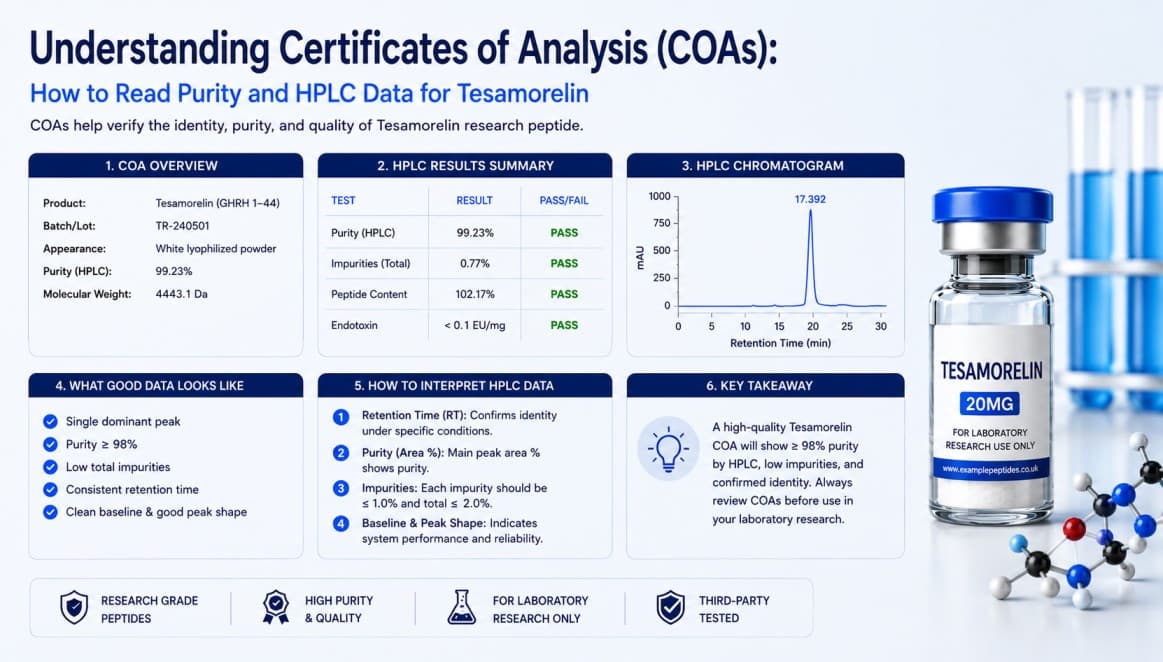
A Certificate of Analysis (COA) is one of the most important documents a researcher receives alongside a peptide sample. It provides independent, batch-specific verification of what is actually in the vial. This article explains how to read a COA for tesamorelin, focusing on the two most common analytical methods: HPLC and mass spectrometry.
What Is a Certificate of Analysis?
A COA is a document, usually produced by a third-party testing laboratory, that reports the analytical results for a specific batch or lot of a research compound. A legitimate COA should always be batch-specific — a generic or undated COA that doesn't match the lot number on your vial should be treated with caution.
Key Sections of a Tesamorelin COA
1. Identification data
- Product name and batch/lot number
- Date of manufacture and/or testing
- Reference molecular formula and molecular weight
2. HPLC Purity Data
High-performance liquid chromatography (HPLC) separates the components of a sample based on how they interact with a stationary phase, producing a chromatogram — a graph of detector response (usually UV absorbance) over time.
- Retention time: the time at which the target peptide elutes; this should be consistent with the reference standard
- Peak area / purity percentage: the area under the main peak, expressed as a percentage of total peak area, is generally reported as the purity figure (e.g., "98.5% purity"). Research-grade peptides sold in the UK typically report purity figures above 98%, though researchers should independently verify this is adequate for their intended analytical use
- Secondary peaks: smaller peaks alongside the main peak may indicate synthesis by-products, truncated sequences, or degradation products — worth reviewing if unusually large
3. Mass Spectrometry Data
Mass spectrometry (MS) confirms the molecular weight of the peptide, verifying that the correct sequence — rather than a similar but incorrect one — is present in the vial. For tesamorelin, the observed mass should correspond closely to its established molecular weight (~5135 g/mol); a significant deviation may indicate a synthesis error or incorrect product.
Questions Worth Asking a Supplier
- Is the COA batch-specific, matching the lot number on the vial you received?
- Was testing conducted by an independent third-party laboratory, or produced in-house?
- Is both HPLC and mass spectrometry data provided, or purity data alone?
A Note on Interpreting COAs
A COA verifies chemical identity and purity — it does not verify sterility, endotoxin levels, or suitability for any particular application, and it is not equivalent to the quality assurance processes required of licensed medicines under MHRA's Good Manufacturing Practice (GMP) framework. Research-grade compounds are not manufactured or tested to pharmaceutical-grade GMP standards, and COAs should be interpreted with that distinction in mind.
Summary
Reading a COA carefully — checking batch matching, HPLC purity, and mass spectrometry confirmation — is one of the most useful due-diligence steps a researcher can take when sourcing peptides like tesamorelin.
This article is provided for scientific and educational purposes only. It does not constitute medical advice. Products referenced are sold strictly for laboratory research use only and are not licensed medicines in the UK.
Disclaimer: The information provided in this article is intended solely for educational and scientific discussion regarding laboratory research materials. Products referenced by Flex Peptides are supplied exclusively for laboratory research purposes and are not intended for human consumption, therapeutic use, medical treatment, or diagnostic applications. Researchers are responsible for complying with all applicable UK laws, regulations, and institutional laboratory practices.