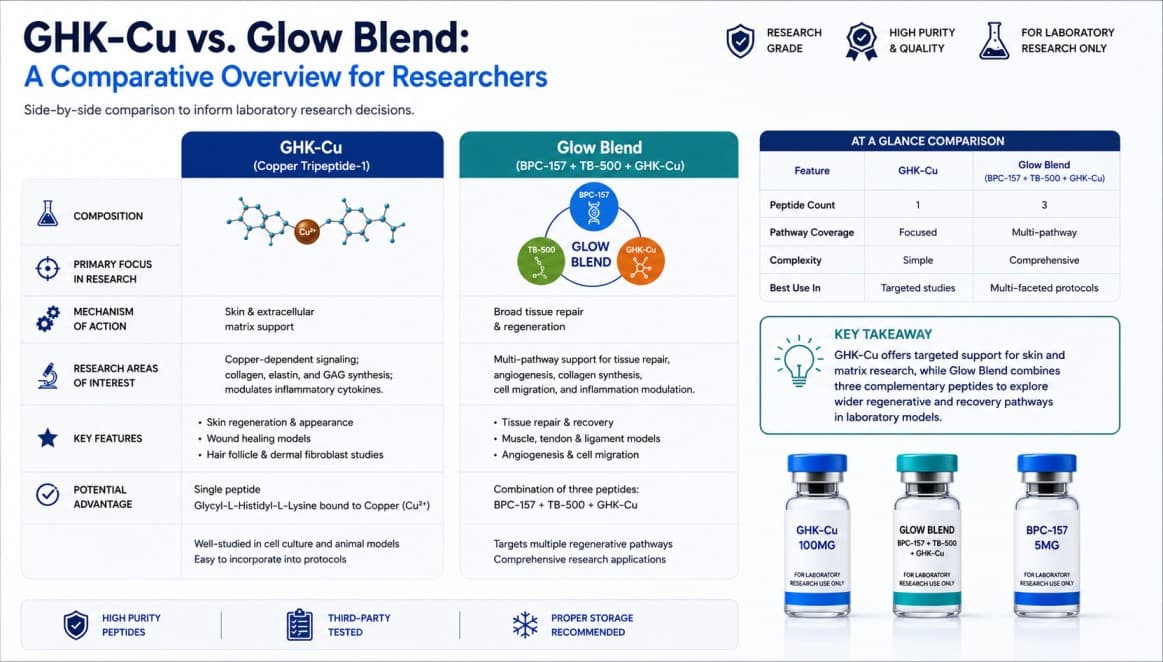
Explore the differences between GHK-Cu and Glow Blend by examining peptide composition, formulation strategies, and laboratory research characteristics.
If you're choosing between a single-compound peptide and a pre-formulated blend, the decision comes down to what your research question actually requires — clean attribution to one compound, or a formulated combination studied as it's supplied.
GHK-Cu: a single, well-defined compound
GHK-Cu has a defined molecular formula and weight, verifiable via a straightforward Certificate of Analysis. When you order it, you know exactly what compound and concentration you're working with, and any effect you observe can be attributed to that one molecule without needing to account for interactions with other peptides in the same vial.
What a "blend" product is
A blend is a formulated combination of multiple peptide compounds supplied together — KLOW 80mg is the other blend product in our catalogue and a useful second example. With any blend, the exact compounds and ratios included in a given batch should be verifiable through the Certificate of Analysis, the same way a single compound's purity is — a supplier who can't specify what's actually in a blend batch shouldn't be trusted with either product type.
Choosing between a single compound and a blend
Studying the properties of a single, well-characterised compound → a single-compound peptide like GHK-Cu is generally preferable for clarity of results — there's nothing else in the vial to account for.
Studying a formulated combination as it's actually used in practice → a blend product is the more direct research subject, provided the batch composition is documented clearly enough to interpret your results against it.
Neither is inherently "better" — they answer different research questions, and the right choice depends entirely on what you're trying to learn.
Regulatory note
Both single-compound and blend research peptides referenced here are sold strictly for laboratory research use and are not licensed medicines in the UK. The same COA-verification standard applies to both — don't relax your vetting for a blend just because it's a more complex product.
Related reading
What Is GHK-Cu? A Complete Guide
What Is KLOW 80mg? A Research Guide.