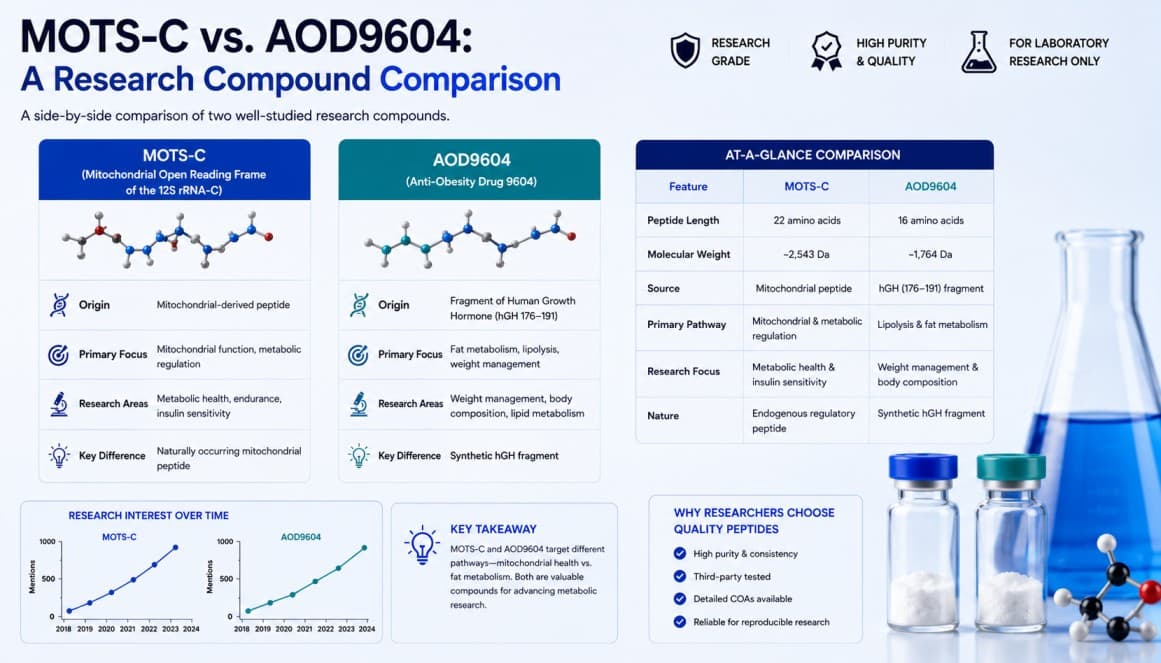
An overview comparing two widely studied research peptides, focusing on molecular design, research methodologies, and analytical differences.
For laboratory research use only. Not for human or animal consumption.
Introduction
MOTS-C and AOD9604 are two peptides that frequently appear in metabolic and mitochondrial research literature, despite having very different origins and mechanisms of interest to researchers. This article compares their chemistry and the contexts in which each is typically referenced.
MOTS-C: A Mitochondrial-Derived Peptide
MOTS-C is a small peptide (16 amino acids) that is notable for being encoded within the mitochondrial genome, rather than the nuclear genome like most peptides and proteins. This origin makes it a compound of interest specifically within mitochondrial biology and metabolic research literature.
Key characteristics:
- Short sequence length (16 amino acids), relatively straightforward to synthesise at high purity
- Frequently referenced in literature discussing mitochondrial-nuclear communication — the concept that mitochondria may signal to the rest of the cell via peptides they encode
- Studied in metabolic research models exploring cellular energy regulation pathways
AOD9604: A Modified Fragment of Human Growth Hormone
AOD9604 is a synthetic peptide corresponding to a modified fragment of the C-terminus of human growth hormone (specifically, the region historically referred to as the GH fragment 176-191, with a modified terminus for stability). It was originally developed as part of research into isolating specific regions of the growth hormone molecule associated with particular activity, separate from the full-length hormone's broader receptor-binding profile.
Key characteristics:
- A short fragment (approximately 15–17 amino acids depending on the exact modification) rather than a full-length hormone
- Referenced in literature exploring structure-activity relationships within specific growth hormone fragments
- Distinct in origin and mechanism of interest from full-length growth hormone or GHRH analogues such as tesamorelin
Structural Comparison Table
| Feature | MOTS-C | AOD9604 |
|---|---|---|
| Origin | Mitochondrial genome-derived peptide | Fragment of human growth hormone |
| Length | 16 amino acids | ~15–17 amino acids (fragment) |
| Research focus | Mitochondrial signalling, metabolic pathways | GH fragment structure-activity studies |
Why Researchers Distinguish Between Them
Despite both being short peptides sometimes discussed in metabolic research contexts, MOTS-C and AOD9604 have entirely different biological origins and mechanisms of research interest. Conflating the two in a study design would be a meaningful error — a point covered further in our related article on common laboratory research mistakes.
Regulatory Note
Both MOTS-C and AOD9604 are sold in the UK strictly as research chemicals, not licensed medicines, and are not approved for human or animal consumption. Nothing in this article should be interpreted as guidance for human use, in line with MHRA regulations under the Human Medicines Regulations 2012.
This article is provided for scientific and educational purposes only. It does not constitute medical advice. Products referenced are sold strictly for laboratory research use only and are not licensed medicines in the UK.