Successful peptide research depends on good laboratory practice. Learn about common handling mistakes and practical methods to improve research consistency.
For laboratory research use only. Not for human or animal consumption.
Introduction
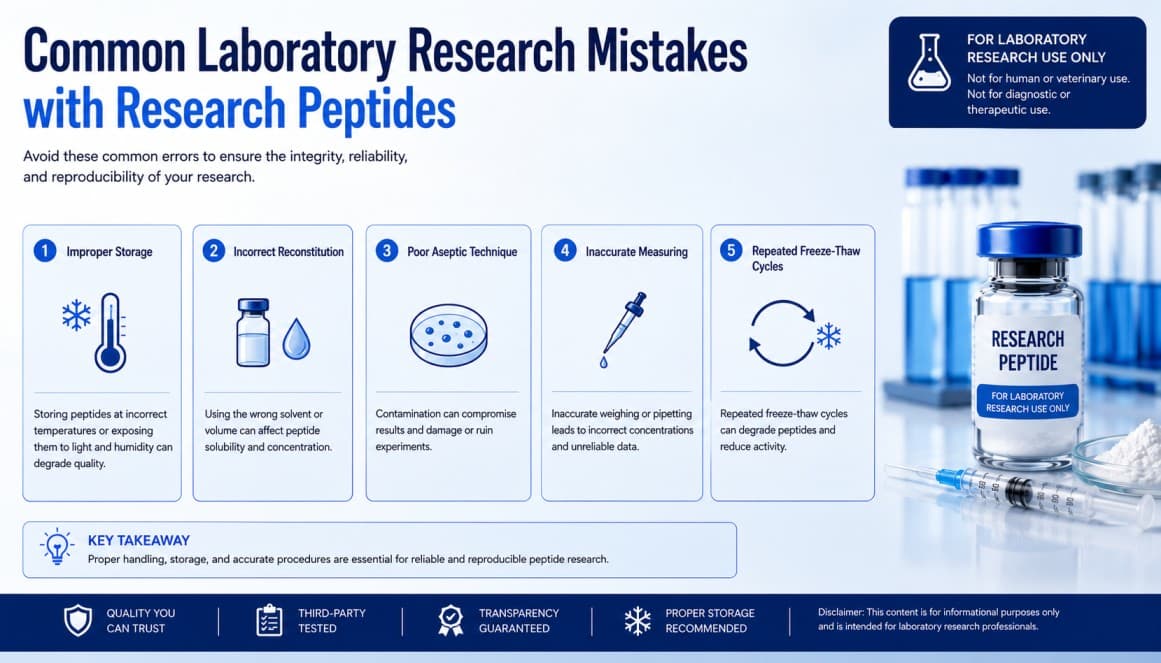
Working with research peptides requires attention to detail — small errors in handling, documentation, or study design can compromise results. This article outlines some of the most common mistakes researchers make when working with peptide compounds, and how to avoid them.
1. Skipping COA Verification
One of the most frequent mistakes is failing to check the Certificate of Analysis against the specific batch received, or accepting a generic COA that isn't matched to the lot number on the vial. Always verify HPLC purity and mass spectrometry data are batch-specific before beginning any analytical work (see our related article on reading COAs).
2. Improper Storage Before Use
Lyophilized peptides degrade faster than expected when:
- Left at room temperature for extended periods before storage
- Exposed to repeated freeze-thaw cycles after reconstitution
- Stored without protection from light, where the compound is photosensitive
These storage errors can compromise sample integrity before a study even begins, leading to inconsistent or non-reproducible results.
3. Inconsistent Reconstitution Technique
Vigorous shaking, incorrect diluent choice, or inconsistent reconstitution volumes between samples can introduce unnecessary variability into a study. Following a consistent, documented reconstitution protocol for every sample helps ensure comparability across an experiment (see our related article on storage and reconstitution best practice).
4. Conflating Structurally Different Compounds
Peptides that are grouped together informally in commercial or discussion contexts (for example, discussing all "growth hormone peptides" as though interchangeable) may have entirely different origins, sequences, and mechanisms of research interest. Treating structurally distinct compounds as equivalent in a study design — for instance, assuming a GHRH analogue and a growth hormone fragment behave identically — is a common source of flawed comparisons (see our related MOTS-C vs. AOD9604 comparison article).
5. Inadequate Documentation
Failing to log batch numbers, reconstitution dates, diluent volumes, and storage conditions makes it difficult to trace back and explain unexpected or inconsistent results later in a study. Good laboratory record-keeping is as important as the chemistry itself.
6. Overlooking Regulatory Context
Researchers and suppliers alike should remain clear that research peptides sold in the UK are not licensed medicines. Assuming that a compound's availability as a "research chemical" implies it has been assessed for safety or efficacy in humans is a significant misunderstanding — these compounds have not undergone the MHRA licensing process required of medicines, and no such claims should be made or relied upon.
Summary
Most avoidable errors in peptide research come down to verification, consistency, and documentation. Careful attention to COA checking, storage conditions, reconstitution protocol, correct compound identification, and record-keeping will meaningfully improve the reliability of any research outcome.
This article is provided for scientific and educational purposes only. It does not constitute medical advice. Products referenced are sold strictly for laboratory research use only and are not licensed medicines in the UK.
Disclaimer: The information provided in this article is intended solely for educational and scientific discussion regarding laboratory research materials. Products referenced by Flex Peptides are supplied exclusively for laboratory research purposes and are not intended for human consumption, therapeutic use, medical treatment, or diagnostic applications. Researchers are responsible for complying with all applicable UK laws, regulations, and institutional laboratory practices.