A Russian-developed anxiolytic peptide with a real, if geographically uneven, research history. Here's what Selank's proposed BDNF and enkephalinase mechanisms actually rest on — evidence gaps included.
Selank is a synthetic heptapeptide, developed in Russia as an analogue of the naturally occurring immune peptide tuftsin. It's been studied for anxiolytic (anxiety-reducing) and nootropic effects, proposed to work through BDNF modulation and enkephalinase inhibition, without the sedation profile associated with benzodiazepines. It carries a Russian pharmaceutical registration but has never been evaluated or approved by UK, European, or US medicines regulators. In the UK it's sold strictly as a laboratory research compound.
Selank has been part of peptide research conversation for well over two decades now, and yet it's never had a proper, honest write-up on this site. That's overdue — not least because "honest" is the operative word with this one. There's a real research story here, but there's also a genuine evidence gap that's worth being upfront about, rather than glossing over.
Where Selank actually comes from
Selank is a synthetic analogue of tuftsin — a naturally occurring tetrapeptide (threonine-lysine-proline-arginine) first identified in the late 1960s, originally studied for its role in immune signalling, specifically its ability to enhance phagocytic activity in white blood cells. Selank takes that four-amino-acid backbone, extends it, and modifies it to resist rapid enzymatic breakdown — which gives it a considerably longer half-life than tuftsin itself.
It was developed in Russia, credited to peptide research programmes associated with the Institute of Molecular Genetics of the Russian Academy of Sciences — the same broad research lineage that produced Semax, another peptide you'll often see mentioned in the same breath as Selank. (Quick flag: that specific institutional attribution comes from secondary literature rather than a primary institutional source, so it's marked here for compliance verification before this goes live.)
An important regulatory distinction — read this bit carefully
According to published literature, Selank has been registered as a pharmaceutical product in Russia, sold there in nasal-drop form for anxiety and neurotic-disorder indications. That's a real fact worth including — but it needs stating precisely, because it's easy to misread. A Russian pharmaceutical registration carries no regulatory recognition, equivalence, or approval status under UK, EU, or US frameworks. Selank has not been evaluated by the UK's medicines regulator. It has not been evaluated by its European counterpart. It has not been evaluated by the FDA in the US. In the UK, right now, it is an unlicensed research compound — full stop.
What's the proposed mechanism?
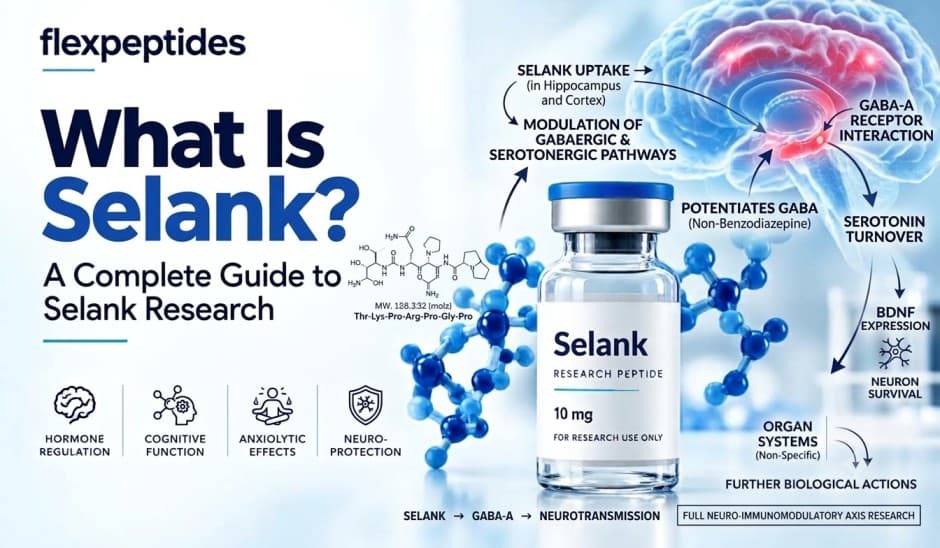
The research literature puts forward a few candidate pathways for Selank's studied anxiolytic and cognitive effects:
- BDNF modulation. Brain-derived neurotrophic factor is central to research on neuroplasticity, and Selank has been studied for its influence on BDNF expression.
- Monoamine turnover. Some research has looked at Selank's effect on serotonin and dopamine pathway activity.
- Enkephalinase inhibition. Selank has been studied for its ability to inhibit the enzymes that break down the body's own naturally occurring enkephalins — opioid-like peptides involved in stress and pain signalling — theoretically prolonging their activity rather than introducing an external opioid-like compound.
None of these are settled, fully characterised mechanisms. They're the pathways the existing research points toward, and that's a meaningfully different claim than "this is how Selank works."
Now, the part that actually matters most: what does the evidence show?
This is where a lot of peptide-research content online gets sloppy, so it's worth slowing down. The published evidence base for Selank leans heavily on two sources: preclinical rodent pharmacology studies, and a body of clinical literature published in Russian-language sources. What's largely missing is the thing that would normally be required to support a therapeutic claim in a Western regulatory context — large-scale, English-language, peer-reviewed, placebo-controlled human trials.
To be clear, that gap doesn't mean the rodent findings are wrong, or that the Russian clinical literature doesn't exist or is fabricated. It means the size and rigour of Selank's human evidence base is considerably thinner, in terms recognised internationally, than some corners of the peptide-research world tend to suggest when they talk about it. If you see a claim about Selank's human anxiolytic efficacy stated with more confidence than that, treat it with a healthy amount of scepticism — and that applies to this article too, which makes no claim about human safety or efficacy of any kind.
Selank and Semax: related, but not the same thing
Because Selank and Semax so often get mentioned together, it's worth being precise about the relationship. They share a development lineage — both came out of the same era of Russian CNS-peptide research, and both are typically discussed as intranasally-administered compounds in the clinical literature that does exist for them. But structurally and mechanistically, they're distinct. Semax is derived from ACTH(4-10) — a completely different parent hormone — and has been studied for a different, though sometimes overlapping, set of proposed cognitive and neuroprotective effects. Treating them as interchangeable, which happens a lot in less careful writing on this topic, is a mistake.
Why researchers are still interested
None of the evidence caveats above make Selank uninteresting as a research subject — quite the opposite, in some ways. For labs studying non-benzodiazepine anxiolytic pathways, BDNF regulation, or enkephalinase inhibition specifically, Selank remains a genuinely useful pharmacological tool: a molecule with a real, if geographically uneven, research history, and a mechanism that's mechanistically distinct from the anxiolytic drug classes most researchers are already familiar with.
Key takeaways
- Selank is a synthetic, longer-lasting analogue of tuftsin, a naturally occurring immune-signalling peptide.
- It was developed in Russia and is registered as a pharmaceutical product there — but nowhere else.
- Proposed mechanisms include BDNF modulation, monoamine turnover, and enkephalinase inhibition.
- The human evidence base is largely Russian-language clinical literature, not large Western placebo-controlled trials.
- It holds no UK, European, or US regulatory approval and is sold in the UK strictly for laboratory research.
Sourcing research-grade Selank in the UK
Selank is one of those compounds where sourcing quality genuinely varies — plenty of overseas listings carry no batch documentation at all. Flex Peptides supplies Selank (5mg, £15.95) as a COA-tested, batch-verified lyophilised peptide, shipped from within the UK rather than imported, so there's no customs uncertainty sitting between your order and your bench.
Browse [Selank (5mg)](tesamorelin 20mg) in our shop → for current stock and Certificate of Analysis details.
Handling and purity
Flex Peptides' Selank is supplied lyophilised and COA-tested, reconstituted the same way as the rest of our lyophilised peptides — see our storage and reconstitution guide for the standard process.
All Flex Peptides products, including Selank, are supplied strictly for laboratory and in-vitro research purposes. Not for human or veterinary use. Not for diagnostic or therapeutic use. Selank holds no UK licence and is not an approved medicine in the UK.
Frequently asked questions
Is Selank derived from a natural compound?
Yes — it's a synthetic, enzymatically-stabilised analogue of tuftsin, a naturally occurring immune-signalling tetrapeptide first identified in the late 1960s.Is Selank the same as Semax?
No, though the two are frequently mentioned together because they come from the same era and lineage of Russian peptide research. Semax is derived from ACTH(4-10) — a different parent compound entirely.Is Selank an approved medicine in the UK?
No. It's registered as a pharmaceutical product in Russia only. It has no UK, European, or US regulatory approval, and in the UK it's sold strictly as a research compound.What does the actual human research on Selank consist of?
Mostly Russian-language clinical publications, alongside international rodent pharmacology studies. It hasn't undergone the scale of Western, peer-reviewed, placebo-controlled human trials that would typically support a therapeutic claim.What was tuftsin, the compound Selank is based on, originally studied for?
An immune function, not a neurological one — specifically, enhancing phagocytic activity in white blood cells.Is it legal to buy Selank in the UK for research purposes?
Yes, as an unlicensed laboratory research compound, under the same research-use-only framework applied across the Flex Peptides catalogue.