Kisspeptin sits at the very top of the reproductive hormone cascade — discovered as a cancer gene, later found to trigger GnRH release. Here's what Imperial College London's human studies actually found, and where the evidence stops.
Kisspeptin is a naturally occurring peptide hormone, produced from the KISS1 gene, that sits at the top of the signalling chain controlling reproduction in humans. It triggers the release of gonadotropin-releasing hormone (GnRH), which in turn drives the entire hypothalamic-pituitary-gonadal axis. Most of what's known about it in humans comes from controlled clinical research, including a well-known series of studies out of Imperial College London. It carries no UK licence for human use and is sold strictly as a laboratory research compound.
If you've typed "what is kisspeptin" into Google recently, you've probably noticed something: most of what comes back is either a Wikipedia-style stub or a sales page dressed up as an article. There's a genuinely interesting research story here, and it deserves better than either of those. So let's actually get into it.
Kisspeptin didn't start out as a reproductive hormone
Here's the part almost nobody mentions: kisspeptin wasn't discovered because scientists were looking for a reproductive regulator. It was found in 1996 by a team at Pennsylvania State University's Hershey Medical Centre, and it was being studied as a cancer gene — specifically, a metastasis suppressor. The name itself is reportedly a nod to the institute's location in Hershey, Pennsylvania, home of the famous chocolate "Kisses," layered on top of its job of sending certain cancer cells a metaphorical "kiss of death" by stopping them spreading.
For about seven years, that's what kisspeptin research was about. Then, in 2003, everything changed — and it happened almost by accident, from two completely separate directions at once.
The 2003 discovery that flipped the whole field
Two research groups, working independently, published back-to-back papers in the New England Journal of Medicine in 2003. Both had been investigating families affected by hypogonadotropic hypogonadism — a condition where puberty simply doesn't start, because the body isn't producing enough gonadotropin-releasing hormone (GnRH). Both teams traced the fault to mutations in a gene called KISS1R (also known as GPR54). That gene, it turned out, encodes the receptor that kisspeptin binds to.
In other words: without a working kisspeptin receptor, GnRH release never gets switched on, and puberty never starts. Overnight, an obscure cancer-metastasis gene became one of the most important discoveries in reproductive endocrinology in decades. That's not an exaggeration — it's the kind of finding that reshapes a field's whole model of how something works, and it's exactly what happened here.
So what does kisspeptin actually do?
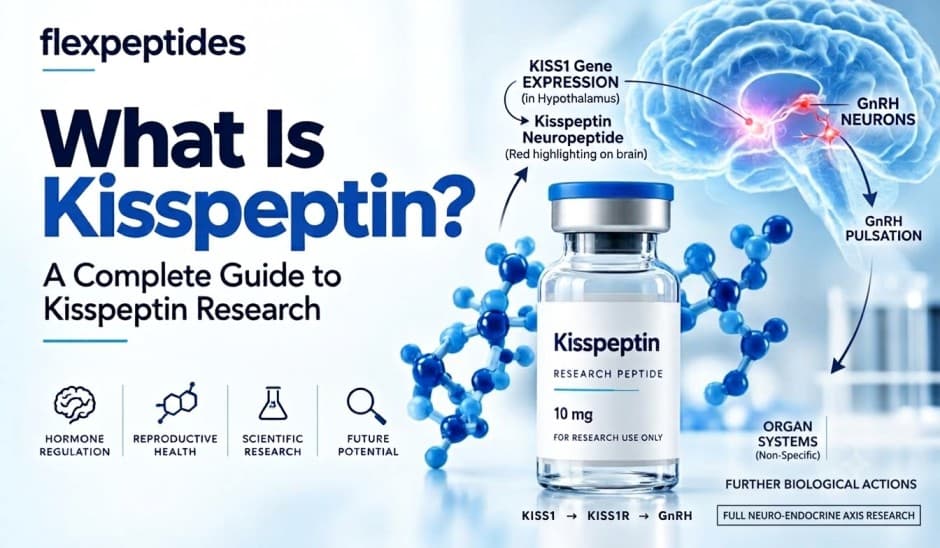
In research terms, kisspeptin acts on KISS1R receptors expressed on GnRH neurons in the hypothalamus. Activating those receptors triggers GnRH release. GnRH then travels to the pituitary gland, where it stimulates release of luteinising hormone (LH) and follicle-stimulating hormone (FSH) — the two hormones that, further downstream, drive sex hormone production and reproductive function in general. Kisspeptin, in short, sits at the very top of that cascade. It's the switch, not the downstream signal.
This is also why kisspeptin research gets described as sitting "upstream" of the reproductive axis, a phrase you'll see a lot if you start reading the primary literature. It's not interchangeable with GnRH, hCG, or other compounds that act further down the same chain — it's the thing that decides whether the chain fires at all.
What Imperial College London's research actually found
If you're going to read one strand of kisspeptin research closely, make it this one, because it's genuinely well designed and it's UK-based. A team at Imperial College London, led by Professor Waljit Dhillo within the college's Investigative Endocrinology group, ran a randomised, double-blinded, placebo-controlled crossover study — published in the Journal of Clinical Investigation in 2017 — involving 29 healthy men.
Here's how it worked: each participant received either an intravenous kisspeptin infusion or a plain vehicle infusion, on separate occasions, while lying in an fMRI scanner and viewing a mix of sexual, romantic/couple-bonding, negative, and neutral images. The researchers weren't just watching brain activity — they were also tracking hormone levels and having participants complete mood and reward-sensitivity questionnaires.
What they found: kisspeptin infusion increased activity in limbic brain regions tied to reward and emotional processing — including the amygdala and cingulate cortex — and this tracked with self-reported reductions in sexual aversion and improved mood. A follow-up study from a related group in 2020, also published in the Journal of Clinical Investigation, looked at longer-acting kisspeptin receptor agonists as a possible avenue for treating female reproductive disorders.
It's worth being blunt about what this evidence is and isn't. This was intravenous administration, in a hospital research setting, under direct medical supervision, with full ethical approval and monitoring. It tells us something real and interesting about how kisspeptin behaves in a tightly controlled clinical research context. It tells us nothing about how it behaves outside one. Kisspeptin remains an investigational compound. It has never been granted a licence for any therapeutic use, in the UK or anywhere else.
Where kisspeptin research is heading next
Beyond the 2017 fMRI study, the same Imperial College research programme has explored kisspeptin's potential as a research tool for triggering ovulation in fertility research settings — the logic being that kisspeptin sits more selectively upstream than the GnRH analogues typically used for that purpose in research protocols, which might (in theory, and this is still being studied) offer a cleaner signal to work with. Combine that with the receptor-agonist work mentioned above, and you can see why kisspeptin receptor biology is still, nearly thirty years after the gene was first identified, a genuinely active area of pharmacological research.
What kisspeptin research is not
Worth clearing up two common mix-ups. First: kisspeptin is not itself a sex hormone. It doesn't bind oestrogen or androgen receptors — it acts on GnRH neurons, one step removed from the sex-hormone cascade, not inside it. Second: it's not interchangeable with hCG or GnRH analogues, which are the compounds more commonly discussed in fertility research contexts and which act further downstream in the same axis. Confusing the three is an easy mistake to make from a quick skim of the literature, and it's one worth avoiding if you're citing this compound in your own research notes.
Key takeaways
- Kisspeptin was discovered in 1996 as a cancer-metastasis suppressor, not a reproductive hormone.
- Its role in reproduction was only identified in 2003, via mutations in its receptor gene, KISS1R.
- It acts upstream of GnRH, triggering the release cascade that governs the entire reproductive hormone axis.
- The best-known human research comes from Imperial College London (Prof. Waljit Dhillo's group), using intravenous administration under clinical supervision.
- It holds no licence for human use in the UK and is sold strictly as a laboratory research compound — not for human or veterinary use.
Sourcing research-grade Kisspeptin in the UK
If your protocol calls for Kisspeptin, where you source it from matters almost as much as the compound itself. Flex Peptides supplies Kisspeptin (5mg, £23.95) as a batch-tested, COA-verified lyophilised peptide, dispatched from within the UK — no import paperwork, no customs delay, and no guessing whether a batch will clear the border before your study timeline needs it to. Every batch ships with a Certificate of Analysis available on request, so purity is something you can verify before it goes anywhere near your bench.
Browse Kisspeptin (5mg) in our shop → to check current stock and batch documentation.
Handling and purity
Flex Peptides' Kisspeptin is supplied lyophilised and batch-tested, with a Certificate of Analysis available confirming purity. Like the rest of the lyophilised peptides in the range, it needs reconstituting with bacteriostatic water before it's usable in a laboratory protocol — our bacteriostatic water guide and COA guide walk through the standard process.
All Flex Peptides products, including Kisspeptin, are supplied strictly for laboratory and in-vitro research purposes. Not for human or veterinary use. Not for diagnostic or therapeutic use.
Frequently asked questions
What is kisspeptin used for in research?
Mainly reproductive endocrinology and neuroscience — studying the hypothalamic-pituitary-gonadal axis, GnRH regulation, and the limbic/emotional-processing pathways tied to reproductive hormone signalling.Where does the name "kisspeptin" come from?
From the KISS1 gene, first identified at Hershey Medical Centre in Pennsylvania — the name is widely reported to reference the institute's Hershey, Pennsylvania location, alongside the gene's originally studied role in suppressing tumour metastasis.Is kisspeptin a sex hormone?
No. It doesn't bind sex-hormone receptors directly. It acts on KISS1R receptors on GnRH neurons — a step upstream of, not inside, the sex-hormone cascade.Is kisspeptin the same as GnRH or hCG?
No. Both of those act further downstream in the reproductive axis. Kisspeptin's research significance is specifically its position upstream of them.Is kisspeptin legal to buy in the UK for research?
Yes, as an unlicensed research compound sold strictly for laboratory and in-vitro use — the same research-use-only framework that applies across the Flex Peptides catalogue.Is kisspeptin approved for any human use in the UK?
No. It has no licence for any therapeutic use in the UK and remains an investigational compound studied only in controlled clinical research settings.