Discover how NAD+ and MOTS-C are studied in cellular and mitochondrial research. This guide explores their research roles, key pathways, and what to consider when buying these research compounds in the UK.
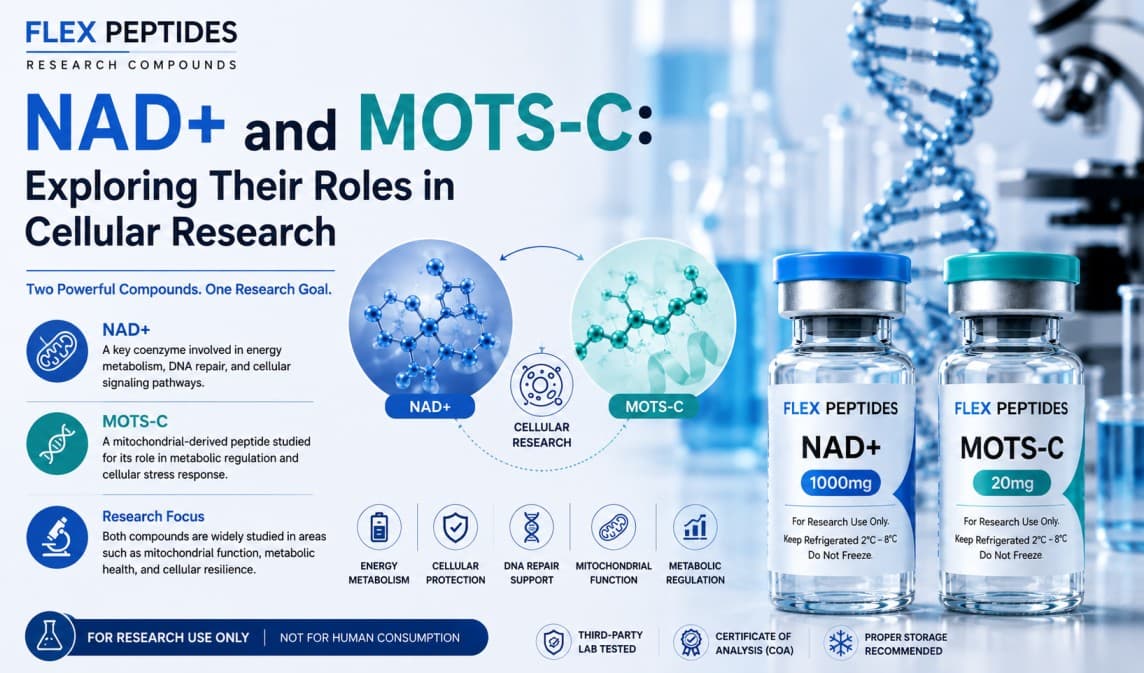
NAD+ and MOTS-c are two molecules that, while structurally unrelated, both feature prominently in mitochondrial and cellular-ageing research — which is why they're frequently studied side by side, and why this guide covers both together.
What is NAD+?
Nicotinamide adenine dinucleotide (NAD+) is a coenzyme present in every living cell, central to redox reactions and cellular energy transfer. It's one of the most heavily studied molecules in cellular-ageing and mitochondrial research, which is also why it's frequently discussed alongside related molecules like MOTS-c (below) and NMN — see our NAD+ vs. NMN comparison for that specific distinction.
What is MOTS-c?
MOTS-c is a mitochondrial-derived peptide — encoded within mitochondrial DNA rather than the cell's nuclear genome, which makes it a relatively recent and distinctive discovery in the peptide research space. It's studied for potential roles in metabolic regulation.
Overlapping research territory
Both compounds turn up in research connected to:
- Mitochondrial function and efficiency
- Cellular energy metabolism
- Ageing-related biological processes
- Metabolic regulation pathways
How they differ
NAD+ is a coenzyme central to redox reactions and energy transfer within nearly every cell. MOTS-c, by contrast, is a peptide believed to act more like a signalling molecule — the two occupy different functional categories even where their research territory overlaps.
Why researchers study them together
Some research examines potential relationships between NAD+ availability and MOTS-c activity, aiming to better understand how mitochondria coordinate energy production and cellular signalling as a connected system rather than two isolated pathways.
Sourcing for laboratory use
We supply NAD+ and MOTS-c as separate, clearly labelled research compounds, each with batch-specific quality documentation. For guidance on vetting any UK peptide supplier — not just for these two compounds — see our full supplier checklist.
Disclaimer
NAD+ and MOTS-c, as discussed here and supplied by Flex Peptides, are research chemicals only. Neither is approved, intended, or supplied for human or animal use.
Related reading
NAD+ vs NMN: The Research Differences
Glutathione 1500mg: A Research Guide