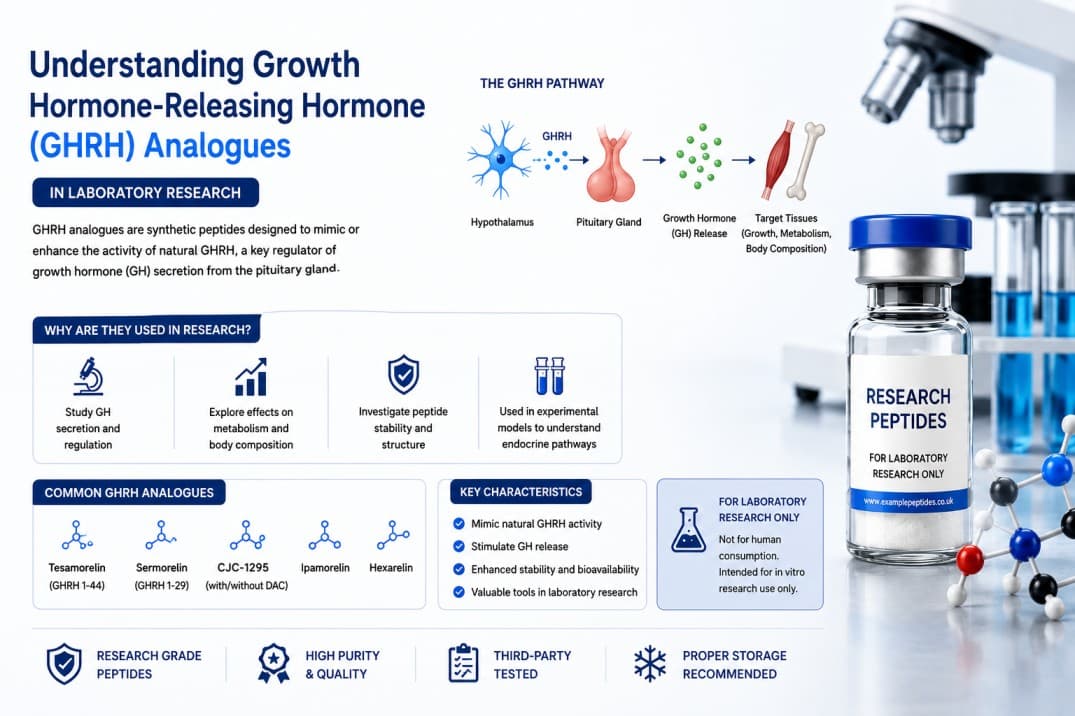
An educational introduction to Growth Hormone-Releasing Hormone analogues, explaining peptide design, receptor biology, and common laboratory research applications.
For laboratory research use only. Not for human or animal consumption.*
Introduction
Growth hormone-releasing hormone (GHRH) analogues occupy a significant place in endocrinology-adjacent peptide research. This article provides a general, educational overview of what GHRH analogues are, how they are studied, and why they remain a focus of ongoing scientific literature.
What Is GHRH?
GHRH is a naturally occurring hypothalamic peptide hormone. In physiological research models, it acts on the anterior pituitary gland, binding to the GHRH receptor and stimulating the synthesis and release of growth hormone (GH). Native GHRH has a very short biological half-life, which limits its usefulness as a stable research reference compound — a key reason synthetic analogues were developed.
Why Analogues Are Developed
Researchers have developed structurally modified GHRH analogues for several study-related reasons:
- Improved stability — modifications that reduce susceptibility to enzymatic degradation, allowing for more consistent experimental conditions
- Receptor selectivity studies — analogues help researchers isolate and study specific receptor interactions
- Comparative pharmacology — differences between analogues allow structure-activity relationship (SAR) studies
Common GHRH Analogues Referenced in Literature
Several GHRH-based compounds appear frequently across peptide research literature, including sermorelin, CJC-1295, and tesamorelin. Each carries distinct structural modifications that researchers compare when studying stability, receptor affinity, and pharmacokinetic behaviour in experimental models. (See our related comparison article for a structural breakdown.)
Research Applications
Within published scientific literature, GHRH analogues have been studied in the context of:
- Basic endocrine physiology and receptor pharmacology
- Metabolic research models
- Peptide chemistry and stability engineering
This article does not make claims about outcomes for human subjects, and all research referenced in scientific literature involving human trials is subject to its own separate regulatory and ethical approval frameworks that fall outside general research-chemical supply.
Regulatory Considerations for UK Researchers
GHRH analogues sold as research chemicals in the UK are not licensed medicines. Under MHRA rules, any product marketed with implied therapeutic benefit for humans requires a marketing authorisation. Legitimate research suppliers therefore restrict product information to chemical composition, purity data, and general research context — never dosing, administration, or health claims.
##Summary
GHRH analogues, including tesamorelin, remain widely referenced in peptide and endocrinology research literature due to their structural diversity and relevance to receptor pharmacology studies. As with all research chemicals, use should be confined strictly to appropriately licensed laboratory settings.
This article is provided for scientific and educational purposes only. It does not constitute medical advice. Products referenced are sold strictly for laboratory research use only and* are not licensed medicines in the UK.
Disclaimer: The information provided in this article is intended solely for educational and scientific discussion regarding laboratory research materials. Products referenced by Flex Peptides are supplied exclusively for laboratory research purposes and are not intended for human consumption, therapeutic use, medical treatment, or diagnostic applications. Researchers are responsible for complying with all applicable UK laws, regulations, and institutional laboratory practices.