Learn how Tesamorelin is structured, how its amino acid sequence differs from native GHRH, and how peptide synthesis techniques contribute to research-grade quality. This guide focuses on analytical chemistry and laboratory research.
Tesamorelin was developed as a stabilised analogue of human growth hormone–releasing hormone (GHRH), designed to resist the rapid enzymatic degradation that limits unmodified GHRH's utility in research settings. Understanding the underlying chemistry — sequence, modification, and synthesis route — matters before you use it in laboratory work, not just for academic interest but for correctly interpreting your own results.
Amino acid sequence
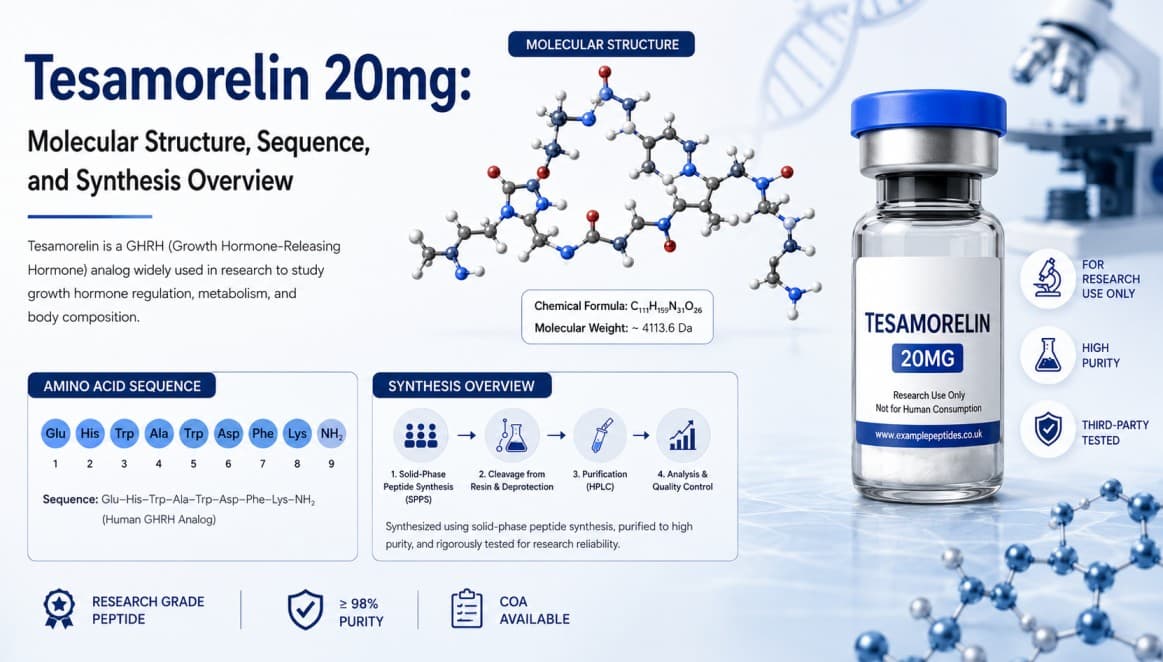
Tesamorelin comprises 44 amino acids mirroring human GHRH 1-44, making it one of the larger peptides commonly available to researchers. Its size relative to shorter GHRH analogues is itself a relevant consideration for reconstitution and handling.
The N-terminal modification
A trans-3-hexenoic acid group at the N-terminus is what distinguishes tesamorelin structurally from unmodified GHRH. This modification is understood to influence the molecule's resistance to enzymatic degradation by dipeptidyl peptidase-4 (DPP-4) — the primary mechanism by which native GHRH is rapidly broken down, and the specific problem this modification was designed to address.
Molecular formula and weight
Tesamorelin's chemical composition approximates C₂₂₁H₃₆₆N₇₂O₆₇S₁, with a molecular weight around 5,135 g/mol. Treat these as reference figures — always verify the exact values against your specific batch's Certificate of Analysis rather than relying on a generic reference figure.
Synthesis route
Production uses solid-phase peptide synthesis (SPPS), requiring high-fidelity coupling efficiency at each step, HPLC purification to remove synthesis byproducts, and lyophilisation for powder stability. Given the complexity of synthesising a 44-residue peptide with a specific N-terminal modification, synthesis quality has a proportionally larger impact on purity than it does for shorter, simpler peptides.
Why purity verification matters here specifically
Given that complexity, request a Certificate of Analysis showing both HPLC purity data and mass spectrometry confirmation of molecular weight — for a peptide this size, the two verification methods together tell you meaningfully more than either alone, since a longer sequence has more points where synthesis can introduce variability.
Summary
Tesamorelin is a 44-residue, N-terminally modified GHRH analogue designed for enzymatic-degradation resistance, produced via solid-phase peptide synthesis. Its size and modification make purity verification via combined HPLC and mass spectrometry data particularly important — verify every batch against its specific COA rather than relying on reference figures like the ones above.
Related reading
Tesamorelin Research: A Literature Guide
Understanding Certificates of Analysis (COAs)