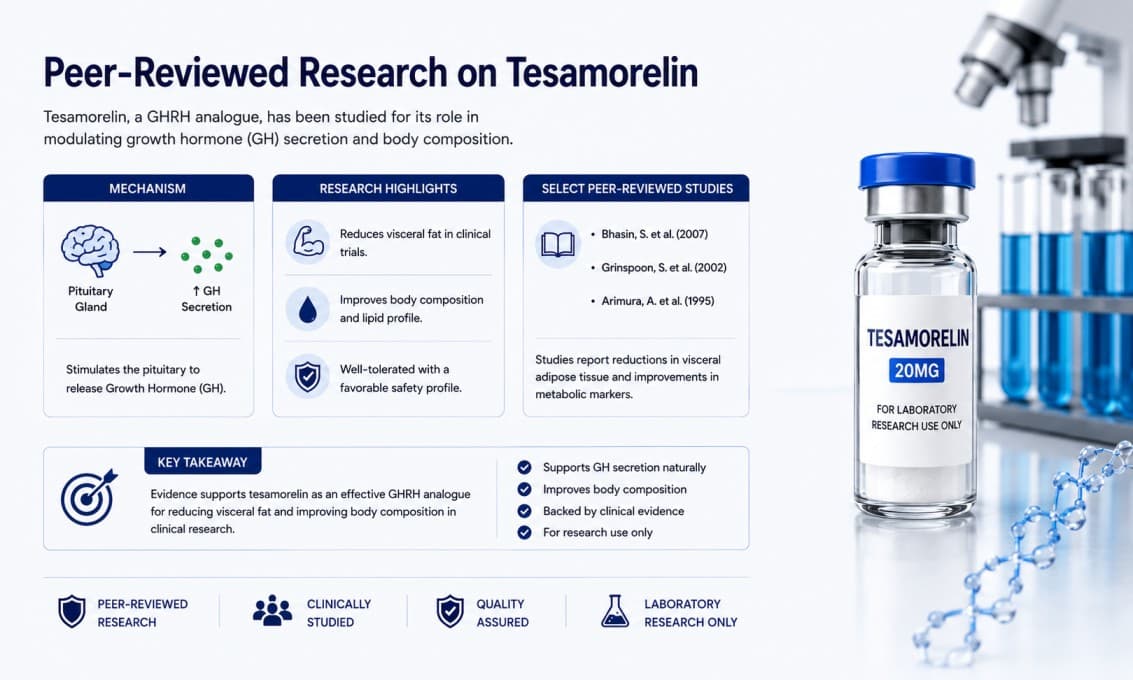
This article summarizes peer-reviewed publications involving Tesamorelin, highlighting laboratory methodologies, analytical techniques, and peptide research developments.
Tesamorelin has a substantial body of scientific literature behind it, spanning peptide chemistry, receptor pharmacology, and clinical research contexts. This guide is an orientation to the types of published research available and where to find it — not a restatement of specific study conclusions, which you should always read from the primary source.
Categories of published research
Chemistry and stability studies examine tesamorelin's structural modifications and its resistance to enzymatic degradation.
Receptor pharmacology studies explore its interaction with GHRH receptors in experimental models.
Clinical trial literature comes from regulated drug-development phases — this is a distinct body of work from research-grade tesamorelin sold for laboratory use (see the note below).
Comparative peptide reviews position tesamorelin alongside other GHRH analogues, most notably sermorelin and CJC-1295 — see the comparison section below for the structural detail.
Where tesamorelin fits among GHRH analogues
Tesamorelin is one of several GHRH analogues studied in laboratory research, alongside compounds like sermorelin and CJC-1295. What distinguishes it is a modification to the native GHRH structure — detailed in our molecular structure and synthesis overview — designed to improve resistance to enzymatic degradation. If your research involves comparing GHRH analogues directly, that page covers the structural distinctions in more depth than a literature-orientation guide like this one should attempt to.
Where to find primary literature
Start with PubMed, Google Scholar, DrugBank, and peer-reviewed endocrinology journals. Read primary sources directly rather than relying on secondary summaries — including this one. A literature roundup can point you toward categories of research and where to look; it shouldn't substitute for reading the actual studies relevant to your work.
A note on interpreting clinical literature
Keep licensed clinical medicine research and research-grade material clearly separated in your thinking. Research-grade tesamorelin sold in the UK is not MHRA-licensed, and clinical trial literature describes a regulated drug-development pathway that doesn't apply to laboratory research use. Don't extrapolate clinical dosing or efficacy claims from one context to the other.
Summary
Tesamorelin's literature spans four distinct categories — chemistry, receptor pharmacology, clinical trials, and comparative reviews — each useful for different research questions. Go to the primary sources on PubMed and Google Scholar rather than secondary summaries, and keep clinical and research-grade contexts clearly distinct when you're reading.
Related reading
Tesamorelin 20mg: Structure & Synthesis
Understanding Certificates of Analysis (COAs)