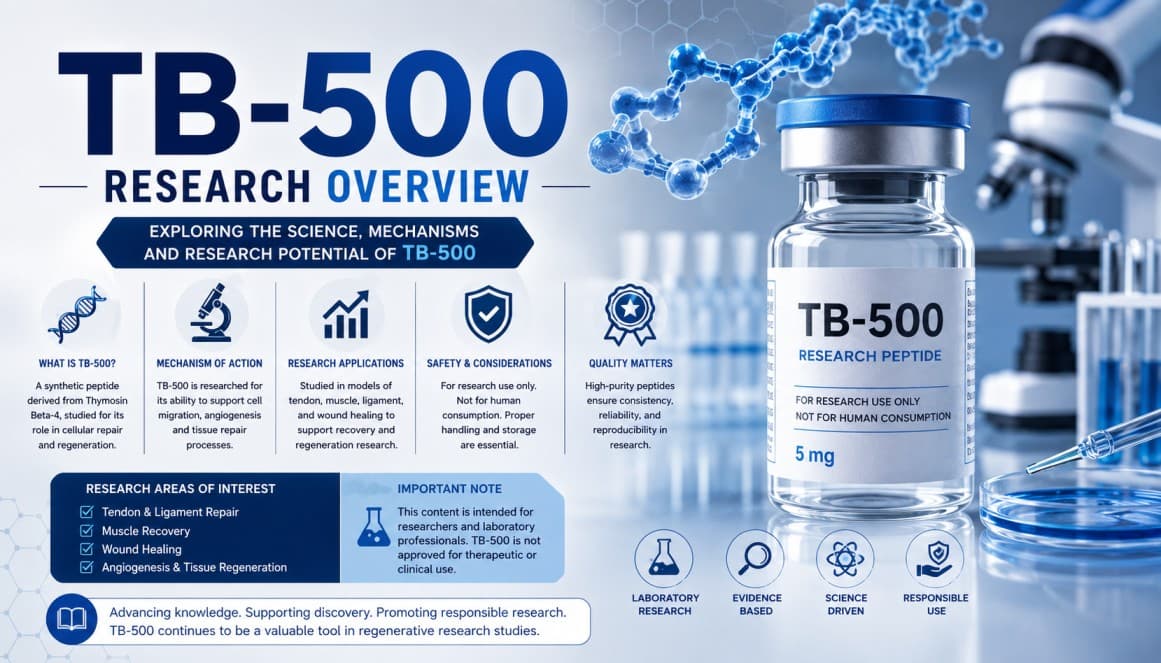
TB-500 Research Overview provides an evidence-based introduction to TB-500, covering its biological mechanisms, areas of scientific interest, and current research applications. This guide is intended to support researchers with accurate, up-to-date information for laboratory and preclinical research purposes only.
TB-500 is a synthetic peptide fragment derived from Thymosin Beta-4, a naturally occurring protein found in nearly all human and animal cells. Over the past decade it has become one of the more frequently studied peptides in tissue repair and regenerative research, appearing across a range of animal models examining wound healing, muscle recovery, and cellular migration. This overview covers what the current research shows, why the peptide continues to draw scientific attention, and what researchers should look for when sourcing material for laboratory work.
What Is TB-500?
TB-500 refers to a short synthetic sequence based on the actin-binding region of Thymosin Beta-4. Thymosin Beta-4 itself plays a role in regulating actin, a protein central to cell structure and movement. Because actin is involved in how cells migrate and rebuild tissue after injury, researchers have used TB-500 as a tool to study these processes in a more controlled, isolated way than working with the full-length protein.
As with other research peptides, it's essential to state plainly: TB-500 is not licensed or approved for human or veterinary use by the MHRA, FDA, or any comparable regulatory authority. It is manufactured and sold strictly for laboratory and in-vitro research, and any legitimate supplier will say so clearly on their product listings.
Why TB-500 Appears So Often in Research Literature
A few recurring areas of interest show up across the published studies:
Cell migration and actin regulation
Because Thymosin Beta-4 is directly tied to actin dynamics, much of the foundational research on TB-500 focuses on how it influences cell movement — a process relevant to wound closure and tissue remodelling models.
Wound healing models
Animal studies have examined how TB-500 affects the speed and quality of healing in skin and soft tissue injury models, often measuring markers of inflammation and new tissue formation.
Cardiac and vascular research
A portion of the literature looks at Thymosin Beta-4 derivatives in models of cardiac tissue injury, exploring whether the peptide influences the survival of heart muscle cells following induced damage.
Muscle and connective tissue studies
Similar to research on other repair-focused peptides, some studies investigate TB-500's role in muscle fibre models, examining recovery timelines and structural changes after experimentally induced injury.
It's worth being direct about the state of the evidence here: the large majority of TB-500 studies are preclinical, conducted in animal or cell-culture models. Robust, peer-reviewed human clinical trials are limited, and this is precisely why the compound remains unapproved for therapeutic use anywhere in the world. Findings in animal models are a starting point for further research, not a confirmation of effects in humans.
Sourcing TB-500 for Legitimate Research
For any lab, academic institution, or qualified researcher looking to study TB-500, the sourcing process deserves as much scrutiny as the experimental design. Researchers looking to buy peptides UK should evaluate suppliers against a consistent checklist:
- Independent purity verification – A certificate of analysis (COA) using HPLC or mass spectrometry should confirm both identity and purity for each batch.
- Batch-specific documentation – Lot numbers and corresponding test results allow for reproducibility across research trials.
- Explicit research-only labelling – Reputable sellers of research peptides UK clearly state that products are not intended for human or animal consumption.
- Transparent handling instructions – Guidance on storage temperature, light sensitivity, and reconstitution should be readily available.
This is one of the areas where a well-established UK peptide supplier can make a real difference to research quality. Flex Peptides (flexpeptides.co.uk) operates in this space with a focus on documented batch testing and consistent synthesis standards, which matters when the goal is repeatable, credible experimental results.
What "Research Grade" Should Actually Mean
The phrase research grade peptides is used broadly across the industry, but it should point to specific, verifiable standards:
- High purity thresholds – Genuine research-grade material is typically verified at or above 98% purity through third-party lab testing, not simply asserted by the seller.
- Consistent synthesis protocols – Solid-phase peptide synthesis (SPPS) should follow a repeatable process from batch to batch to minimise variability between experiments.
- Full documentation – Every batch should come with a certificate of analysis and safety data sheet (SDS) suitable for laboratory handling.
- Appropriate shipping conditions – Peptides like TB-500 are sensitive to heat and moisture and should be shipped and stored accordingly.
Suppliers marketing laboratory peptides UK should be able to answer detailed questions about synthesis method, testing frequency, and storage stability without difficulty. A supplier unwilling or unable to produce a COA for a specific batch is a clear red flag.
Questions Worth Asking Before Purchasing
- Does the listing include a batch-specific certificate of analysis, rather than a generic or outdated one?
- What synthesis and purification method was used to produce the peptide?
- Is the product explicitly labelled "for laboratory research use only — not for human or animal consumption"?
- What storage conditions are recommended (typically lyophilised peptides require storage at -20°C, protected from light and moisture)?
- Is reconstitution guidance provided in terms relevant to research use — solvent type and concentration calculations — rather than administration instructions?
Final Thoughts
TB-500 continues to be a peptide of genuine interest in tissue repair and regenerative research, particularly around cell migration and wound healing models. But as with many peptides in this category, there's a meaningful gap between promising animal data and confirmed outcomes in human clinical settings. For researchers, closing that gap responsibly starts with rigorous sourcing, transparent batch documentation, and a firm commitment to research-only use.
Disclaimer
This article is provided for general informational and educational purposes only. TB-500 and other peptides referenced here are not approved by the MHRA, FDA, or any other regulatory body for human or veterinary use, diagnosis, treatment, cure, or prevention of any disease or condition. All peptides sold by Flex Peptides (flexpeptides.co.uk) or referenced in this article are intended strictly for laboratory and in-vitro research purposes by qualified professionals and are explicitly not for human or animal consumption. Nothing in this article constitutes medical advice, and it should not be interpreted as an endorsement or instruction for personal use, self-administration, or off-label application of any substance. Always consult a licensed physician or qualified healthcare professional regarding any health-related questions, and consult appropriate regulatory guidance before purchasing, handling, or storing any research chemical. The author and publisher accept no liability for misuse of the information contained in this article.