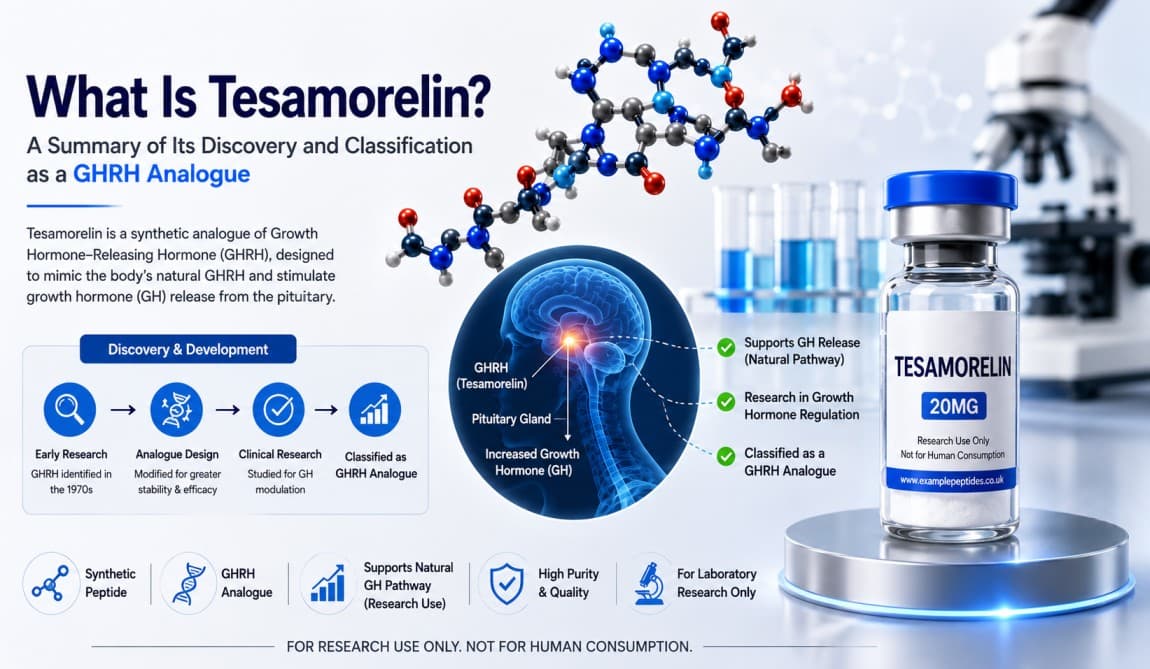
This article reviews the scientific development of Tesamorelin, explains its classification as a synthetic GHRH analogue, and discusses why it remains relevant in peptide research literature.
For laboratory research use only. Not for human or animal consumption.
Introduction
Tesamorelin is one of the more widely referenced peptides in growth hormone-releasing hormone (GHRH) research literature. This article summarises, from a purely educational and historical standpoint, what tesamorelin is, how it was developed, and how it is classified within pharmacological research.
Classification
Tesamorelin belongs to a class of compounds known as GHRH analogues — synthetic peptides engineered to mimic the structure and receptor-binding activity of endogenous growth hormone-releasing hormone. In research settings, GHRH analogues are studied for their interaction with the GHRH receptor on pituitary somatotroph cells, which in physiological models triggers downstream release of growth hormone.
Origin and Development
Tesamorelin was originally developed by Theratechnologies, a Canadian biopharmaceutical company, as a modified version of GHRH 1-44 designed for improved metabolic stability. In several jurisdictions, tesamorelin was subsequently studied in clinical trials and received regulatory approval as a licensed prescription medicine (marketed under the brand name Egrifta) for a specific clinical indication. This regulatory history is noted here for factual and educational context only.
Important UK Regulatory Distinction
It is important to note that in the United Kingdom, tesamorelin sold as a research compound is not a licensed medicine. Under the Human Medicines Regulations 2012, only products with a valid MHRA marketing authorisation may be supplied, marketed, or administered as medicines for human use. Research-grade tesamorelin sold by UK suppliers is intended exclusively for in-vitro laboratory research and is:
- Not approved by the MHRA for human consumption
- Not licensed as a medicine or food supplement
- Not accompanied by dosing or administration guidance for people
Any supplier presenting research peptides with therapeutic claims, dosing instructions, or implied human use would fall outside this framework and into unlicensed medicine territory — which is why reputable research suppliers restrict all product information strictly to chemical and research-context data.
Why Researchers Reference Tesamorelin
Within academic and pharmaceutical research literature, tesamorelin is frequently referenced as a case study in:
- Peptide half-life extension via structural modification (see our related article on its N-terminal hexenoic acid group)
- GHRH receptor pharmacology
- Comparative peptide stability studies against other GHRH-based research compounds
Summary
Tesamorelin is a well-documented GHRH analogue with an established place in peptide and endocrinology research literature. Any use of tesamorelin as a research chemical in the UK must remain strictly confined to laboratory settings, with no implication of human administration, in line with MHRA regulatory requirements.
This article is provided for scientific and educational purposes only. It does not constitute medical advice. Products referenced are sold strictly for laboratory research use only and are* not licens*ed medicines in the UK.
Disclaimer: The information provided in this article is intended solely for educational and scientific discussion regarding laboratory research materials. Products referenced by Flex Peptides are supplied exclusively for laboratory research purposes and are not intended for human consumption, therapeutic use, medical treatment, or diagnostic applications. Researchers are responsible for complying with all applicable UK laws, regulations, and institutional laboratory practices.