Discover the structural similarities and differences between popular GHRH analogue peptides used in scientific research, with emphasis on peptide chemistry rather than biological outcomes.
For laboratory research use only. Not for human or animal consumption.
Introduction
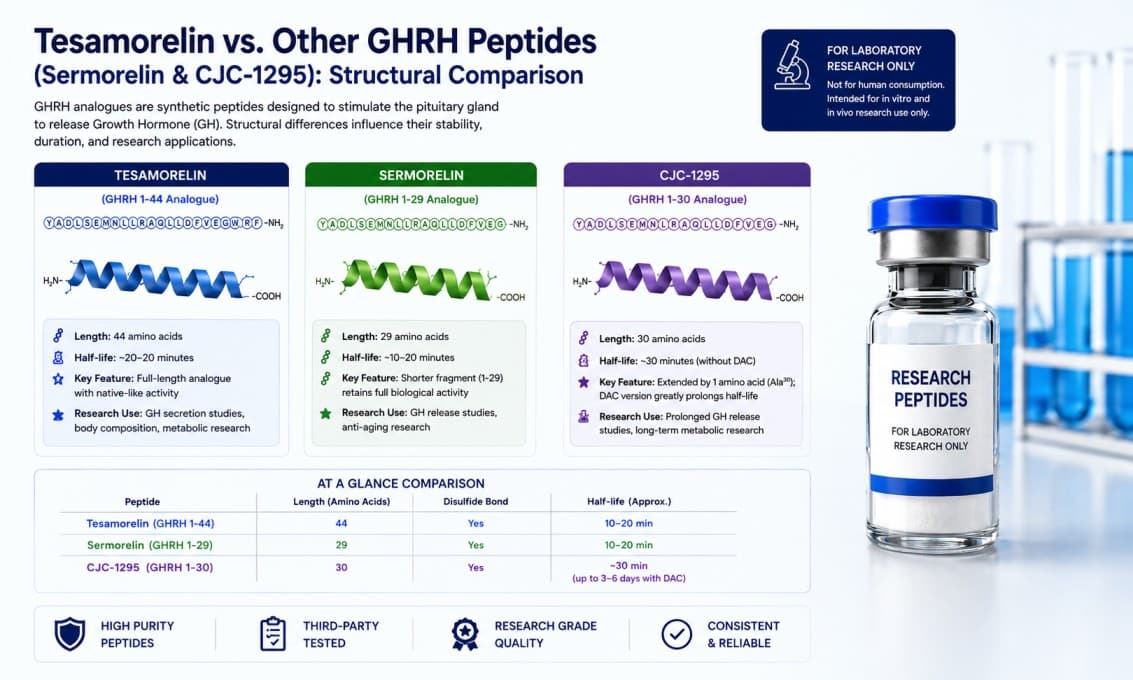
Researchers working with GHRH-based peptides frequently need to distinguish between the several analogues available for laboratory study. This article compares the structural characteristics of tesamorelin, sermorelin, and CJC-1295 — three of the most commonly referenced GHRH analogues in peptide research literature.
Tesamorelin
- Sequence basis: Full-length GHRH 1-44
- Key modification: Trans-3-hexenoic acid group at the N-terminus
- Relevance in research: Frequently cited as a reference compound in DPP-4 resistance and peptide stability studies, owing to its full-length sequence and N-terminal modification
Sermorelin
- Sequence basis: A truncated GHRH fragment, GHRH 1-29
- Key characteristic: Represents the minimum active fragment of GHRH identified as retaining receptor-binding activity in research models
- Relevance in research: Often used in comparative studies examining whether shorter GHRH fragments retain comparable receptor affinity to the full-length peptide
CJC-1295
- Sequence basis: A modified GHRH 1-29 analogue
- Key modification: Several amino acid substitutions designed to increase resistance to enzymatic breakdown; some formulations studied in literature also reference a Drug Affinity Complex (DAC) conjugation intended to extend plasma stability in experimental models
- Relevance in research: Frequently referenced in comparative half-life and stability literature against unmodified GHRH fragments
Structural Comparison Table
| Feature | Tesamorelin | Sermorelin | CJC-1295 |
|---|---|---|---|
| Sequence length | 44 amino acids | 29 amino acids | 29 amino acids (modified) |
| Key modification | N-terminal hexenoic acid | None (native fragment) | Amino acid substitutions ± DAC |
| Literature focus | Stability, DPP-4 resistance | Minimal active fragment studies | Extended half-life studies |
Why This Comparison Matters for Researchers
Understanding these structural distinctions helps researchers select the appropriate reference compound for a given study design — whether the focus is receptor-binding kinetics, degradation resistance, or comparative structure-activity relationships. Because these peptides differ meaningfully in sequence length and modification, results from studies using one analogue should not be assumed to generalise directly to another without independent verification.
A Note on Sourcing
Regardless of which GHRH analogue is used, researchers should always verify purity and identity via a Certificate of Analysis (COA) with HPLC and mass spectrometry data, since synthesis quality can vary meaningfully between suppliers — particularly for longer, more complex sequences like tesamorelin.
This article is provided for scientific and educational purposes only. It does not constitute medical advice. Products referenced are sold strictly for laboratory research use only and are not licensed medicines in the UK.
Disclaimer: The information provided in this article is intended solely for educational and scientific discussion regarding laboratory research materials. Products referenced by Flex Peptides are supplied exclusively for laboratory research purposes and are not intended for human consumption, therapeutic use, medical treatment, or diagnostic applications. Researchers are responsible for complying with all applicable UK laws, regulations, and institutional laboratory practices.