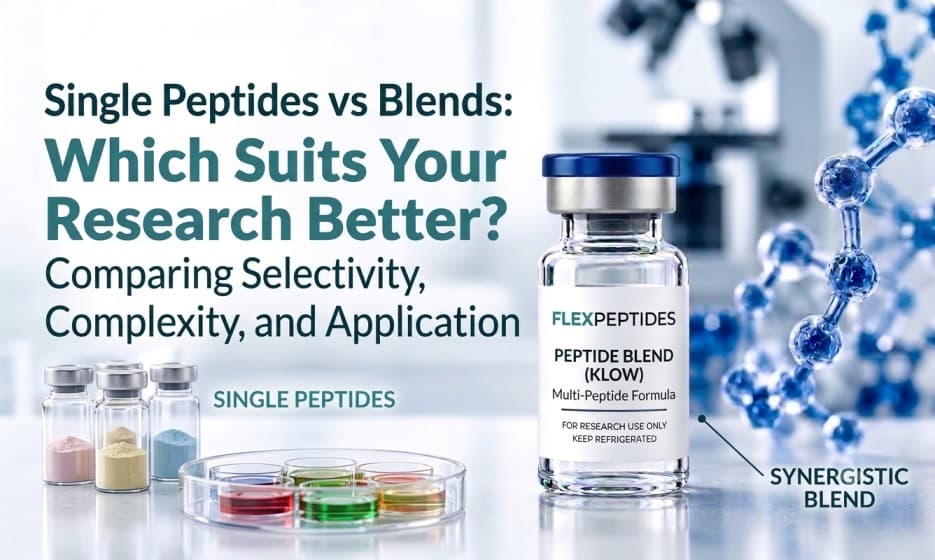
Single peptides give researchers full control to isolate and vary one compound independently; blends offer convenience and often lower combined cost, but reduce the ability to attribute an observed effect to any one specific component. The right choice depends entirely on the research question being asked.
Why this is a genuine research-design decision, not just a shopping choice
The single-vs-blend decision affects what a research protocol can actually conclude. A study using a blend can observe effects of the combined formula but generally can't attribute those effects to any one specific component without additional isolated-compound comparison arms — a meaningfully different research design from working with single, independently variable compounds.
When single peptides make more sense
If a research question is specifically about one compound's mechanism, dose-response relationship, or isolated effect, single peptides are the only appropriate choice — a blend would introduce uncontrolled variables that undermine the ability to draw a clean conclusion about that one compound specifically.
When a blend might make sense
If a research protocol is specifically interested in a combined-formula's overall effect — replicating how a commercially available blend product behaves as a whole, for instance — then working with the actual pre-made blend, rather than reconstructing it from individual components, may better reflect the actual research question.
The cost and convenience trade-off
Blends often cost less combined than sourcing each component separately, and require less individual reconstitution and measurement work — a real practical advantage for research that doesn't need individual-component control.
A middle path: sourcing individual components to build a custom combination
For research that wants combination-effect data while retaining individual-component control, sourcing each peptide separately and combining them under a controlled, documented protocol offers a middle path — more setup work than either a single peptide or a pre-made blend, but retaining the most experimental flexibility.
What to check regardless of which approach is chosen
Certificate of Analysis verification remains essential either way — for single peptides, standard purity and identity verification; for blends, verification of component composition and ratios as discussed in our KLOW and blends explainer.
What Flex Peptides offers
Flex Peptides stocks both individual research peptides and pre-made blends like KLOW, with COA data available on request for either format.
Mapping the decision to specific research scenarios
It can help to work through a few concrete scenarios rather than reasoning about this decision purely in the abstract. A researcher investigating a single compound's dose-response curve clearly needs a single peptide, since a blend would make it impossible to isolate that compound's specific contribution. A researcher aiming to replicate published findings on a specific commercial blend product needs that actual blend, not a self-assembled approximation, since subtle formulation differences could affect comparability with the published work. A researcher exploring whether two compounds might interact in a new way they haven't previously been studied together needs individually sourced components combined under their own controlled protocol, since no existing commercial blend is likely to match their specific proposed combination and ratio.
Why the decision can change as a research question evolves
It's worth noting that a research programme's needs at this decision point aren't necessarily fixed for its entire duration. Exploratory early-stage work might reasonably start with a convenient pre-made blend to get a general sense of a combined formula's effects, before a research question narrows sufficiently to require switching to individually sourced components for a more controlled follow-up study isolating specific variables. Recognising that the single-vs-blend decision can and should be revisited as a research question sharpens, rather than treated as a one-time choice made at the outset and never reconsidered, supports better-aligned research design over a project's full lifecycle.
Budgeting time and resources for whichever path is chosen
It's worth factoring the practical resource implications of each path into project planning from the start, not just the scientific rationale. A custom combination built from individually sourced components generally requires more upfront time for separate reconstitution, measurement and combination of each compound, plus more extensive documentation to keep track of ratios and batch references across multiple products — real overhead that a pre-made blend avoids. Weighing this practical time cost honestly against the added experimental control a custom approach provides helps set realistic expectations for how much a given research phase will actually take to execute properly, rather than underestimating the workload a fully custom approach involves. Building in a realistic time buffer for this additional overhead when planning a custom-combination phase of a project avoids the common trap of underestimating how much longer multi-component work takes relative to working with a single compound or a ready-made blend, a mismatch that can otherwise quietly derail an ambitious project timeline.
Key takeaways
- The single-vs-blend decision is a genuine research-design choice, not just a purchasing preference.
- Single peptides are necessary for research questions requiring isolated, independently variable compounds.
- Pre-made blends suit research specifically interested in a combined formula's overall effect.
- Blends generally offer cost and convenience advantages over sourcing each component separately.
- A custom, self-combined approach offers a middle path between full blend convenience and full single-compound control.
FAQ
Can a blend be used to study one specific component's effect?
Not reliably — a blend introduces uncontrolled combined variables that undermine attributing an effect to any one component specifically.Is it cheaper to buy a blend or the individual peptides separately?
Blends are often cheaper combined, though this varies by supplier and specific formulation.
For laboratory research use only. Not for human or veterinary use.